Relying on nameplate capacity to size a dryer for a 2 TPH kibble line is the fastest way to ruin your product batch and waste energy.
To properly size dryer 2 TPH kibble equipment, you must calculate local wet-bulb temperatures, match airflow volumes to specific evaporation rates, and align heat sources with regional utilities, rather than simply selecting a machine based on its theoretical throughput.
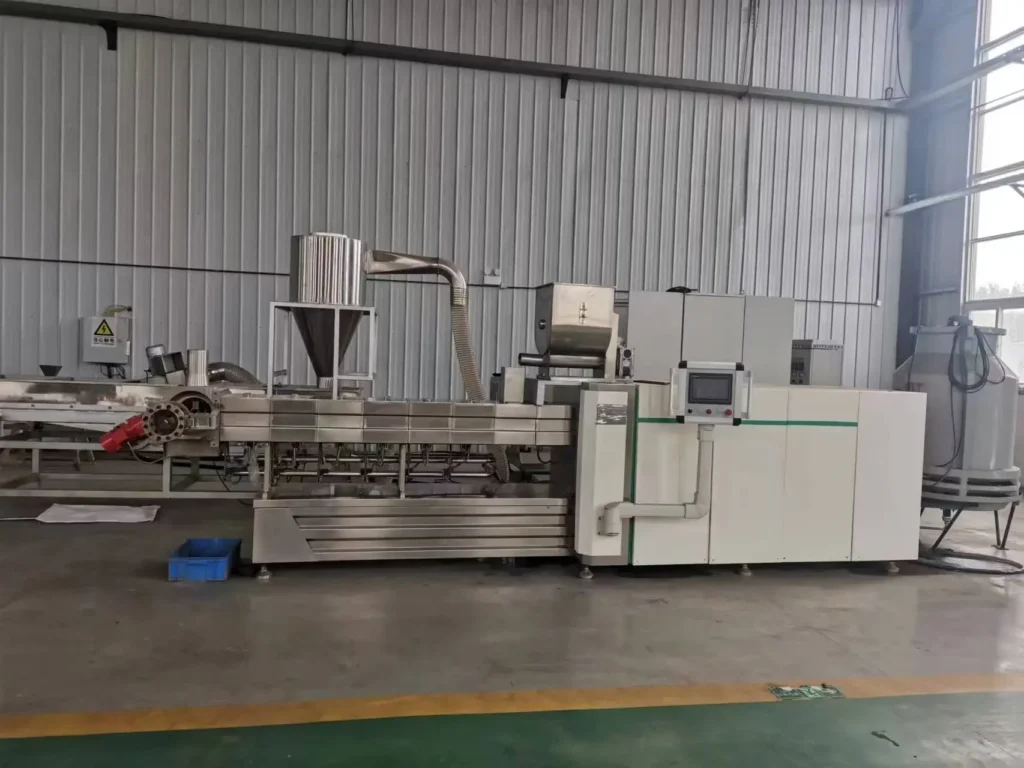
I still remember my first major overseas project in the Middle East. We shipped a complete pet food extrusion line, and the drying section was selected strictly according to standard engineering tables. When the machine arrived and started running during the peak summer season, the ambient heat completely overwhelmed the cooling tower. The water temperature drop failed, heat exchange efficiency plummeted, and the finished kibble moisture content exceeded safe limits. An entire warehouse of dog food was at risk of molding. From that day on, I stopped trusting standard工况 and started obsessing over local psychrometric data. When you size dryer 2 TPH kibble systems, ignoring the local climate means your thermal efficiency will collapse the moment the machine hits the factory floor.
Let us break down how to actually match your drying and cooling systems to your specific site conditions.
Why Nameplate Capacity Fails in Real Climates?
Most buyers assume that a larger dryer is inherently safer, but the true bottleneck is always the local wet-bulb temperature dictating the actual evaporation rate.
When you attempt to size dryer 2 TPH kibble lines, the manufacturer’s nameplate usually reflects a theoretical evaporation capacity tested under ideal, controlled conditions. In reality, the air’s ability to absorb moisture depends entirely on the local climate. If you are operating in a high-humidity region, the exhaust air reaches saturation much faster, drastically reducing drying efficiency.
Consider a project in Southeast Asia where a buyer installed a standard drying setup. The high ambient humidity caused severe exhaust condensation inside the ductwork. The drying efficiency dropped noticeably, and the retention time became insufficient to achieve the target moisture content. The solution was not to buy a bigger dryer, but to increase the airflow volume and install dehumidification pre-treatment for the intake air.
| Climate Factor | Standard Nameplate Assumption | Real-World Site Reality | Required Engineering Adjustment |
|---|---|---|---|
| Ambient Humidity | Controlled / Low | Uncontrolled / High | Noticeably increased airflow volume |
| Wet-Bulb Temp | Standard / Moderate | Extreme / High | Extended retention time ratio |
| Cooling Water Temp | Standard / Low | Elevated / High | Upsized cooling tower capacity |
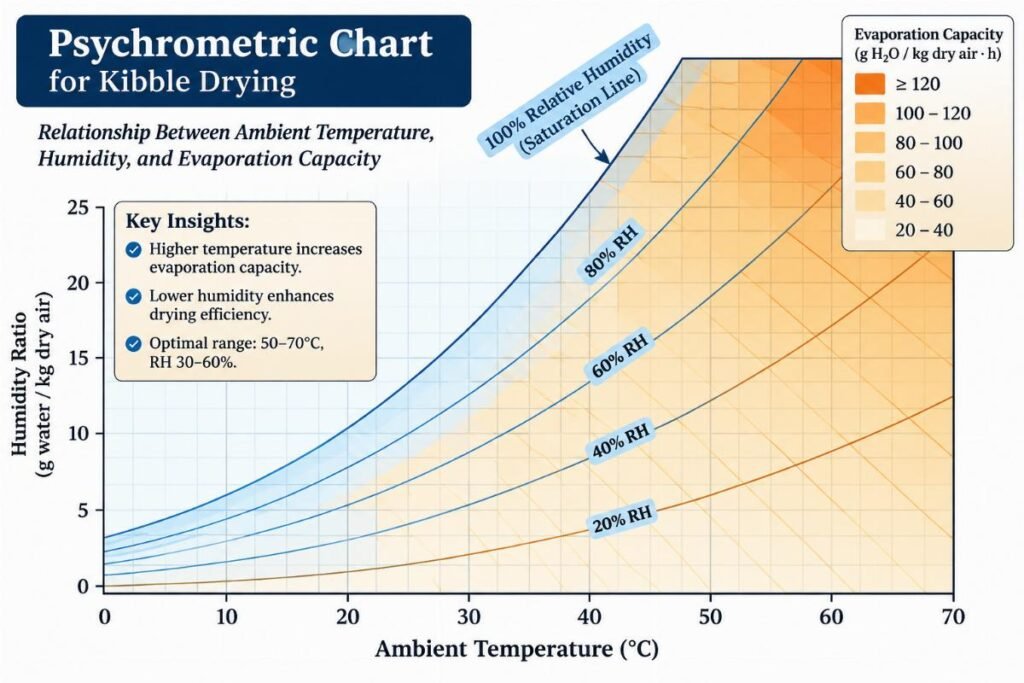
To properly size dryer 2 TPH kibble equipment, you must use psychrometric chart analysis to determine the specific evaporation rate per unit of air.
How to Calculate Airflow and Retention Time for 2 TPH?
Matching the heat-mass balance is the only way to avoid uneven drying and ensure every kibble particle reaches the target moisture level.
When you size dryer 2 TPH kibble systems, the airflow volume must be perfectly balanced with the heat input. A common mistake is oversizing the airflow, which causes severe heat loss and results in uneven drying—some pellets become too brittle while others remain wet inside.
The retention time must be calculated based on the initial moisture content from the extruder and the final target moisture. If the steam pressure drops or the heat source fluctuates, the retention time ratio must be adjusted to compensate.
- Measure Initial Moisture: Determine the exact moisture output from your twin-screw extruder.
- Calculate Evaporation Load: Subtract the target moisture percentage from the initial moisture to find the total water removal requirement.
- Determine Airflow Volume: Use the local wet-bulb temperature to calculate how much moisture each cubic meter of air can carry away.
- Set Retention Time: Adjust the dryer bed depth and conveyor speed to ensure the kibble stays in the heating zone long enough.
During a turnkey line design for a startup pet food brand, we had to completely redesign the internal baffles of the dryer to extend the retention time without increasing the physical footprint, ensuring the heat-mass balance remained stable even when the boiler pressure fluctuated slightly.
What Heat Source Matches Your Local Utilities?
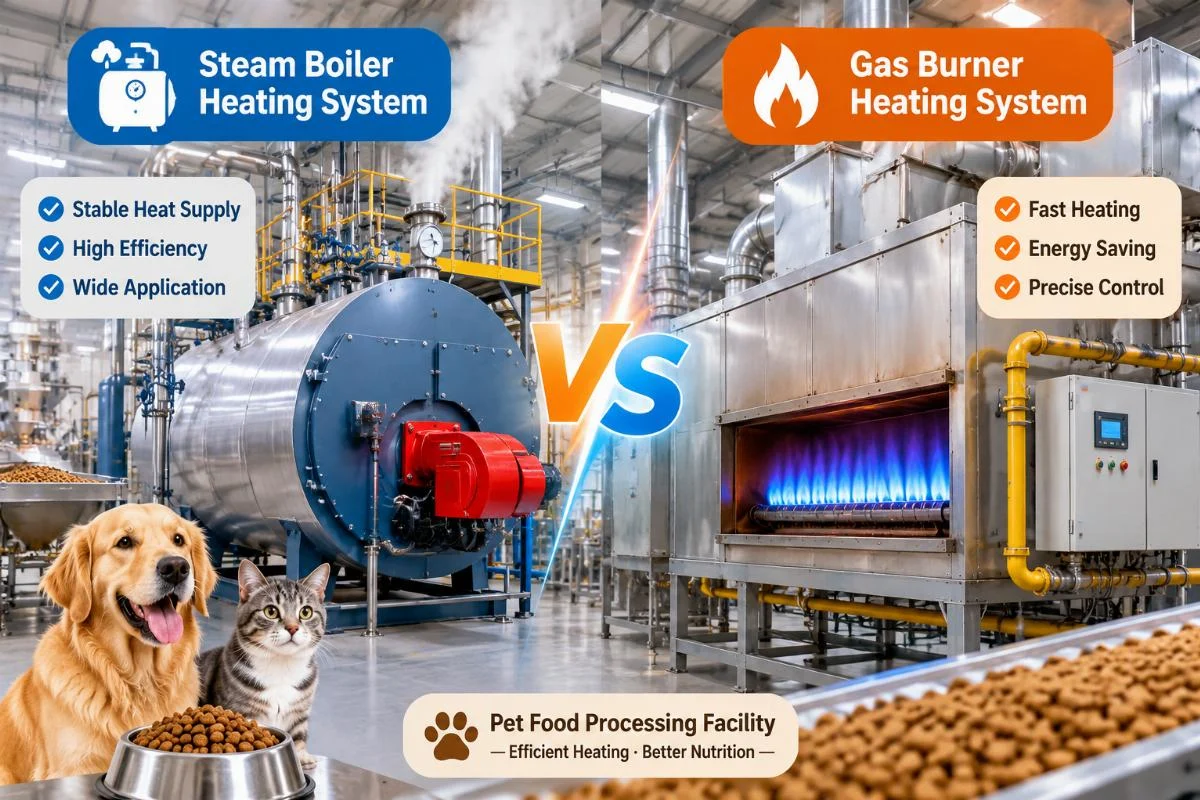
Your local utility infrastructure dictates whether steam or gas will provide the most stable and efficient thermal energy for your line.
When you size dryer 2 TPH kibble equipment, the heat source is not just a preference; it is a strict limitation based on what is available and reliable at your site. A mismatch here leads to constant temperature fluctuations and wasted energy.
| Heat Source | Utility Requirement | Thermal Stability | Best Suited For |
|---|---|---|---|
| Steam Boiler | Stable water/soft water supply, high pressure | Vulnerable to pressure drops | Regions with cheap coal/biomass |
| Gas Burner | Reliable natural gas or LPG pipeline | Robust and highly responsive | Areas with established gas grids |
| Thermal Oil | Specialized maintenance, closed loop | Standard | High-temperature requirements |
In a Latin American project, the buyer initially insisted on a steam-heated dryer because it was cheaper upfront. However, their local steam boiler suffered from frequent pressure drops during peak factory hours. The retention time became insufficient, and the kibble moisture rebounded. We had to retrofit the system with a direct gas-fired heat exchanger to guarantee consistent thermal input.
At Meiteng, when we design integrated drying and cooling systems for our turnkey lines ranging from 200 to 3000kg/h, we customize the heat source matching based on the client’s local site data. We do not just sell a machine; we engineer the thermal profile to match your specific utility reality.
How to Prevent Moisture Rebound During Cooling?
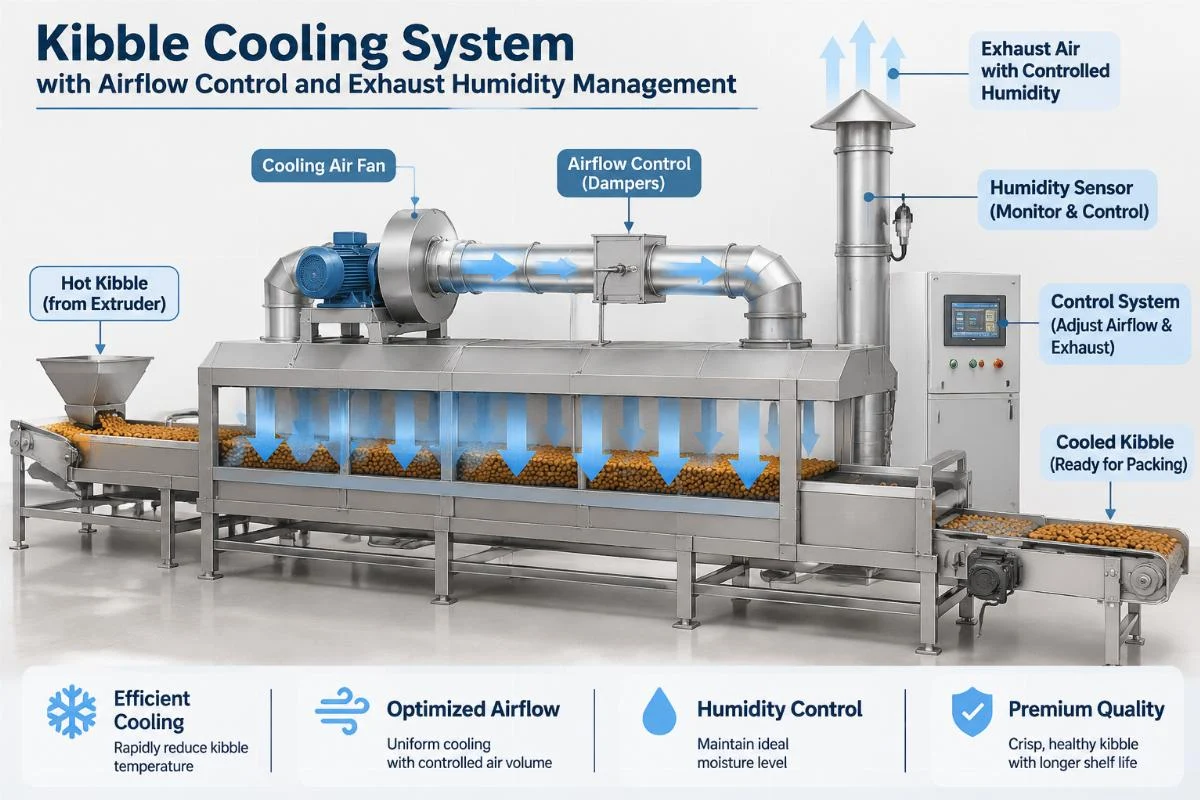
Cooling is not just about dropping the temperature; it is about controlling the exhaust humidity to prevent moisture from migrating back into the kibble core.
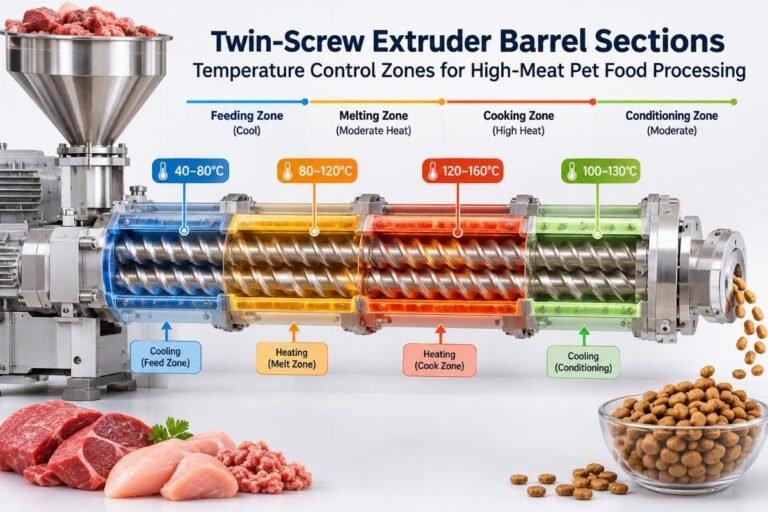
After the drying phase, the kibble is hot and the internal moisture is highly mobile. If the cooling process is too aggressive or the cooling air is too humid, the surface cools and seals, trapping moisture inside, or the kibble absorbs moisture from the cooling air. This is where moisture rebound happens.
To prevent this, the cooling water temperature in the conditioning system and the exhaust humidity during the cooling phase must be strictly controlled. If the ambient air is humid, the cooling fan must pull in air that has been pre-conditioned or dehumidified.
A buyer in a coastal region faced severe moisture rebound because they used standard ambient air for cooling during the rainy season. The kibble surface temperature dropped, but the core remained warm, creating a microclimate inside the bag that led to mold growth within weeks. By upgrading to a closed-loop cooling system with precise humidity exhaust control, the issue was completely resolved.
Meiteng’s turnkey line design includes integrated cooling and flavor-coating systems that account for these exact post-drying thermodynamic challenges, ensuring your product remains stable from the dryer to the packaging line.
Conclusion
Sizing a dryer requires thermodynamic precision, not just a glance at a capacity brochure.
To successfully size dryer 2 TPH kibble lines, you must anchor your design in local psychrometric data, balance airflow with retention time, and align your heat source with regional utilities. Ignoring these factors guarantees moisture issues and energy waste, while mastering them ensures a stable, efficient production line.