Bigger does not always mean better when scaling a pet food production line.
Choosing between a 3-layer and 5-layer pet kibble dryer is not merely a capacity calculation; it is a critical balance of production throughput, factory height constraints, and ocean freight costs. For lines producing 200 to 2000 kg/h, the 3-layer pet food dryer offers superior flexibility for modular lines and standard container shipping, while the 5-layer kibble drying machine maximizes floor space efficiency but demands rigorous factory clearance verification and specialized logistics.
When I first started in the pet machinery export business in Shenzhen, my daily routine involved calculating volumetric loading rates and staring at container inner dimensions. I quickly learned that equipment selection is a physical puzzle before it is a mechanical one. A few years ago, a Southeast Asian factory ordered a massive 5-layer unit for a new kibble line. They focused entirely on the throughput per square meter. However, when the equipment arrived at the port, they realized their factory ceiling height was strictly limited. The 5-layer machine simply could not stand upright. They ended up cutting off the top layer to make it fit, effectively turning it into a 3-layer unit. The ocean freight, rigging costs, and modification fees were completely wasted. Now, whenever I evaluate a pet kibble production line dryer selection, I verify the factory height and door clearance before looking at the extruder specs. The layer count is a hard indicator of both logistics costs and on-site feasibility.
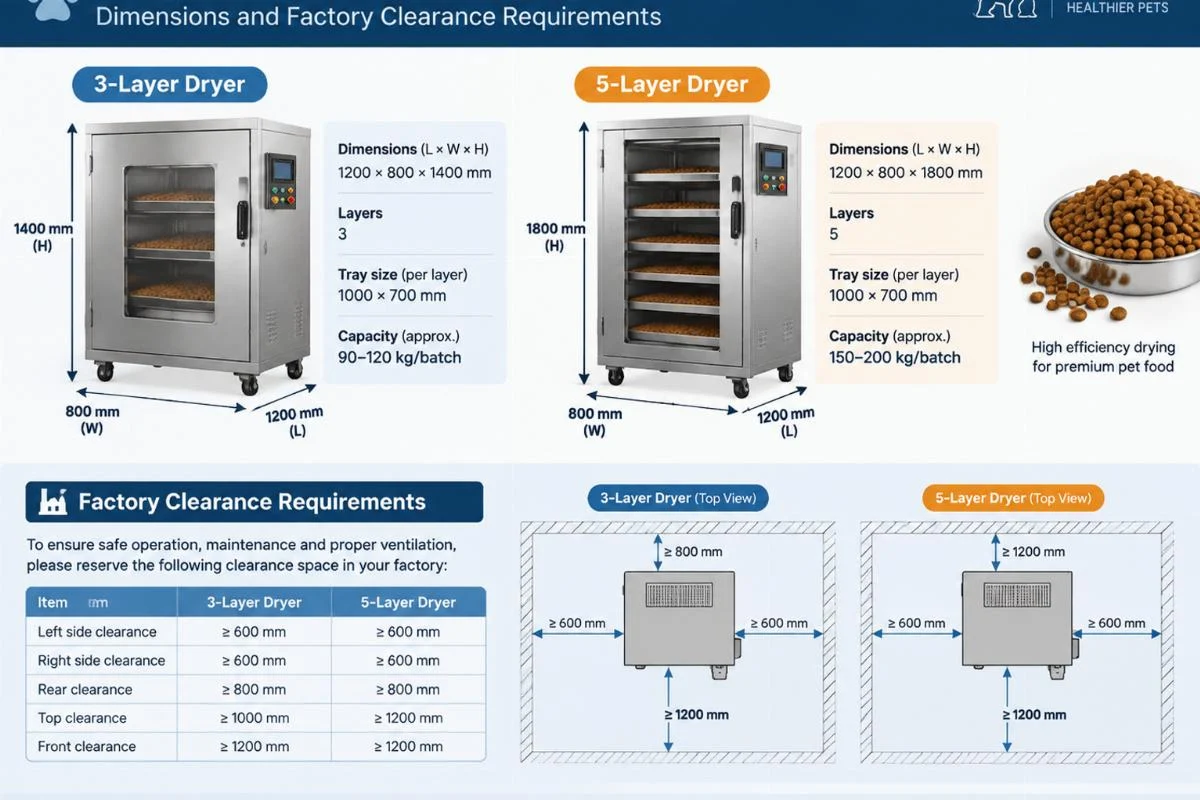
Before diving into the structural differences, it is essential to understand the core capacity differences between 3-layer and 5-layer dryers. The 5-layer kibble drying machine offers significantly higher throughput per square meter of factory floor space. By stacking more mesh belts, it maximizes the drying area within a compact footprint, making it ideal for facilities where land or building width is restricted. On the other hand, the 3-layer pet food dryer provides better flexibility for modular lines. It is easier to integrate with existing cooling or coating systems and allows for more straightforward maintenance access. When calculating the energy consumption per kg of moisture removed across layer configurations, the 5-layer design often retains heat more efficiently due to its enclosed vertical stacking, but the 3-layer design allows for more precise zoning of temperature and airflow across its fewer, wider belts.
How do factory height limits dictate your dryer choice?
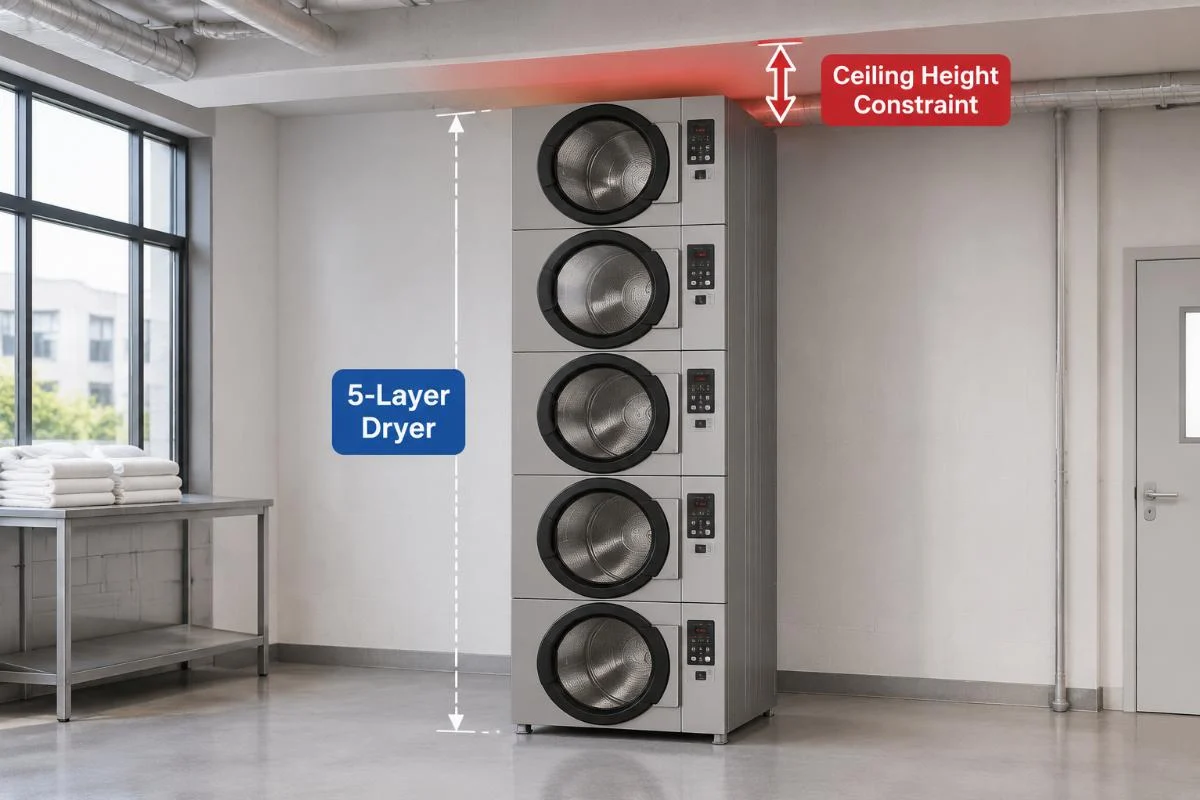
Always verify ceiling height, beam clearance, and door dimensions before finalizing the layer count.
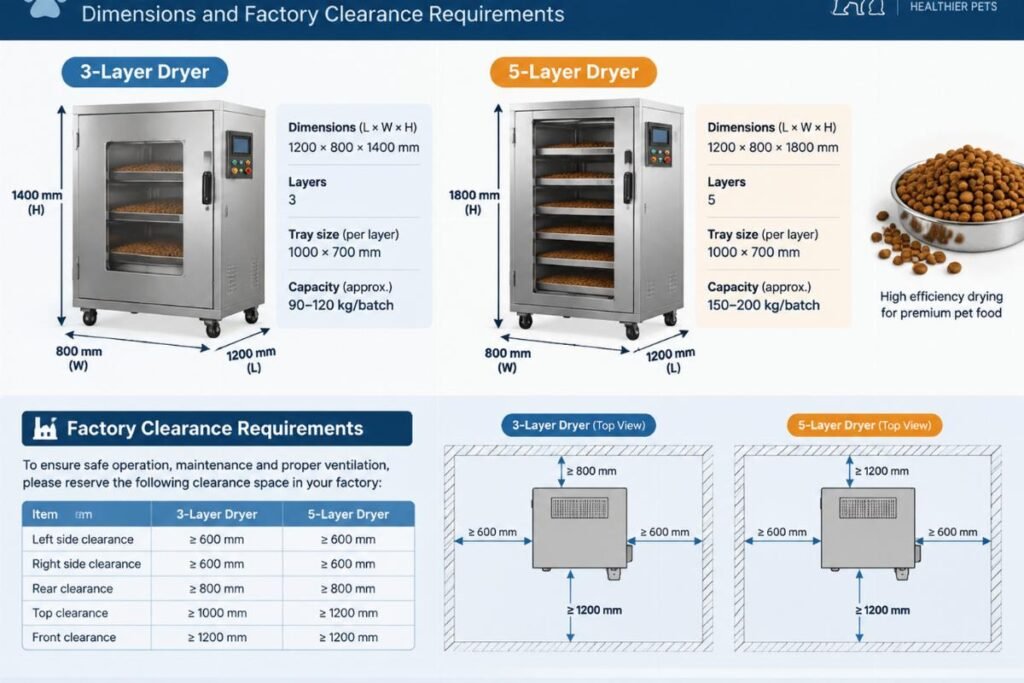
The physical height of the drying equipment is the most common hidden trap in pet food plant design. A standard 5-layer kibble drying machine requires substantial vertical clearance not just for the machine itself, but for the exhaust ductwork, maintenance platforms, and the overhead crane or hoist needed for belt replacement. In many existing warehouses or light industrial parks, the clear height under the beam is restricted. If a 5-layer unit exceeds the standard clearance limits, you face two choices: costly structural modifications to the factory roof or downgrading the machine on-site.
I always cross-reference the machine’s total installed height with local factory building codes and door dimensions. For a 5-layer configuration, the exhaust pipes need to rise high enough to ensure proper draft and condensation management, which adds another meter or more to the overall height requirement. In contrast, a 3-layer pet food dryer sits much lower, leaving ample room for ventilation ducts and overhead lighting.
Consider a mid-sized startup in South America that was expanding their treat line. They initially leaned toward the 5-layer model to save floor space. However, their leased facility had a strict height restriction due to local aviation zone regulations. By switching to a 3-layer pet food dryer, they avoided a massive civil engineering project to raise the roof. The 3-layer design provided the necessary capacity for their 500 kg/h line while fitting perfectly within their existing structural envelope.
How does layer count impact ocean freight and landing costs?
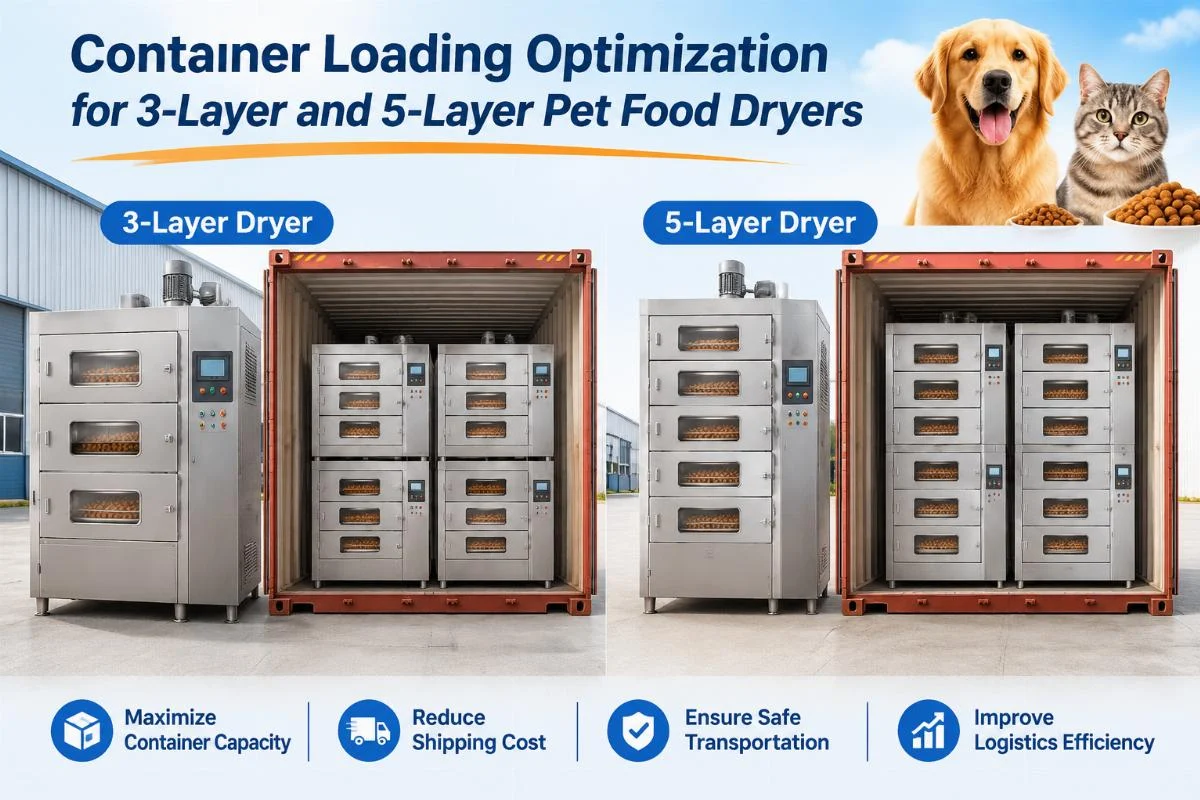
The physical dimensions of the dryer directly dictate the shipping method, which can drastically alter your total landed cost.
As someone who started out handling export documentation and container loading, I look at a machine and immediately calculate its volumetric loading rate. This is where the pet kibble production line dryer selection becomes a financial decision. A 3-layer pet food dryer is designed with dimensions that generally fit within the width and height constraints of a standard 40ft High Cube container. It can be loaded intact or with minimal disassembly, keeping freight costs predictable and low.
Conversely, a 5-layer kibble drying machine is often too tall and wide for standard enclosed containers. It usually requires flat-rack shipping or extensive disassembly. If disassembled, the reassembly process at the destination port requires specialized technicians and increases the risk of installation errors. If shipped on a flat-rack, you are paying for oversized cargo shipping premiums, which can be substantially higher than standard container rates. Furthermore, the rigging costs at both the origin and destination ports for a massive 5-layer unit add a significant surcharge to the final invoice.
This is where integrated system planning becomes crucial. At Meiteng, our expertise in export documentation and container-load consolidation for integrated drying and cooling systems ensures optimal loading rates. By designing the entire thermal processing section—extruder output, multi-layer dryer, and cooler—as a single logistical unit, we can maximize the space inside a 40ft HC or strategically plan flat-rack shipments to minimize void space. A large contract manufacturer in the Middle East recently opted for a 1500 kg/h line with a 5-layer dryer. Because we planned the flat-rack loading sequence alongside the cooling system components during the design phase, we avoided the typical oversized cargo premiums and ensured all critical components arrived in a single, coordinated shipment.
Which configuration fits your specific production scale?
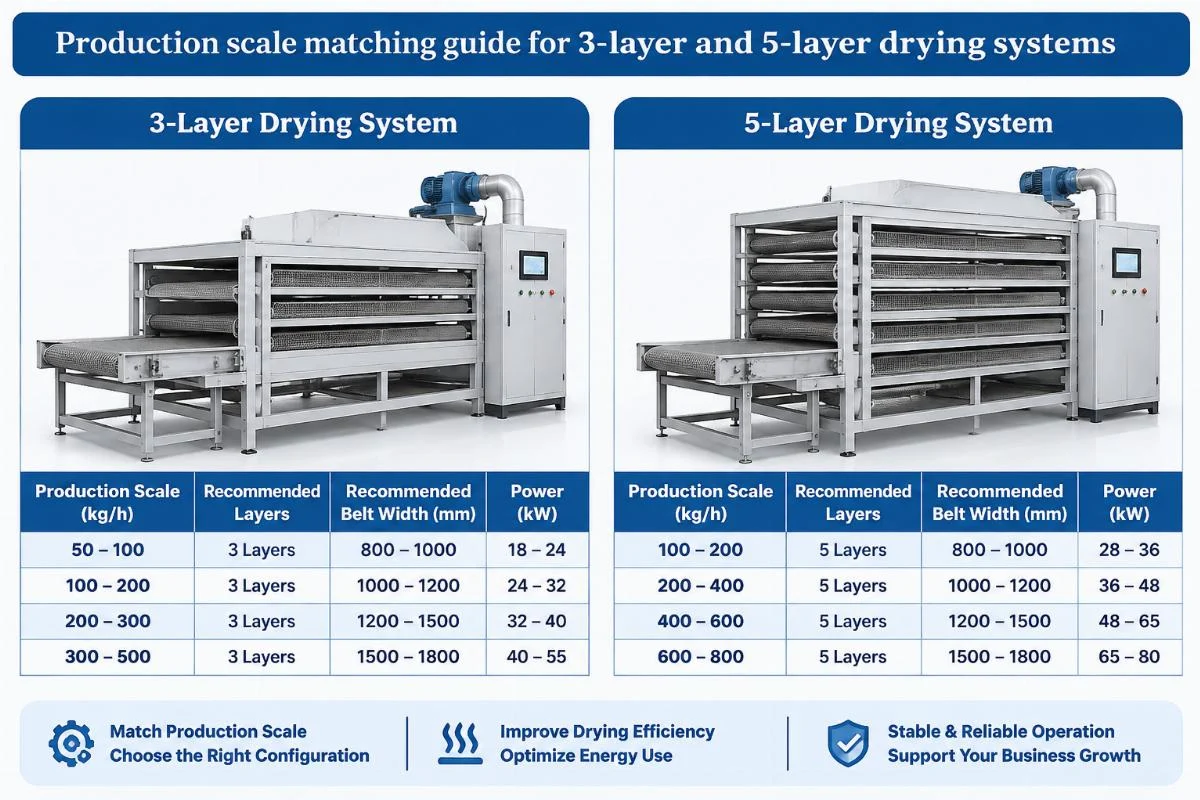
Match the dryer layer count to your hourly throughput targets and long-term expansion strategy.
The decision ultimately comes down to matching the equipment to your specific production scale. For startups and small-to-medium contract manufacturers running lines between 200 and 800 kg/h, the 3-layer pet food dryer is the undisputed sweet spot. It provides sufficient drying capacity, is incredibly easy to ship and install, and leaves room in the capital expenditure budget for other critical line components like advanced coating drums or packaging systems. The operational flexibility of the 3-layer design also makes it easier to run multiple short batches of different kibble recipes, as the belts are more accessible for cleaning and changeovers.
For large contract manufacturers or established brands scaling up to 1000 kg/h and beyond, the 5-layer kibble drying machine becomes necessary to handle the volume without requiring an impossibly long factory building. The 5-layer design compresses the drying time and distance into a smaller footprint, which is essential when every square meter of factory space is accounted for. However, buyers must be prepared for the higher initial logistics investment and the strict factory height requirements.
When comparing the two, it is vital to look beyond the basic spec sheet. Evaluate the energy consumption per kg of moisture removed, the ease of mesh belt tensioning, and the accessibility of the heating exchangers. A machine that is slightly harder to access for daily maintenance will cost you far more in downtime over a decade than the initial savings in floor space.
Conclusion
Selecting the right dryer layer count is a balance of throughput, physical constraints, and logistics.
The choice between a 3-layer and 5-layer pet kibble dryer extends far beyond simple capacity metrics. It requires a holistic evaluation of your factory’s vertical limits, your budget for ocean freight, and your specific hourly production targets. By prioritizing physical feasibility and logistical efficiency alongside mechanical performance, you ensure a smoother installation and a more cost-effective operation from day one.
Machines Mentioned in This Article

cat food machine
Dog Food Extruder Machine Manufacturer for Pet Food Kibble Making Line
View Machine
cat food machine
Pet Food Processing Equipment Plant Manufacturer Dog Food
View Machine
cat food machine
Dry Dog Food Production Line Pet Food Pellet Machine
View Machine
cat food machine