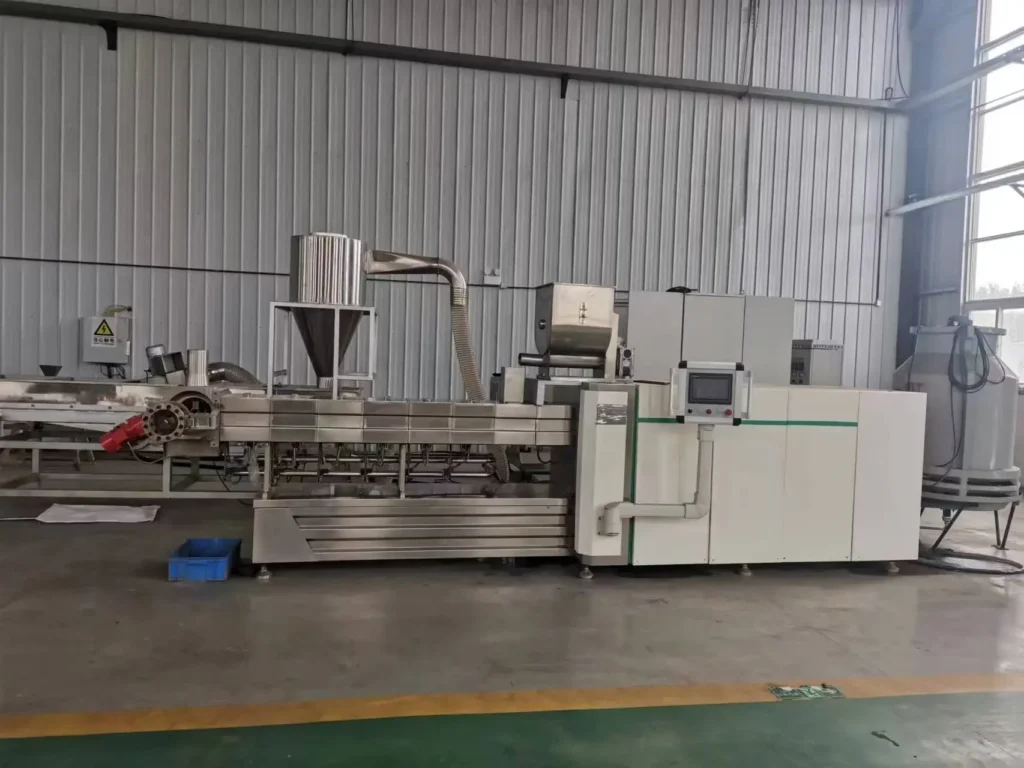

Bigger capacity does not equal better ROI for contract manufacturers; rapid changeover and cleaning efficiency dictate real profitability.
When selecting contract pet food manufacturer equipment, the core answer to scaling production while minimizing changeover downtime is prioritizing equipment flexibility and cleaning efficiency over sheer raw throughput. A highly adaptable twin-screw extruder integrated into a turnkey line prevents costly formula shift delays and hidden downstream bottlenecks.
I still remember the freezing wind at the Global Pet Expo in Chicago years ago. I was helping a North American contract facility source their new processing gear, and I obsessed over the single-machine price tag while completely ignoring the die compatibility of the twin-screw extruder. The result was a disaster. When they ran a high-meat prescription diet, the DS70 blocked the die repeatedly. Cleaning the dead corners took forever, and the extended downtime ruined their weekly delivery schedule, leaving the buyer furious. Transitioning to the equipment supply side later, I deeply understood the pain of contract facilities switching lines. Choosing the right contract pet food manufacturer equipment is never just about reading parameter sheets; formula compatibility and precise temperature control are the actual lifelines for securing contracts.
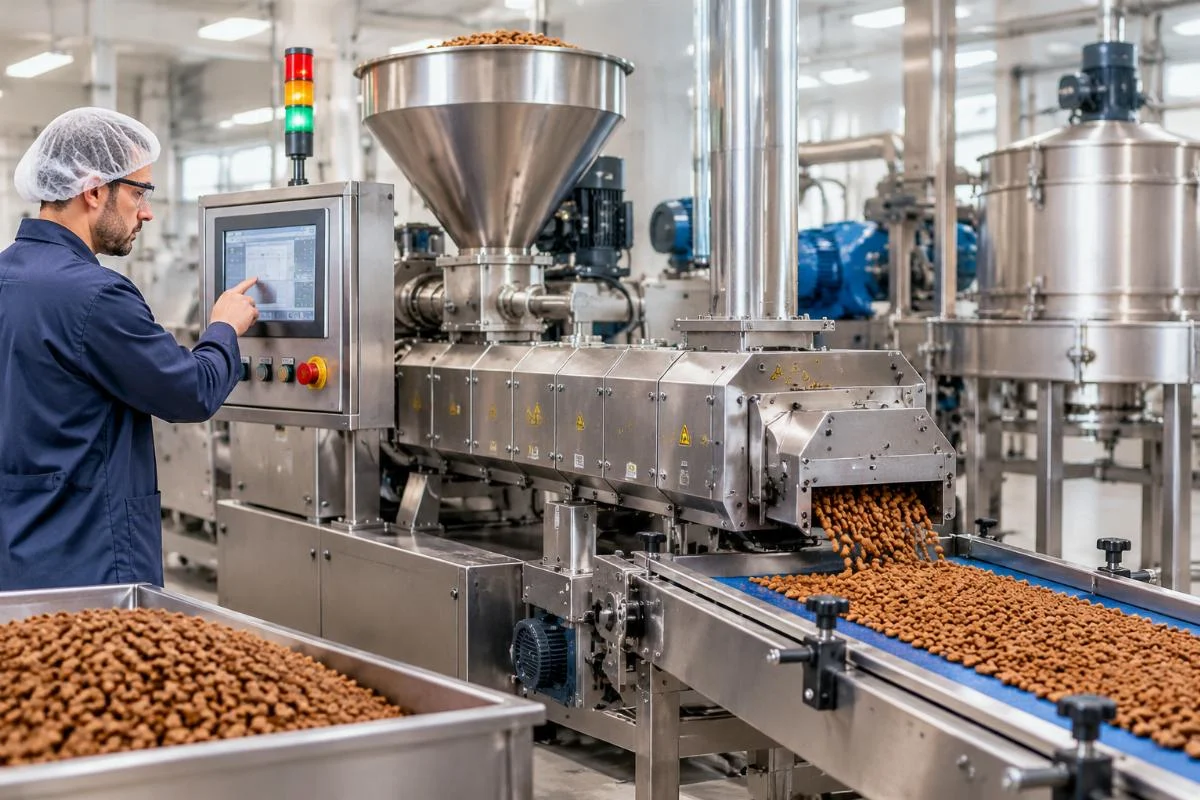
Let us dive into how to build a system that actually makes money instead of just looking impressive on paper.
Why is Flexibility More Critical Than Raw Capacity for Contract Manufacturers?
Quick changeovers prevent revenue loss during formula shifts, making flexibility the true driver of profitability in contract manufacturing.
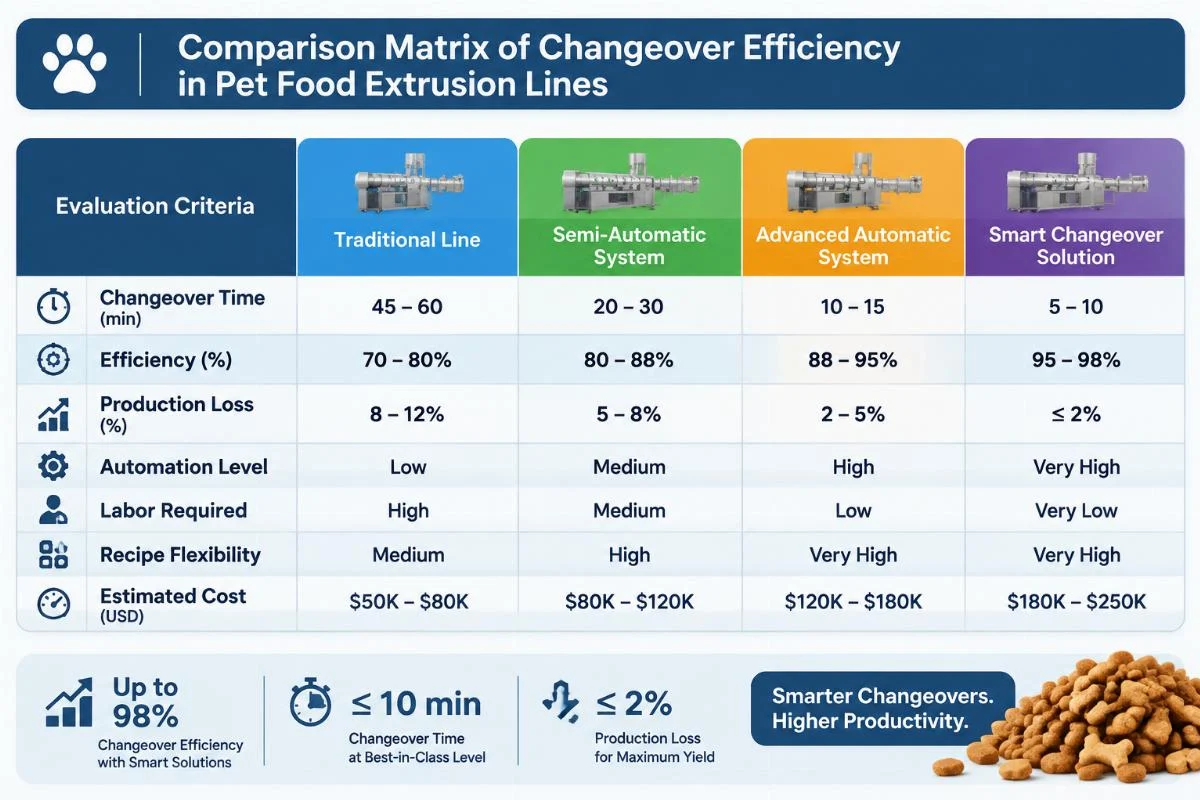
Most buyers mistakenly believe that purchasing the highest capacity machine guarantees the best return. In reality, contract manufacturers handle dozens of diverse formulas weekly. If a machine requires half a day to switch from a poultry-based kibble to a salmon-based sensitive formula, the lost production time easily wipes out the theoretical capacity advantage. The real cost lies in the idle hours and the wasted transitional material.
When evaluating contract pet food manufacturer equipment, you must look at how the system handles recipe transitions. A flexible pet food production line allows operators to swap molds and adjust thermal profiles rapidly.
| Changeover Factor | Rigid Single-Screw Setup | Flexible Twin-Screw Setup |
|---|---|---|
| Mold Swap Time | Noticeably extended | Substantially reduced |
| Formula Adaptability | Vulnerable to high-meat slip | Robust shear control |
| Residual Material Waste | Uncontrolled | Noticeably reduced |
| Downstream Sync | Basic | Full batch-level integration |
A European contract manufacturer once upgraded to a flexible twin-screw extruder for contract manufacturing. They reported that their changeover time dropped noticeably, allowing them to accept smaller, high-margin custom orders that they previously had to reject. The ability to pivot without massive material waste is what separates a profitable contract facility from a struggling one.
How Do Twin-Screw Extruders Handle High-Meat and Sensitive Formulas?
Superior shear control and die compatibility prevent blockages, ensuring consistent quality for high-meat and sensitive recipes.
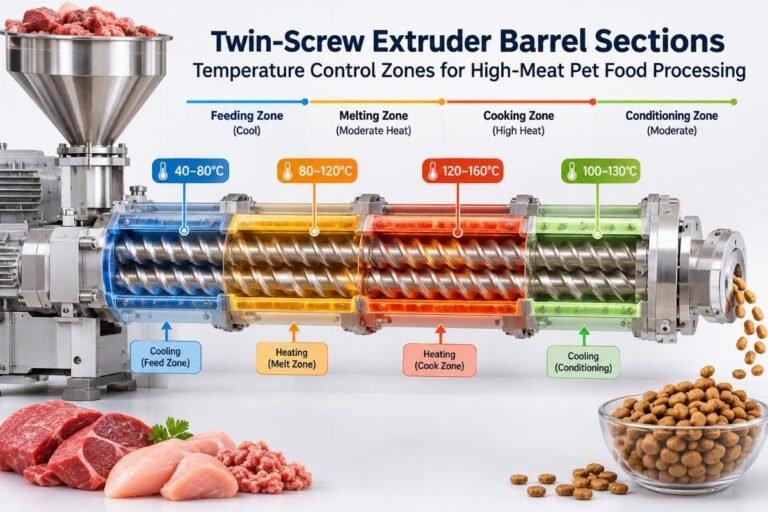
High-meat prescription diets are notoriously difficult to process. The high fat and protein content can cause severe die blockage if the equipment lacks precise shear control. This is where the twin-screw extruder for contract manufacturing proves its worth. Unlike single-screw systems that rely heavily on friction, a twin-screw design provides positive conveying and self-wiping action, allowing for uniform mixing and precise temperature management even with sticky, high-meat formulations.
The custom pet food extrusion machinery must feature advanced barrel temperature zoning and variable speed controls to manage the rheology of sensitive formulas. If the shear heat is not strictly controlled, the proteins can denature prematurely, leading to poor expansion and burnt flavors.
During a field observation at a startup scaling capacity, their initial single-screw setup failed completely when they tried to run a fresh-meat inclusion recipe. The material simply slipped inside the barrel. After switching to a DS-series twin-screw extruder, the positive feed mechanism grabbed the high-meat slurry perfectly. The die blockage frequency dropped to near zero, and the product expansion rate became highly consistent.

What Should a Turnkey Production Line Include to Minimize Downtime?
Integrated drying and flavor-coating systems eliminate hidden bottlenecks, ensuring the entire line operates at peak efficiency.
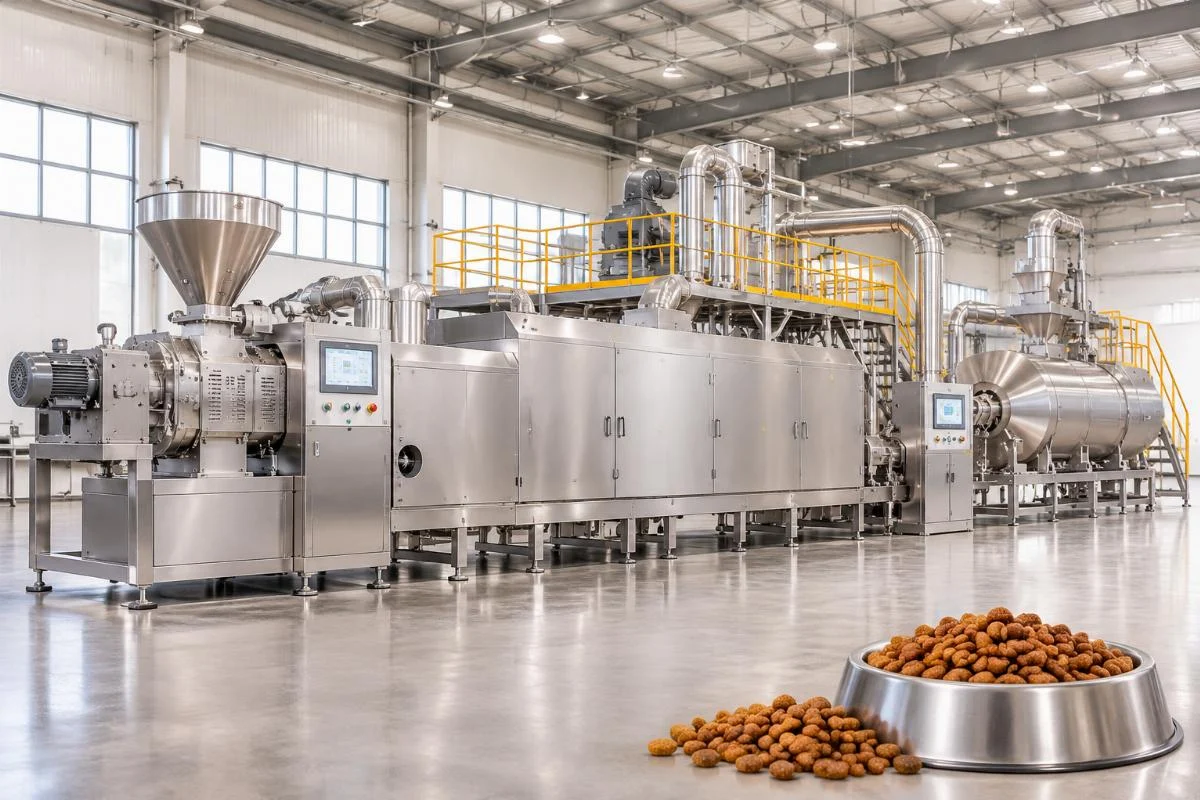
Most buyers focus entirely on the single extruder price, completely ignoring the downstream equipment. This is a massive trap. A high-speed extruder is useless if the dryer cannot keep up, or if the coating drum creates a bottleneck that forces the extruder to wait. A true turnkey line must integrate raw material intake, extrusion, drying, cooling, and flavor coating into a seamless, automated flow.
When sourcing contract pet food manufacturer equipment, ensure the supplier provides comprehensive line design. The drying system must match the extruder’s output capacity precisely, utilizing multi-pass designs to ensure uniform moisture reduction without over-drying the kibble surface. The coating system needs to apply fats and palatants evenly while operating at optimal temperatures to prevent rancidity.
I consulted for a facility that bought a top-tier extruder but paired it with an undersized, poorly designed dryer. The kibble came out perfectly, but the dryer left the center moist, leading to mold issues weeks later. They had to halt production and redesign the entire drying section, costing them a mid-six-figure loss in delayed shipments. By opting for a fully integrated turnkey line from a provider like Meiteng, which includes DS-series extruders paired with matched continuous dryers and coaters, you eliminate these hidden bottlenecks. The on-site installation and operator training ensure every component talks to each other perfectly.
How to Evaluate Equipment for Easy Cleaning and Sanitation?
Food-grade stainless steel and accessible designs meet strict hygiene standards, drastically reducing cleaning time between batches.
In contract manufacturing, sanitation is not just a regulatory requirement; it is a operational necessity. Switching from a fish-based formula to a poultry-based one requires thorough cleaning to prevent cross-contamination and allergen issues. If the equipment has dead corners, complex pipe bends, or uses inferior metals that corrode, cleaning becomes a nightmare that eats into your production schedule.
The best contract pet food manufacturer equipment is constructed entirely from food-grade 304 or 316 stainless steel. The design must prioritize accessibility. Quick-release clamps, CIP (Clean-in-Place) compatible piping, and extruder barrels that split open easily are non-negotiable.
Meiteng’s DS-series twin-screw extruders and turnkey lines are built with 304/316 stainless construction, adhering to strict 3-A sanitary standards. The barrels feature hydraulic opening mechanisms, allowing operators to access the screws and clean residual material in minutes rather than hours. This accessible design, combined with formula development support, ensures that your facility can meet international food safety hygiene standards without sacrificing uptime.

Conclusion
Flexibility and sanitation dictate the true profitability of contract manufacturing, far outweighing raw machine capacity.
Selecting the right contract pet food manufacturer equipment requires a shift in perspective from chasing maximum throughput to optimizing changeover speed and cleaning efficiency. By investing in a flexible twin-screw extruder and a fully integrated turnkey line built with sanitary stainless steel, contract facilities can handle diverse high-meat formulas seamlessly, eliminate downstream bottlenecks, and secure long-term buyer trust.
Machines Mentioned in This Article

cat food machine
Pet Food Processing Equipment Plant Manufacturer Dog Food
View Machine
cat food machine
Dog Food Processing Equipment Manufacturer Pet Food
View Machine
cat food machine
Pet Food Extruder Machine Manufacturer Production Line
View Machine
cat food machine