
Higher meat content does not guarantee better treats if the exhaust moisture remains uncontrolled.
Producing high-quality extruded fish and chicken cat treats relies on precise twin-screw extrusion parameters and proper equipment configuration to ensure optimal texture and nutrient retention, rather than merely scaling up machine capacity.
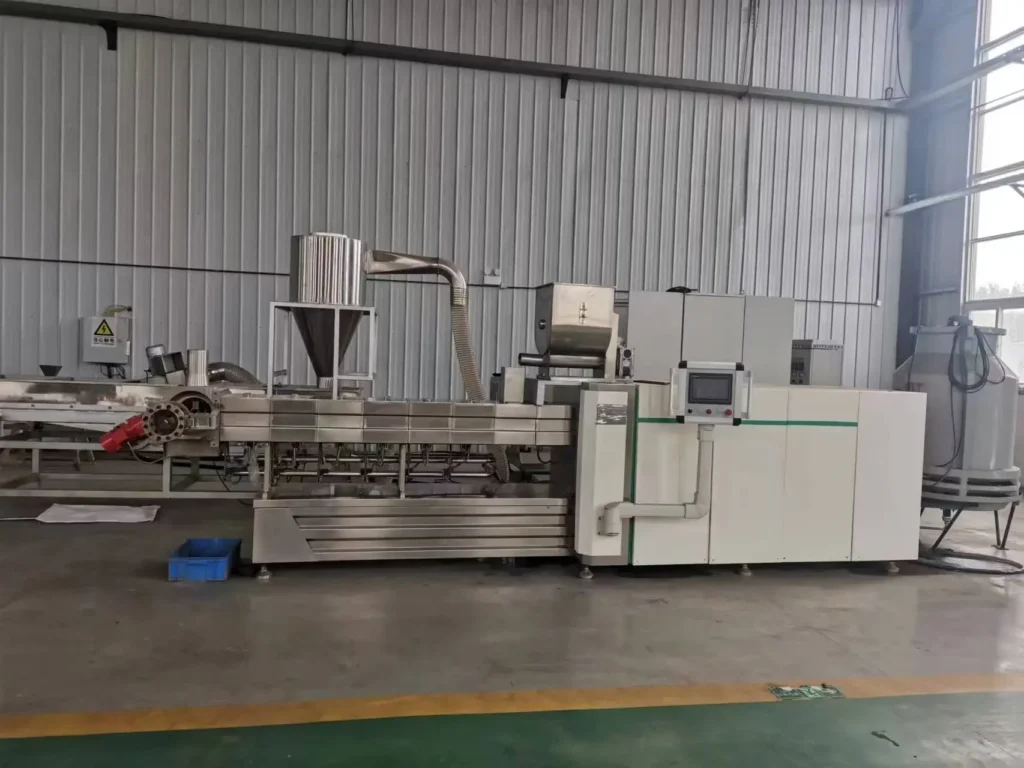
Years ago, I spent days crouching in a workshop near Ningbo Beilun Port, watching a newly installed line ship out. The client insisted the extruded fish and chicken strips were shattering completely after drying. After排查ing the entire setup, the root cause finally surfaced: uncontrolled moisture in the exhaust section of the twin-screw barrel caused uneven puffing density. Transitioning from on-site installation to business development, I became obsessed with matching screw combinations to die hole diameters. Selecting a production line is never just about nominal output; the shear and gelatinization state of the formula inside the barrel dictates the final forming rate. Understanding the extruded cat treats process and equipment is the only way to prevent structural failures in high-protein recipes.

Moving from raw material intake to the final packaged treat requires a deep understanding of how thermal and mechanical energy interact within the barrel.
What Defines the Ideal Texture for Fish and Chicken Cat Treats?
Texture depends entirely on the gelatinization degree achieved inside the extruder barrel.
Historically, the pet food industry focused heavily on ingredient sourcing, assuming that premium fish and chicken blends would naturally yield premium treats. However, industry trends over the past decade have shifted toward processing engineering, recognizing that the physical structure of the treat is forged by thermal and mechanical energy. When dealing with high-protein inputs like fish and chicken, the lack of starch means traditional gelatinization mechanisms must be replaced by precise protein denaturation and texturization.
During my early field observations, I noticed that many startups struggled with treat density. They would adjust the main motor frequency, hoping to increase throughput, but ended up with treats that were either too hard to bite or too porous to hold their shape. The truth is, the ideal crunch requires a specific level of protein melt consistency. If the barrel temperature profile is too aggressive, the proteins burn before they can form a stable matrix. If the shear is insufficient, the mixture exits the die as a dense, unexpanded paste. The extruded cat treats process and equipment must be calibrated to balance these opposing forces, ensuring the protein network expands uniformly upon exiting the die.

Achieving this balance is not about guessing; it is about controlling the specific mechanical energy input relative to the moisture content of the fresh meat slurry.
How Does the Twin-Screw Extrusion Process Work for High-Meat Formulas?
Precise control of shear, temperature, and exhaust moisture is critical for high-protein inputs.
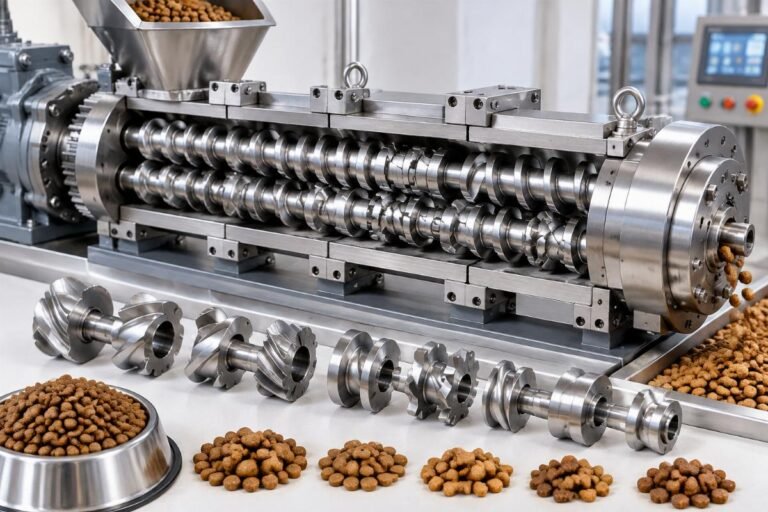
Unlike single-screw systems that rely heavily on friction and barrel drag, twin-screw extruders offer positive conveying and independent control over shear and residence time. This is absolutely vital when processing sticky, high-moisture fish and chicken blends. The process begins with the feeding section, where the co-rotating screws grab the raw material. As the material moves forward, the volume of the screw flights decreases, compressing the mixture and generating frictional heat.
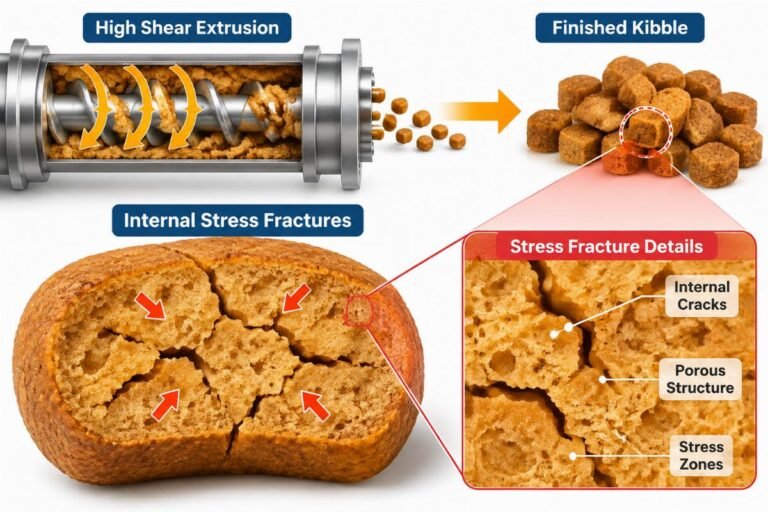
The most critical phase for high-meat formulas is the compression and metering sections, where the exhaust ports are typically located. Here, the goal is to vent out excess moisture and volatile compounds before the final melting zone. I once worked with a contract manufacturer whose treats kept breaking during the cooling phase. They assumed the drying oven was at fault. In reality, the exhaust section was failing to pull enough moisture out of the barrel, leading to flash vaporization at the die face. This created microscopic voids inside the treat, destroying its structural integrity. Proper venting ensures that when the product exits the die, the sudden pressure drop causes a controlled expansion rather than a violent rupture.

Mastering this phase of the extruded cat treats process and equipment prevents the invisible defects that only show up after the treats have been packaged and shipped.
What Equipment is Essential for a Complete Cat Treat Production Line?
Beyond the extruder, integrated drying, cooling, and flavor-coating systems are vital for final quality.
A common misconception among new pet food startup owners is that the extruder is the only machine that matters. They allocate their entire budget to a massive twin-screw machine and neglect the downstream equipment. The reality is that the extruder only shapes the treat; the subsequent systems define its shelf life, palatability, and structural stability.
After extrusion, the treats are soft and highly moist. They must pass through a multi-pass dryer where temperature and humidity curves are strictly controlled. If the drying temperature is too high initially, the surface hardens and traps internal moisture, leading to mold growth later. If it is too low, the treats remain too soft to withstand the coating process. Following drying, the cooling system brings the treats down to ambient temperature, preventing condensation inside the packaging. Finally, the flavor-coating system applies the external palatability enhancers. For fish and chicken treats, this often involves a delicate balance of oil and powder application.
I recall a project where a client wanted to launch a new fish and chicken blend. They bought a top-tier extruder but used a basic, single-stage dryer. The treats emerged from the extruder perfectly formed, but the uneven drying caused them to warp and crack during the coating tumbler operation. The entire batch was ruined. Integrating the drying, cooling, and coating systems into a cohesive line is what separates a laboratory prototype from a commercial success.
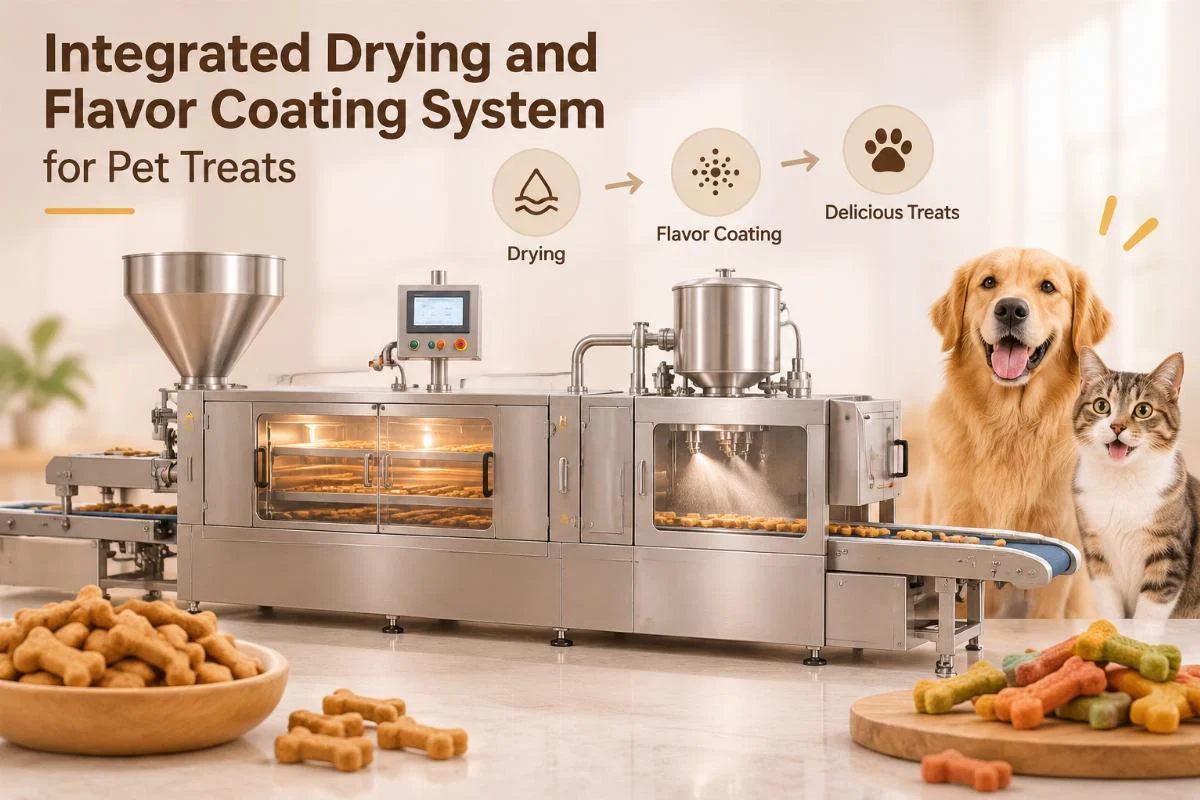
Evaluating the extruded cat treats process and equipment requires looking at the entire line’s synergy, not just the extruder’s standalone performance.
How to Choose the Right Extruder and Die for Your Recipe?
Matching screw combinations and template hole diameters to your specific fish/chicken ratio prevents structural failures.
Selecting the right hardware is an exercise in matching mechanical geometry to rheological properties. Fish and chicken have different protein structures and fat contents. Chicken fat renders at a different temperature than fish oils, and the muscle fibers break down differently under shear. Therefore, the screw configuration inside the barrel must be customized.
The screw elements—conveying, kneading, and reverse—must be arranged to provide the exact amount of shear required for your specific formula. Too many kneading blocks will generate excessive heat, burning the delicate fish proteins. Too few will result in an under-cooked, unstable product. Similarly, the die plate template hole diameter must match the feed rate and the desired treat size. If the holes are too small for a high-viscosity chicken blend, the backpressure will overload the main motor, and the extrudate will fracture. If the holes are too large, the treats will lack the necessary density and crunch.
When advising a client on scaling their treat production, I always start by analyzing their screw profile and die specifications. A Middle Eastern startup once tried to run a high-fish formula on a standard poultry screw configuration. The result was a severe drop in the forming rate and excessive wear on the screw elements. By redesigning the screw combination to handle the higher lipid content and adjusting the die hole diameter to reduce backpressure, we restored the line’s efficiency without changing the extruder model.
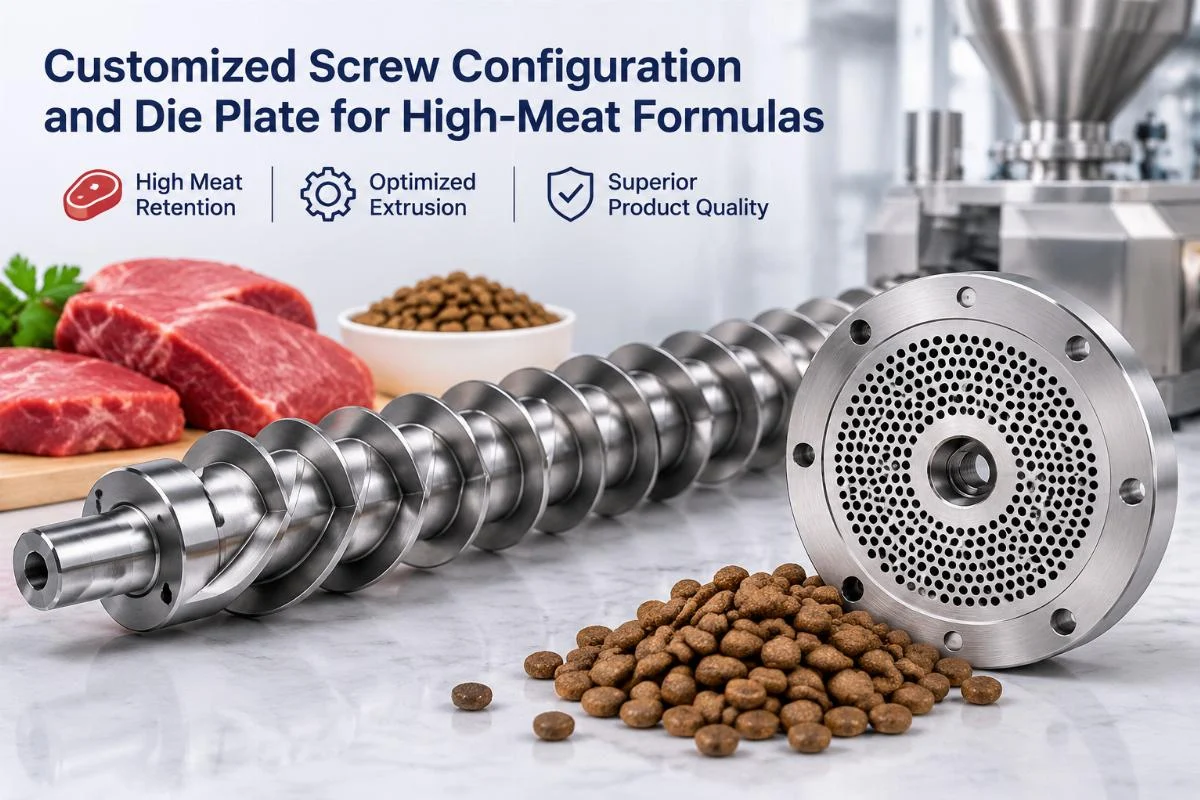
The final success of the extruded cat treats process and equipment hinges on this precise mechanical alignment with the biological reality of the raw ingredients.
Conclusion
Texture and stability are forged by thermal and mechanical control, not just ingredient quality.
Mastering the extrusion of fish and chicken treats requires a holistic view of the production line, from barrel shear and exhaust moisture management to integrated drying and precise die matching. Prioritizing the rheological behavior of the formula inside the machine ensures consistent forming rates and optimal nutrient retention.