
Cheaper single machines always lead to higher long-term costs when processing high-meat formulas.
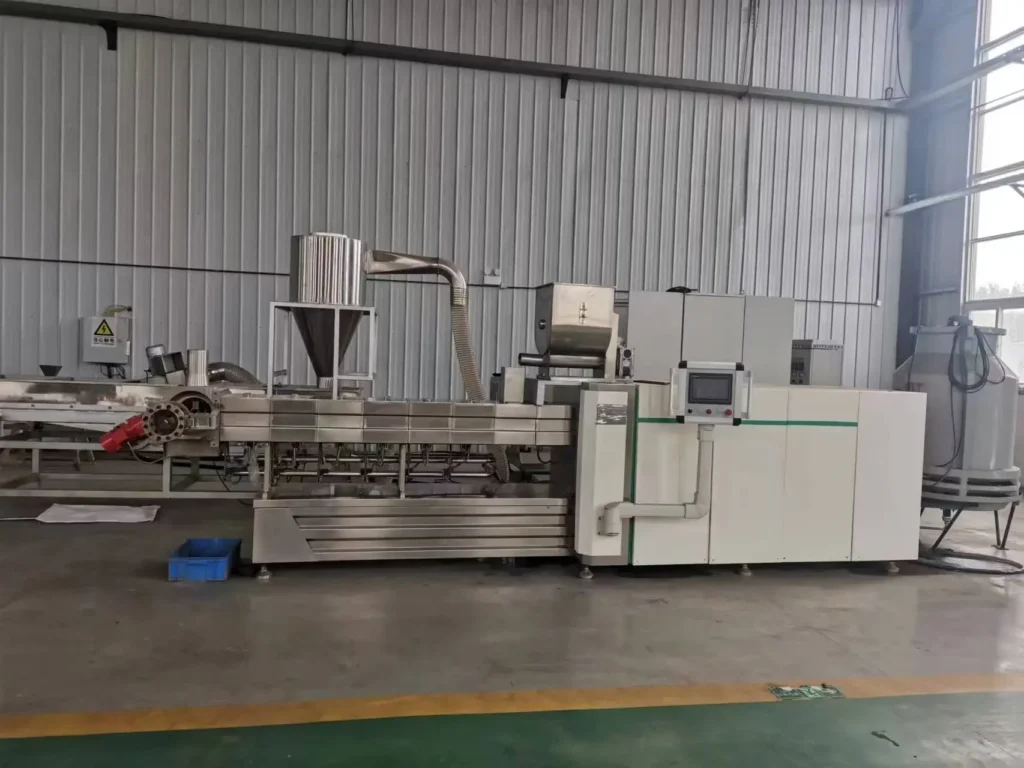
Selecting a Meiteng dog food extruder requires evaluating the entire turnkey line’s matching and screw configuration, not just the single machine price, especially for high-meat formulas. System integration prevents bottlenecks, ensures proper gelatinization, and guarantees smooth factory startup.
I still remember the early days of my career, standing on the workshop floor inspecting equipment quality control before transitioning to international trade. Over the years, I have seen countless new pet food factory owners initially complain that our twin-screw machines were too expensive. To cut costs, they purchased cheaper single-screw alternatives from other suppliers. When they attempted to produce high-meat cat food, the gelatinization rate was completely inadequate. The pellets crumbled at the slightest touch, forcing the entire production line to shut down. Ultimately, they had to come back to us to reformulate the recipe and upgrade to a DS85 twin-screw model. Building a new factory is not just about buying a standalone machine; if the screw arrangement or die hole sizing is slightly off, the output will fail quality checks.
Let us break down how to navigate the equipment selection process without falling into common startup traps.
Why is Turnkey Line Matching More Critical Than Single Machine Price?
A standalone extruder is useless if the downstream drying and cooling systems cannot handle its moisture output.
Many startup owners focus entirely on the extruder’s purchase price, ignoring the fact that pet food processing is a continuous thermal and mechanical workflow. When the moisture content leaving the extruder does not align with the drying oven’s capacity, the product remains susceptible to mold growth during storage.
Consider a recent case involving a new factory setup in Southeast Asia. The owners bought a highly rated extruder but paired it with an undersized, mismatched drying system. The moisture retention was noticeably higher than the safe threshold, leading to widespread mold issues within weeks. The cost of recalling and discarding the spoiled batches far exceeded the initial savings on the extruder.
| Integration Factor | Poorly Matched Line | Properly Engineered Turnkey Line |
|---|---|---|
| Moisture Evaporation | Uncontrolled / Vulnerable to mold | Controlled / Consistent drying cycle |
| Thermal Transfer | Noticeably reduced / Uneven | Robust / Uniform pellet structure |
| System Bottlenecks | Frequent / Unplanned shutdowns | Resistant / Smooth continuous flow |
| Final Product Quality | Self-reported / Inconsistent | Verifiable / Stable gelatinization |
When you evaluate a Meiteng dog food extruder, you must look at how it integrates with the dryer, cooler, and flavor coating system. A turnkey approach ensures that the thermal profile of the extruder matches the evaporation rate of the dryer, preventing the exact mold issues that plague mismatched setups.

How to Choose the Right Meiteng Extruder Model (DS65 vs. DS70 vs. DS85)?
Matching the model to your target capacity and meat inclusion rate is the only way to ensure a viable return on investment.
The DS series offers distinct advantages depending on your production goals. Selecting the wrong size means either underutilizing your capital or constantly running the machine beyond its mechanical limits, which accelerates wear on the screws and barrels.
| Model Specification | DS65 Twin-Screw | DS70 Twin-Screw | DS85 Twin-Screw |
|---|---|---|---|
| Target Capacity Range | Standard / Entry-level scaling | Medium / Expanded output | High / Industrial volume |
| High-Meat Tolerance | Basic / Limited shear pressure | Standard / Enhanced flexibility | Robust / Maximum shear force |
| Screw L/D Ratio Impact | Noticeably reduced / Shorter residence | Controlled / Balanced processing | Substantially extended / Deep mixing |
| Ideal Factory Stage | Pilot testing / Small batch | Growing brand / Regional supply | Mass production / Contract manufacturing |
A medium-scale dog treat factory initially started with a smaller model but quickly faced capacity ceilings as their contracts expanded. By upgrading to the DS70, they achieved a noticeable increase in output without needing to overhaul their entire facility layout. The ROI period dropped significantly because the machine handled their specific treat dough viscosity perfectly.
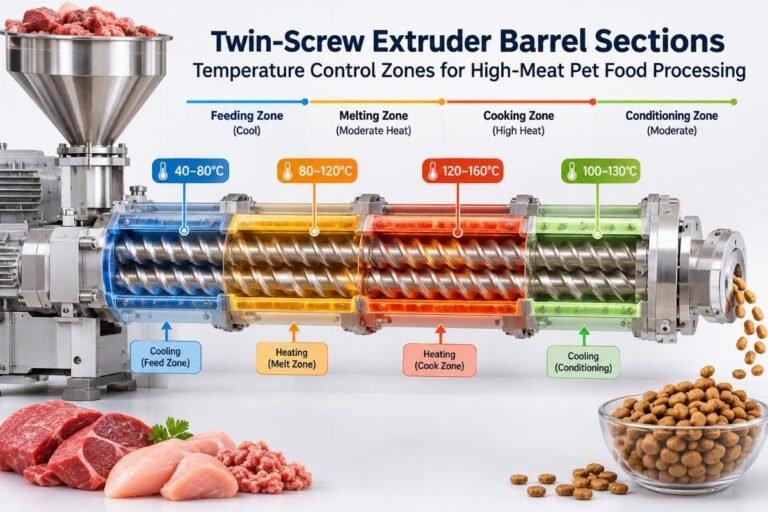
Conversely, a high-meat cat food startup failed to achieve proper gelatinization with a cheap single-screw setup. The shear force was simply insufficient to cook the high protein content. Switching to the DS85 provided the necessary pressure and residence time, transforming their crumbly waste into stable, nutritious kibble.

What Screw Configurations and Die Plates Suit Your Formula?
The screw arrangement and die hole sizing dictate the final product quality far more than the motor horsepower.
It is a common misconception that the extruder barrel does all the work. In reality, the internal geometry of the screws determines the shear, pressure, and residence time of the ingredients. For high-meat formulas, a standard agricultural screw configuration will fail to cook the proteins adequately, resulting in poor digestibility and unstable pellets.
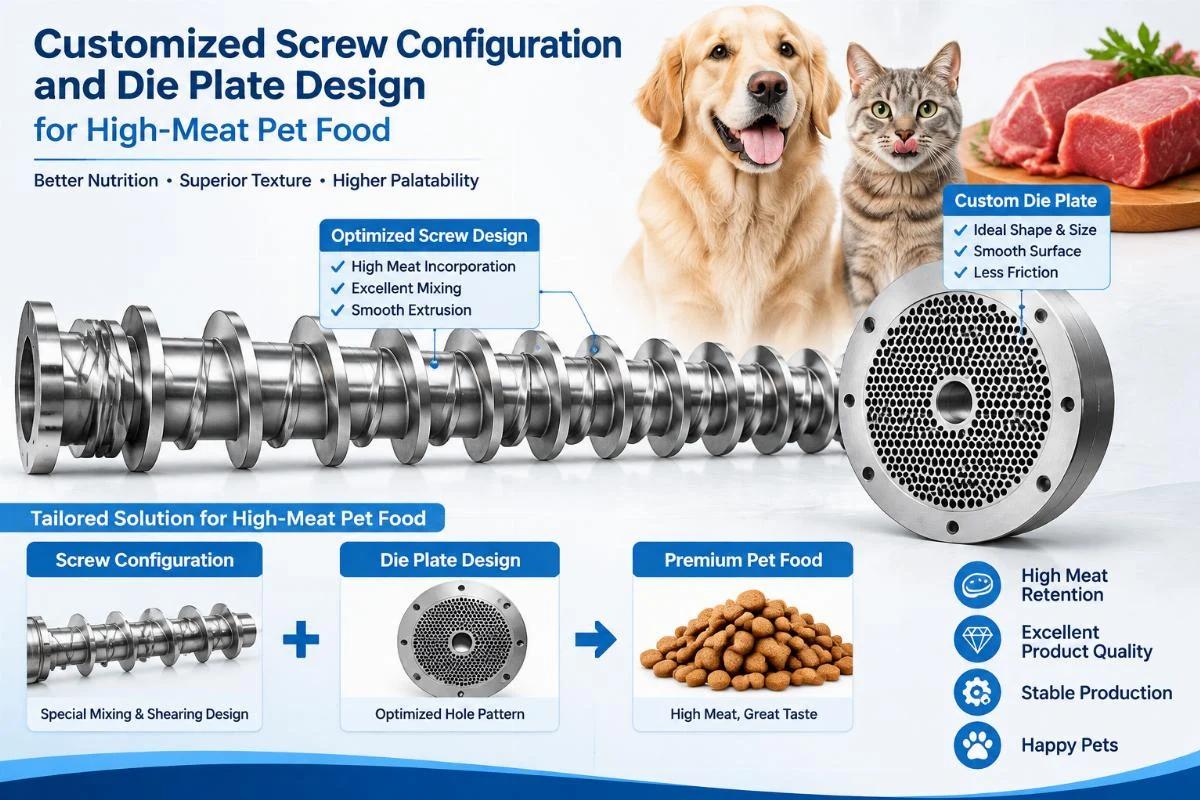
When designing a dog food production line setup, the screw elements must be customized to your specific recipe. If your formula includes high levels of fresh meat or fats, the compression zones need to be adjusted to maintain consistent pressure without causing the material to slip.
Furthermore, the die plate is not just a shape cutter; it influences the backpressure inside the barrel. If the die holes are too large, the material exits undercooked. If they are too small, the motor overloads, and the friction generates excessive heat, destroying vital nutrients.
A European startup approached us with a complex joint-health formula requiring precise kibble shapes and high meat inclusion. By customizing the screw arrangement and selecting the exact die plate geometry, we ensured that the gelatinization rate met international feed machinery standards. The pellets emerged with a uniform density, eliminating the fragile edges that usually cause dust during packaging.
How Does Meiteng Support Formula Development and Installation?
On-site training and R&D support guarantee smooth factory startup, turning raw ingredients into a market-ready product.
Equipment is only half the battle; the recipe is the other. Many new factory owners possess the capital for a Meiteng dog food extruder but lack the nutritional science background to formulate a stable, high-meat kibble. This is where turnkey support becomes indispensable.
Our approach involves deep collaboration during the formula development phase. We do not just hand over a manual; we work with your team to adjust the moisture content, protein ratios, and starch binders to ensure the dough behaves correctly inside the barrel. This R&D support prevents the trial-and-error phase that burns through expensive raw materials.
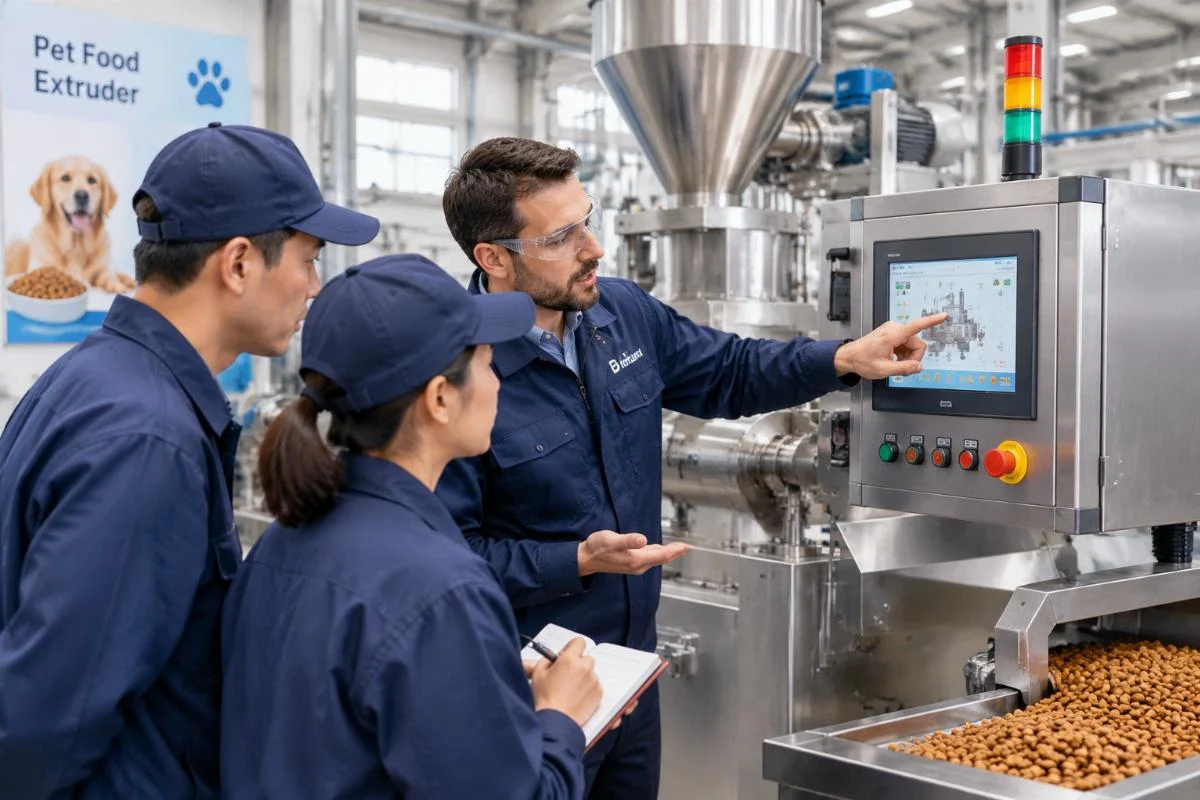
Once the equipment arrives, the installation and commissioning phase is critical. Our technicians guide your operators through the exact startup sequences, temperature profiling, and cutter speed adjustments. We have seen countless facilities where excellent machinery produced poor food simply because the operators did not understand how to balance the steam injection with the feed rate. Comprehensive on-site training bridges this gap, ensuring your team can independently manage the line and troubleshoot minor variations in raw material moisture.
Conclusion
Building a profitable pet food factory demands a holistic view of the entire extrusion ecosystem.
Choosing a Meiteng dog food extruder is about securing a partner who understands that screw configurations, die plate precision, and downstream drying integration are just as critical as the machine itself. By prioritizing turnkey line matching and leveraging dedicated formula R&D support, new factory owners can avoid the costly pitfalls of poor gelatinization and system bottlenecks, ensuring a stable, high-quality output from day one.
Machines Mentioned in This Article

cat food machine
Pet Dog Food Extruder Manufacturer Production Line
View Machine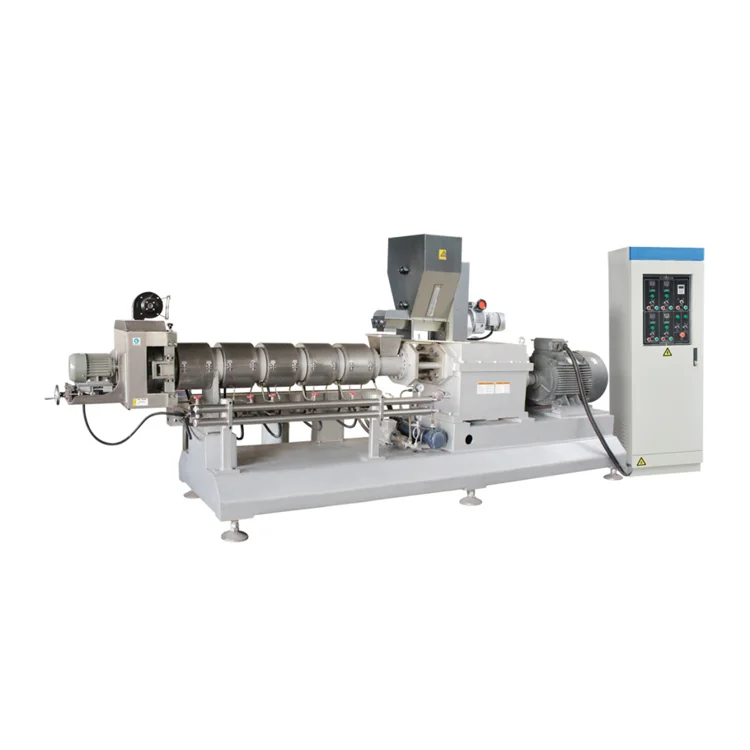
cat food machine
Pet Food Pellet Extruder Machine Manufacturer for Dog Cat
View Machine
cat food machine
Pet Food Extruder Machine Manufacturer Production Line
View Machine
cat food machine