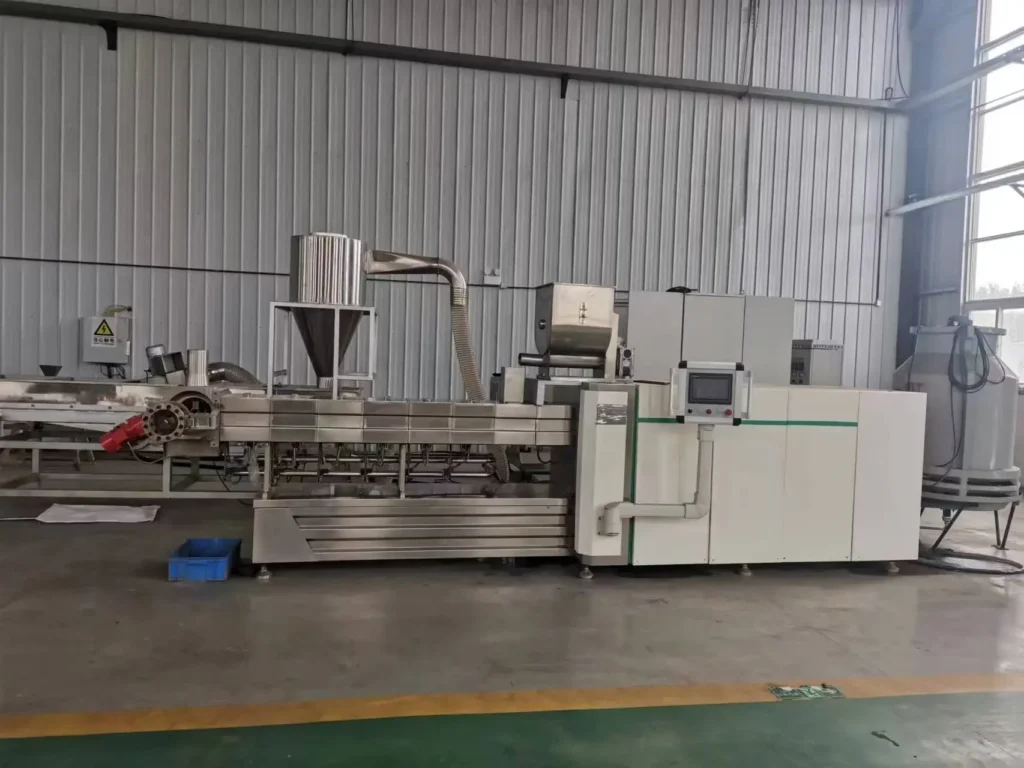

Buying only the extruder to save upfront capital is the most expensive mistake a pet food startup can make.
When evaluating whether to buy a standalone unit or a complete system, the core answer is clear: a standalone extruder saves initial capital but risks severe production halts due to mismatched downstream processes, whereas a full turnkey pet food extruder vs full production line setup ensures stable, continuous output for high-meat formulas.
I still remember the chaos at the Chicago trade show last year. A startup founder pitching a premium high-meat cat food had just purchased a cheap, small-model single-screw machine, ignoring material physics. During the live trial, the barrel jammed completely, the paste slipped, and the shear force failed to cook the high-protein mix. They eventually had to scrap the setup and switch to a DS70 twin-screw configuration. When meat content rises, even a slight deviation in shear force and temperature control will paralyze the entire operation. Selecting equipment requires matching the physical properties of the raw materials, not just staring at the initial price tag. Evaluating the pet food extruder vs full production line options reveals that downstream integration is where the real battle is won or lost.

Let us break down the technical and operational realities behind this decision.
What Are the Hidden Costs of Buying Just an Extruder?
Standalone units require costly manual integration for drying and coating, creating invisible financial drains that quickly erase initial savings.
When a startup opts for a bare extruder, they often underestimate the downstream bottlenecks. The extruder might push out perfectly shaped kibble, but without an integrated drying and cooling system, the moisture content remains dangerously high. I visited a mid-scale treat producer who bought a standalone machine to cut costs. They relied on a makeshift, standalone drying room. The result was uneven moisture distribution, leading to a massive mold rate during storage. The cost of reworking and discarding spoiled batches far exceeded the price of a proper integrated dryer.
Furthermore, flavor coating on a small batch trial basis using manual methods leads to severe inconsistency and raw material waste. Automated flavoring systems ensure every piece is evenly coated, which is critical for palatability. When you compare the pet food extruder vs full production line investments, the hidden costs of manual labor, energy-inefficient standalone dryers, and wasted coating oils make the standalone route financially toxic.
| Integration Factor | Standalone Extruder Setup | Full Turnkey Line |
|---|---|---|
| Drying Efficiency | Uncontrolled / High Waste | Controlled / Uniform Moisture |
| Coating Consistency | Manual / High Oil Waste | Automated / Precise Dosage |
| Energy Consumption | Noticeably Higher | Substantially Reduced |
| Labor Requirement | Heavy Manual Intervention | Minimal / Centralized Control |
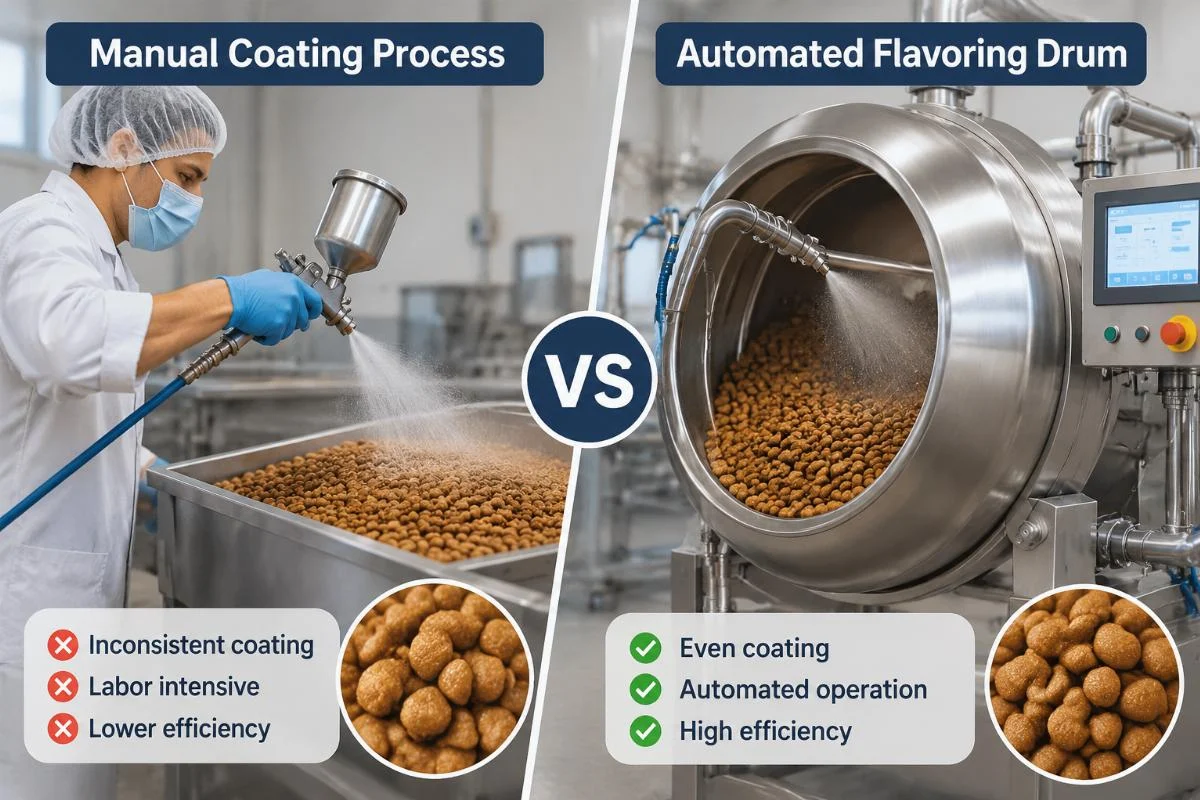
The illusion of a cheaper entry point vanishes the moment you calculate the operational waste.
How Does a Full Turnkey Line Prevent Production Halts?
Integrated systems ensure precise temperature and shear control for high-meat recipes, preventing the catastrophic barrel-jamming that plagues mismatched setups.
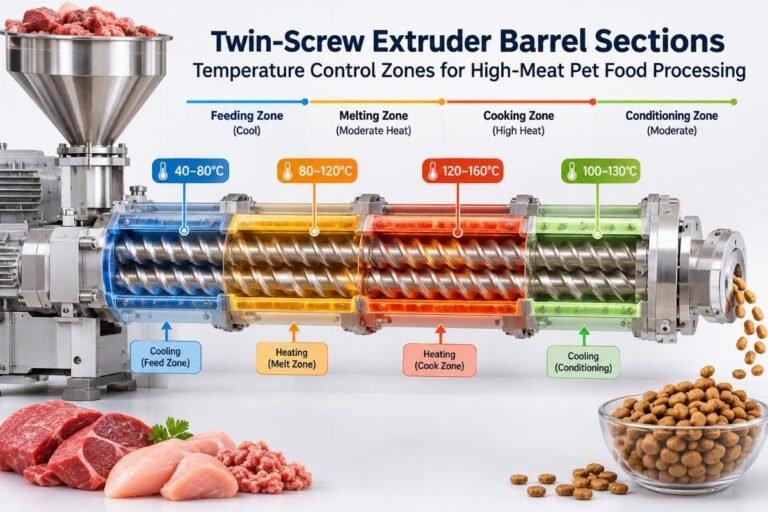
High-meat formulas demand intense mechanical energy and exact thermal management. A single-screw extruder simply cannot generate the necessary shear force without overheating the protein, causing it to burn and stick to the barrel. This is where the twin-screw design, specifically the DS70 configuration, becomes non-negotiable for premium startups. The co-rotating twin screws provide self-wiping action, ensuring that sticky, high-meat pastes are pushed forward uniformly rather than slipping and jamming.
A full turnkey line synchronizes the extruder with the pre-conditioner and the downstream dryer. If the extruder outputs product at a specific temperature and moisture level, the integrated dryer is pre-calibrated to match that exact thermodynamic profile. When you analyze the pet food extruder vs full production line dynamics, the turnkey approach eliminates the guesswork. The PLC controls communicate across the entire line, adjusting screw speed and feed rates in real-time to maintain the exact residence time required for gelatinization.

Production halts are rarely caused by the extruder alone; they are caused by the disconnect between the extruder and the rest of the line.
Which Setup Offers Better ROI for Pet Food Startups?
Full lines reduce long-term operational waste and energy consumption, delivering a vastly superior return on investment over the machine’s lifespan.
Startups often fixate on the capacity number, assuming a higher output equals better ROI. This is a dangerous fallacy. A massive standalone extruder paired with an undersized dryer creates a bottleneck where the extruder must constantly stop and start, waiting for the dryer to catch up. This cycling destroys the thermal stability of the barrel, ruins the product structure, and spikes energy bills.
A properly balanced turnkey line operates in a continuous, steady state. The raw material intake, extrusion, drying, cooling, and coating all flow at a matched velocity. The food-grade stainless steel construction and automated controls minimize downtime for cleaning and maintenance. When evaluating the pet food extruder vs full production line financials, the turnkey line pays for itself by eliminating the mid-six-figure losses associated with spoiled batches, excessive energy draw, and manual labor inefficiencies.
| ROI Impact Area | Standalone Extruder Approach | Full Turnkey Line Approach |
|---|---|---|
| Batch Spoilage Risk | Vulnerable / High | Robust / Minimal |
| Energy Efficiency | Uncontrolled / Spikes | Standard / Optimized |
| Equipment Lifespan | Noticeably Reduced | Substantially Extended |
| Scalability | Rigid / Bottlenecked | Flexible / Seamless |

True ROI is measured in consistent, sellable output, not just theoretical maximum throughput.
How to Choose the Right Extruder Configuration?
Match twin-screw versus single-screw to specific meat content and formula characteristics to avoid mechanical failure.
The choice of configuration must be dictated by the recipe, not the budget. For basic, low-meat, high-starch formulas, a single-screw extruder might suffice. However, the modern pet food market is dominated by high-protein, grain-free, and raw-coated formulations. These require the intense mixing and precise temperature profiling that only a twin-screw system can provide.
Meiteng provides comprehensive formula development support to ensure your recipe is actually extrudable before you commit to a machine. We analyze the hydration rates, fat content, and protein structures to recommend the exact screw configuration and barrel profile. Whether you need the DS65 for moderate outputs or the DS70 for demanding high-meat recipes, the goal is to align the mechanical action with the material science. When comparing the pet food extruder vs full production line options, remember that the extruder is just the heart; the turnkey line is the entire circulatory system.

Never let a supplier sell you a machine that cannot handle your specific recipe’s physical limits.
Conclusion
The pet food extruder vs full production line decision ultimately defines your startup’s operational survival. Choosing a standalone unit invites hidden costs, moisture-related spoilage, and catastrophic jamming when processing high-meat formulas. A full turnkey line guarantees thermodynamic synchronization, precise shear control, and long-term energy efficiency. Match your equipment to your formula’s physical reality, and let integrated engineering protect your bottom line.
Machines Mentioned in This Article

cat food machine
Pet Food Processing Equipment Plant Manufacturer Dog Food
View Machine
cat food machine
Dry Dog Food Production Line Pet Food Pellet Machine
View Machine
cat food machine
Pet Food Production Line Manufacturer
View Machine
cat food machine