
Higher barrel temperatures do not guarantee better puffing; mismatched shear forces will simply cause melt fracture and ruin your batch.
Achieving the ideal cat food extrusion expansion ratio requires a precise balance between recipe starch-to-protein ratios and exact twin-screw temperature and shear force controls, ensuring optimal starch gelatinization without compromising nutritional integrity.
Years ago, while commissioning a pet food line in Riyadh, I faced a nightmare scenario right after startup. The cat food extrusion expansion ratio was practically zero, and the pellets were sinking like stones in water. The client was furious, literally slapping the machine cabinet. I squatted by the discharge port, grabbed a handful of the extrudate, and smelled the faint burnt odor. My background in quality control, where I obsessed over starch gelatinization degrees, kicked in immediately. I knew the barrel temperature profile and the screw shear elements were completely out of sync with the material’s rheology. I ordered the operators to halt the feed, adjusted the front-zone temperatures by a noticeable margin, and swapped out the shear elements for a more restrictive configuration. When we restarted, the expansion was perfectly uniform. Mastering this process means understanding how the ingredients behave inside the腔体, not just reading a parameter sheet.
Let us break down the exact methodology to control these variables and eliminate sinking pellet issues.
How Does Recipe Formulation Dictate Expansion Ratio?
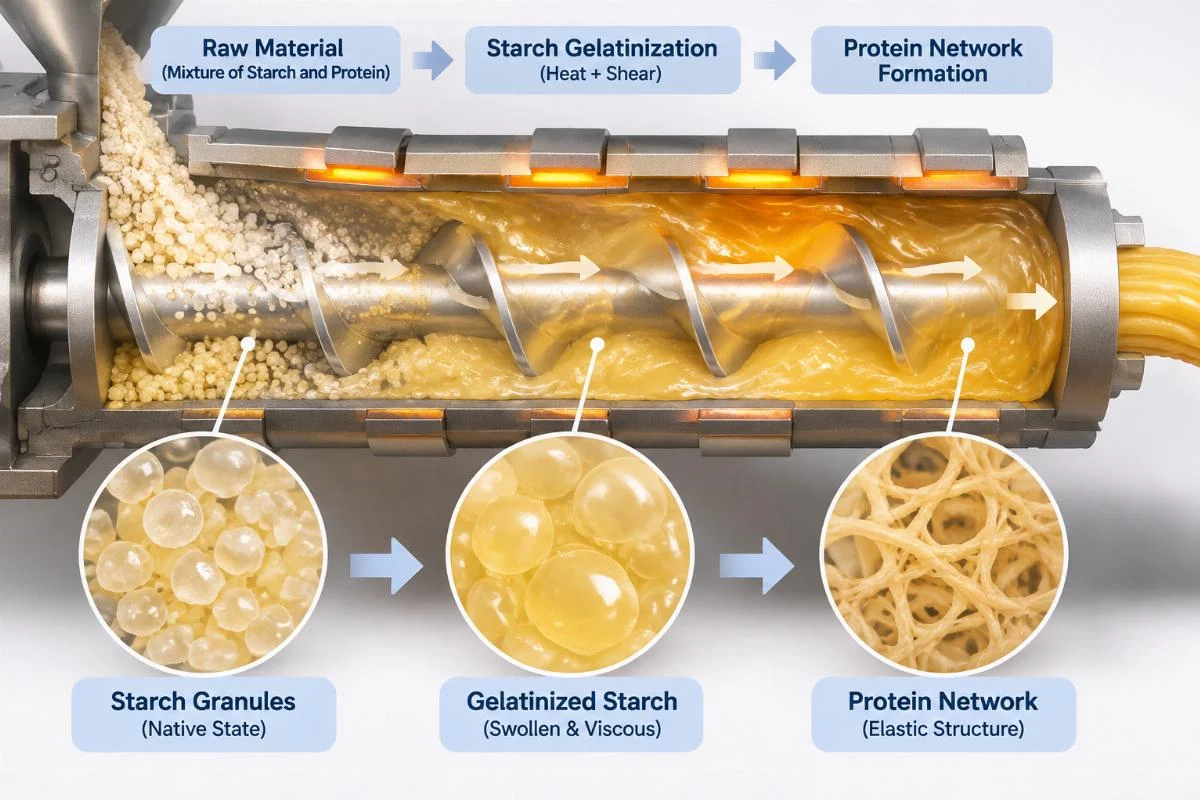
Starch acts as the primary expanding matrix, while protein inherently limits and restricts that expansion.
To control the cat food extrusion expansion ratio, you must first understand the biochemical battle inside the barrel. Starch granules, when subjected to heat, moisture, and mechanical shear, undergo gelatinization. Upon exiting the die and hitting the ambient atmosphere, the superheated water flashes into steam, expanding the gelatinized starch matrix. Protein, however, does not expand. It forms a rigid network that traps the steam. If your formula has a massive meat inclusion, the protein network becomes too dense, choking the expansion.
Here is the step-by-step formulation adjustment process:
- Assess the Starch Baseline: Ensure your recipe contains sufficient gelatinizable carbohydrates. Without a minimum threshold of starch, the cat food extrusion expansion ratio will collapse, regardless of machine settings.
- Calculate Protein Interference: When introducing high-meat slurries or meat meals, anticipate a severe drop in expansion. You must compensate by increasing the specific mechanical energy (SME) input to break down the protein structures adequately.
- Balance Moisture Content: Inconsistent bulk density often traces back to feed moisture variance. Calibrate your preconditioner to maintain strict moisture control. Even a minor fluctuation can cause the melt to either fracture or fail to expand upon die exit.
- Map the Die Hole Scaling: Adjust die diameter scaling to match the rheological resistance of your specific recipe. A thicker dough requires larger die openings to prevent excessive backpressure and motor overload.
What Process Factors Control Twin-Screw Extrusion?
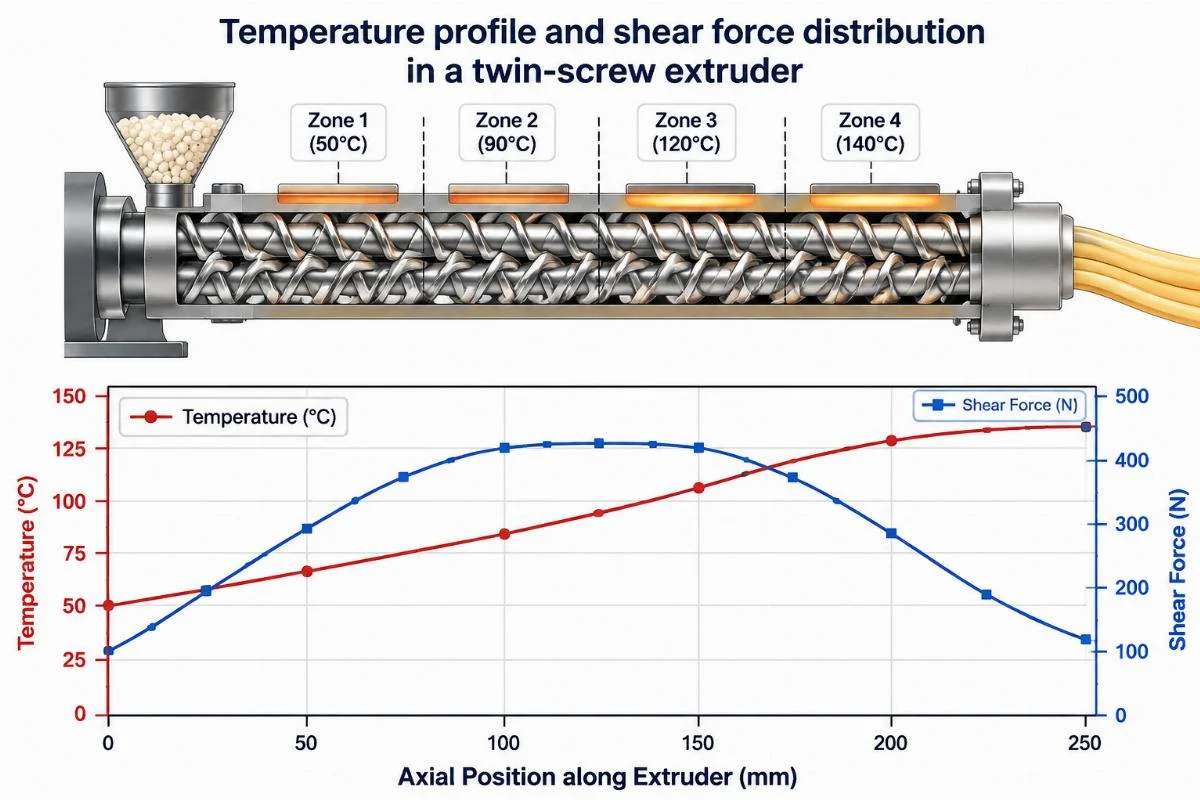
Temperature zones and shear force are the absolute core drivers of the final pellet structure.
Many operators mistakenly believe that cranking up the heat is the universal fix for poor expansion. This is a counter-intuitive trap. If the shear force mismatches the thermal profile, you will get melt fracture, resulting in rough, misshapen, or collapsed pellets.
Follow this sequence to dial in your twin-screw extruder expansion control:
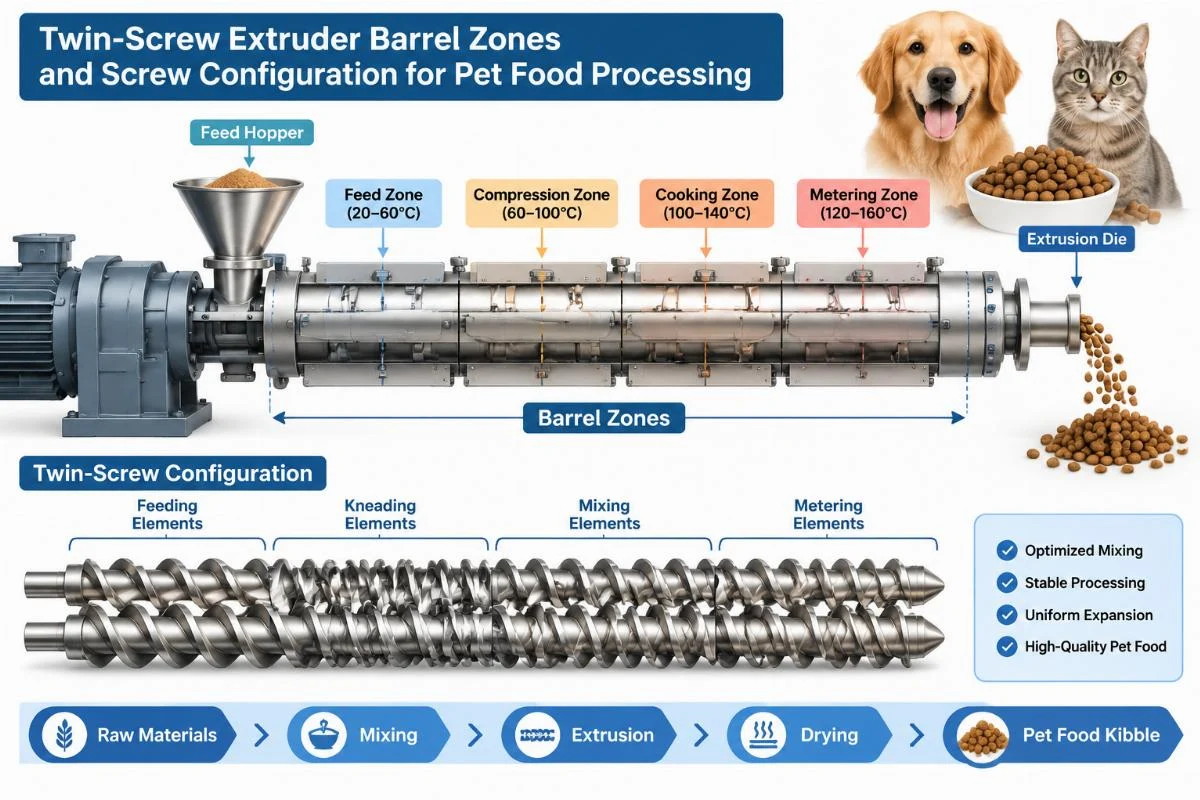
- Profile the Temperature Zones: Do not use a flat temperature profile. The feeding zone must remain cool to prevent premature bridging. The compression and metering zones require escalating heat to achieve full gelatinization. The die zone must be carefully balanced—too hot, and the melt lacks viscosity to hold gas; too cold, and it blocks the die.
- Calculate Shear Force via Screw Speed: Shear force is generated by the differential speed of the co-rotating screws and the restrictive elements. Higher screw speeds increase the SME, generating frictional heat and breaking down fibrous proteins.
- Monitor the Melt Pressure: Use the pressure sensor at the die face as your primary feedback loop. A stable melt pressure indicates a homogeneous melt viscosity, which is mandatory for a consistent cat food extrusion expansion ratio.
- Execute SME Calculation: Continuously calculate the specific mechanical energy to ensure you are delivering the exact mechanical work required for your specific recipe’s viscosity.
How to Troubleshoot Hard or Sinking Pellets?
Mismatched shear and temperature cause poor gelatinization, leading directly to hard, dense, and sinking pellets.
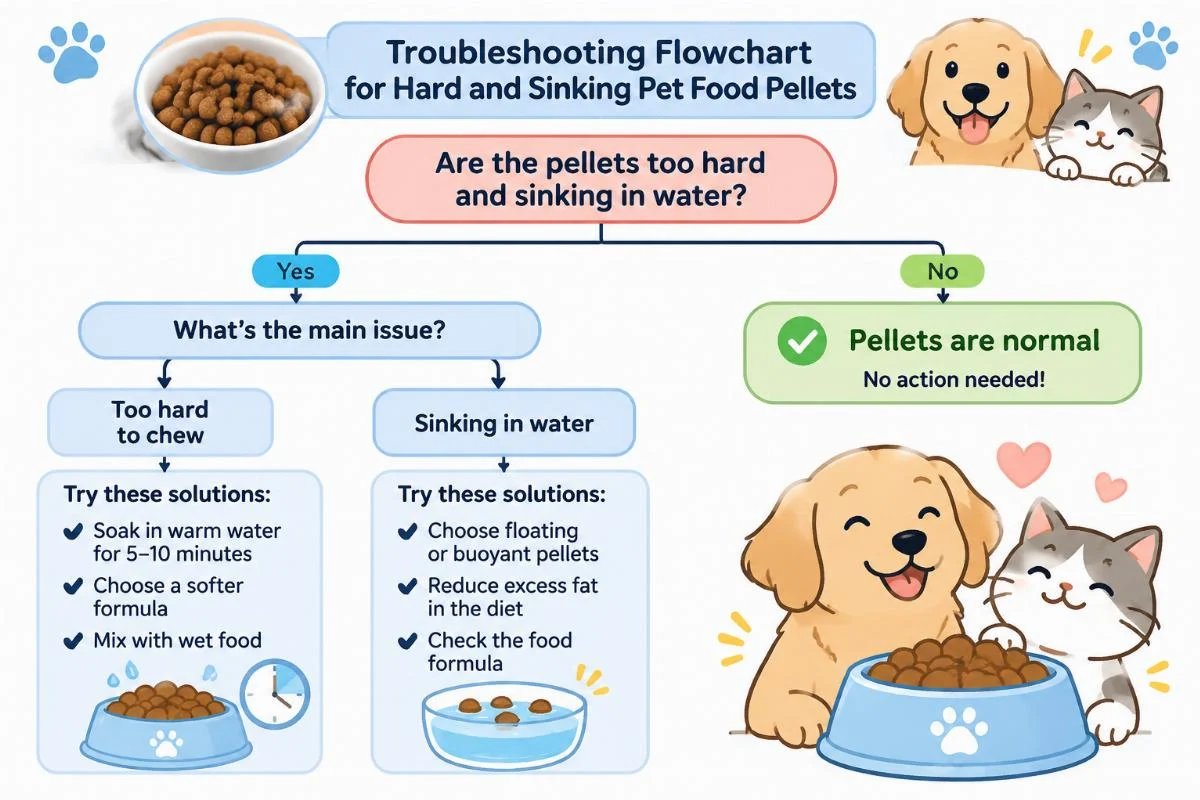
When pellets sink, it means the internal cell structure failed to form or collapsed immediately after exiting the die. The density is too high, and the moisture flash-off was insufficient. Troubleshooting these cat food pellet sinking hard issues requires a systematic teardown of the process parameters.
Step-by-step troubleshooting protocol:
- Inspect the Front-Zone Temperatures: If the material is not plasticizing early enough, it will not form a continuous melt. Increase the front-zone temperatures incrementally to ensure early starch breakdown.
- Evaluate the Shear Elements: If the melt is plasticized but still dense, the shear force is too low to generate the necessary frictional heat and protein breakdown. Replace neutral conveying elements with reverse or narrow-pitch kneading blocks to intensify the shear.
- Check the Die Land Length: A die with an excessively long land length will cause too much pressure drop and cooling, killing the expansion right at the exit point. Shorten the die land to allow immediate flash-off.
- Implement Turnkey Line Adjustments: Resolving these issues on a single machine is only half the battle. The entire downstream drying and cooling sequence must be calibrated to lock in the expanded structure. This is where comprehensive turnkey line design becomes critical. At Meiteng, our on-site commissioning and formula development support specifically target these rheological mismatches. We do not just ship the hardware; our engineers map the screw configuration and thermal profiles to your exact recipe, ensuring the cat food extrusion expansion ratio remains stable from the first batch to the thousandth.
Why Screw Configuration Matters for High-Meat Recipes?
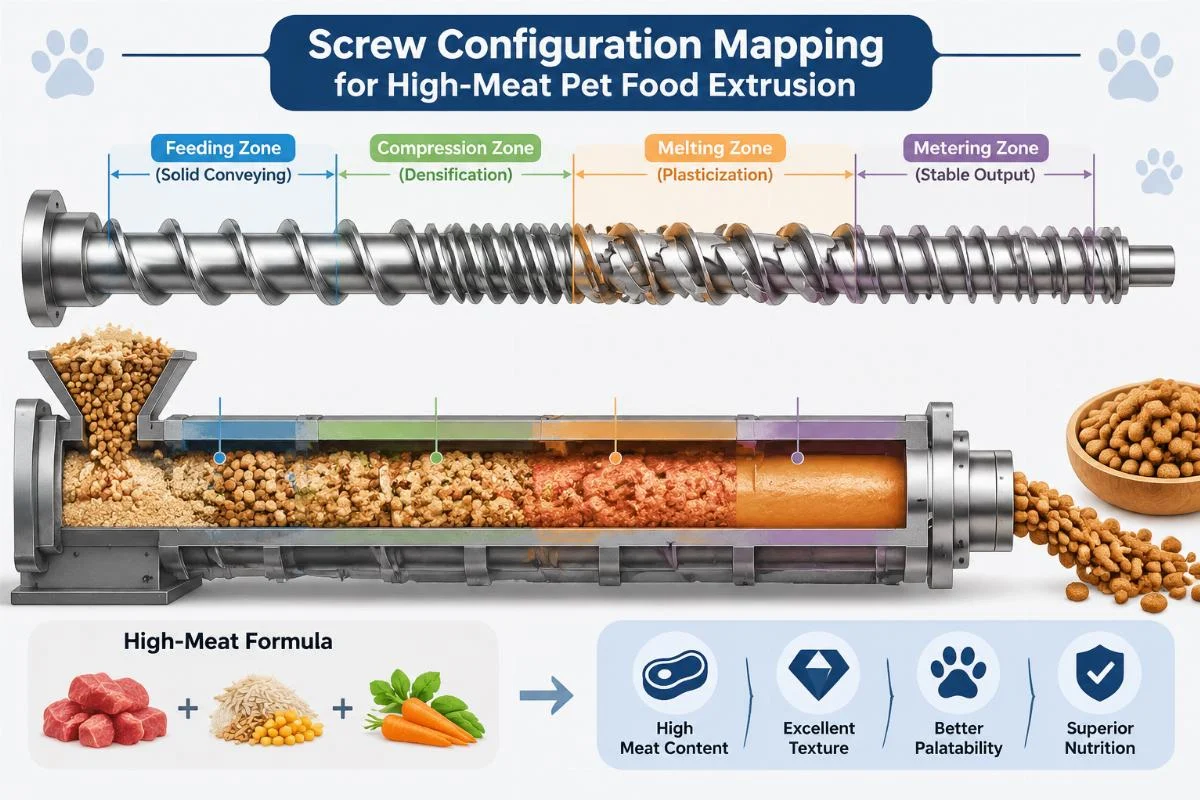
Customized shear elements are mandatory to handle the extreme viscosity of high-protein formulas without sacrificing expansion.
Another massive misconception in the industry is that high protein guarantees poor expansion. This is false. With the correct screw configuration mapping, you can achieve magnificent high-meat puffing. The secret lies in how you distribute the mechanical energy along the shaft.
Procedure for high-meat screw configuration:
- Increase the L/D Ratio: High-meat recipes require more residence time to fully denature the complex protein matrices. Extending the length-to-diameter ratio of the barrel provides the necessary time for thermal and mechanical breakdown.
- Strategic Kneading Block Placement: Do not cluster all kneading blocks at the end. Distribute them to create multiple zones of high shear, interspersed with conveying elements to allow for pressure buildup and material mixing.
- Manage the Fill Degree: High-protein doughs are viscous and resist flow. You must adjust the feed rate and screw speed to maintain an optimal fill degree in the kneading zones, preventing motor stalling while ensuring intense mixing.
- Validate with Gelatinization Testing: Never guess. Perform starch gelatinization degree testing on the final extrudate to verify that the mechanical energy successfully disrupted the starch and protein structures.
Conclusion
Mastering the cat food extrusion expansion ratio is an exercise in balancing biochemical limitations with precise mechanical energy. By rigorously controlling the starch-protein matrix, dialing in the thermal and shear profiles, and customizing the screw configuration for high-meat formulas, manufacturers can consistently produce light, uniform, and floating pellets. True process mastery requires looking beyond the basic parameter sheet and understanding the rheological behavior of the ingredients inside the barrel.