Choosing a pet food extruder is never about picking the highest capacity; it is about matching screw configurations to your specific meat content and moisture formulas to avoid torque alarms and hard-core products.
When evaluating a pet food extruder manufacturer, the most critical question to ask is not about maximum throughput, but whether their screw element arrangement can handle your exact recipe friction without triggering torque limits. You must verify the screw combination layout, specific torque limits, and actual throughput rates per die size to ensure the machine matches your high-meat formulas, rather than just accepting a generic capacity chart.
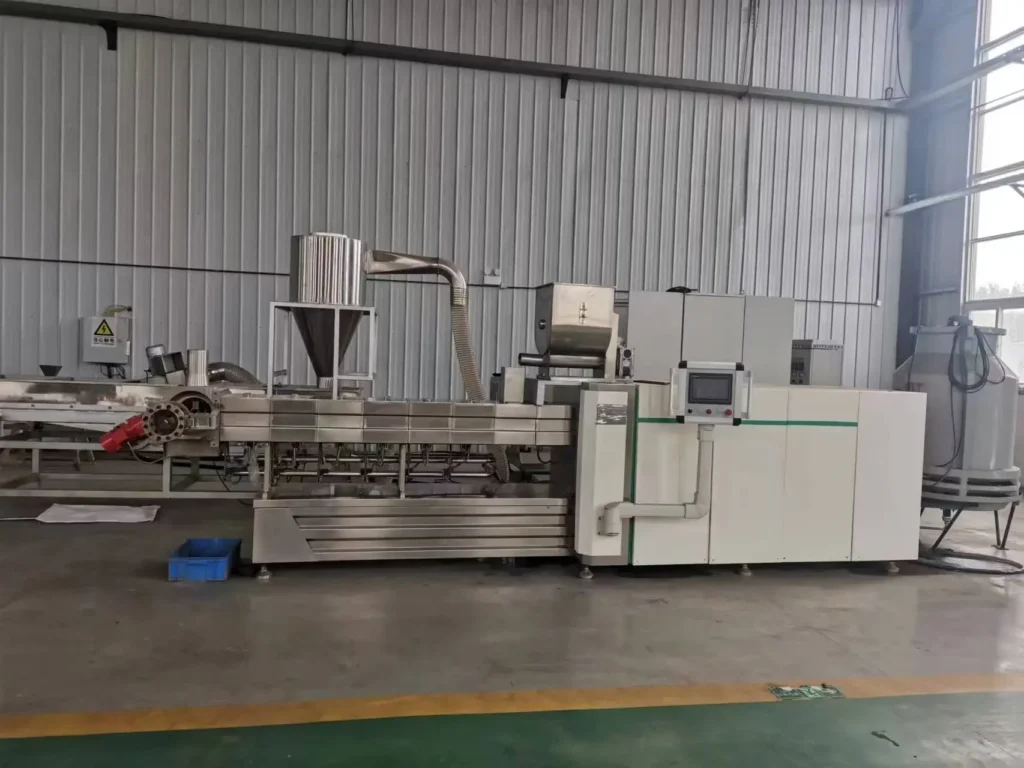
Before moving into sales, I spent years on installation sites. I remember a specific night in Dongguan debugging a DS70 twin-screw extruder. The client insisted on using a smaller model to force a high-meat content formula. The result was immediate torque alarms, and the extruded dog food came out with hard cores. We had to redesign the screw combination overnight to save the production line. That现场 experience cemented a strict rule for me: ignore capacity promises. Whether the meat content is high or moisture levels are tricky, we rely on the parameter sheets of the DS70 and DS95 models. Buying a production line is not about buying a piece of iron; the formula and the machine must fit seamlessly.

Transitioning from the factory floor to evaluating suppliers means looking past the brochures and focusing on the mechanical realities of extrusion.
Why Do Capacity Charts Fail for High-Meat Formulas?
Capacity charts often fail for high-meat formulas because actual output depends on recipe friction and shear heat generation, not just motor size.
Most buyers assume that a bigger motor guarantees better performance. The true reason is that optimized screw element arrangement matters significantly more for specific recipes. Conversely, many believe higher capacity is always better. However, oversized barrels reduce shear heat, which ruins the texture of high-meat formulas by failing to properly gelatinize the starches around the meat proteins.
When you consult a pet food extruder manufacturer, you must understand that a machine rated for a certain output on a basic corn-based diet will perform drastically differently on a fresh meat diet. The friction coefficient changes entirely. If the barrel is too large for the specific recipe, the material slips, shear heat drops, and the product exits the die undercooked or with a dense, hard core.
| Evaluation Factor | Standard Capacity Chart Claim | Reality for High-Meat Formulas |
|---|---|---|
| Motor Sizing | Bigger motor equals higher output | Optimized screw arrangement dictates actual torque management |
| Barrel Volume | Larger barrel increases capacity | Oversized barrels reduce shear heat, ruining high-meat texture |
| Throughput Rating | Based on low-friction dry ingredients | Drops noticeably with high-moisture, high-friction meat pastes |
A European contract manufacturer once ordered a massive twin screw extruder for high meat content based purely on a standard capacity chart. The actual output dropped noticeably because the barrel volume was too large to generate the necessary shear heat for their specific fresh chicken formula. They had to consult a pet food extruder manufacturer to downsize the barrel configuration and adjust the L/D ratio to restore the thermal profile required for proper expansion.

What Screw Configuration Questions Prevent Torque Alarms?
To prevent torque alarms, you must ask the supplier exactly how their kneading and conveying elements are distributed to handle your specific meat percentages.
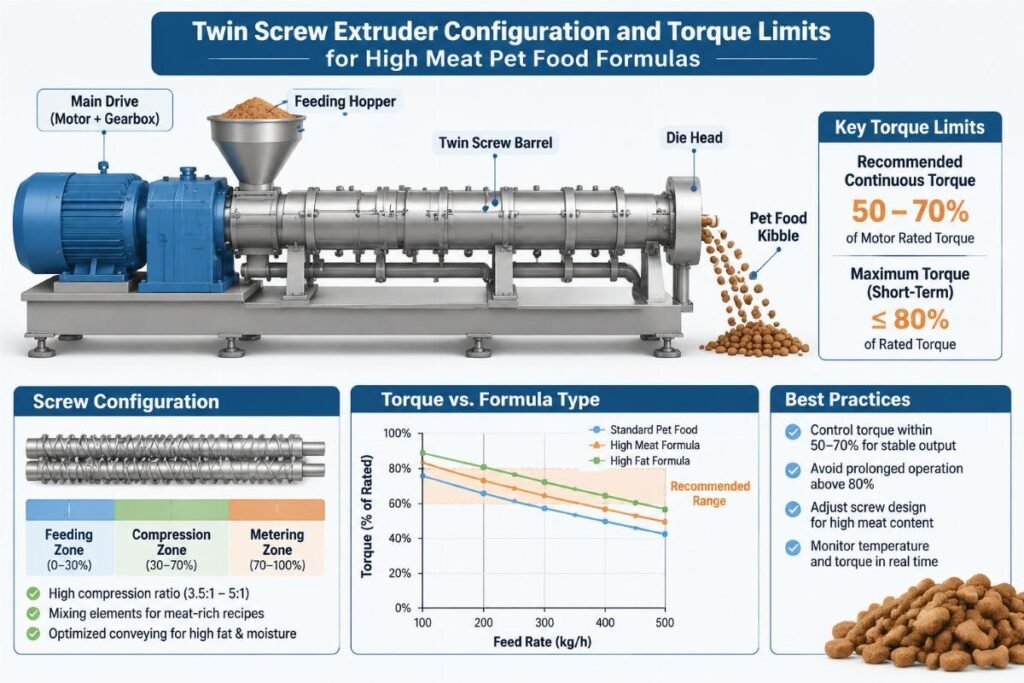
Torque alarms are the primary indicator of a mismatch between the recipe and the screw profile. When processing a twin screw extruder for high meat content, the material creates immense resistance. If the conveying elements are too aggressive or the kneading blocks are misaligned, the motor hits its pet food extruder torque limits instantly.
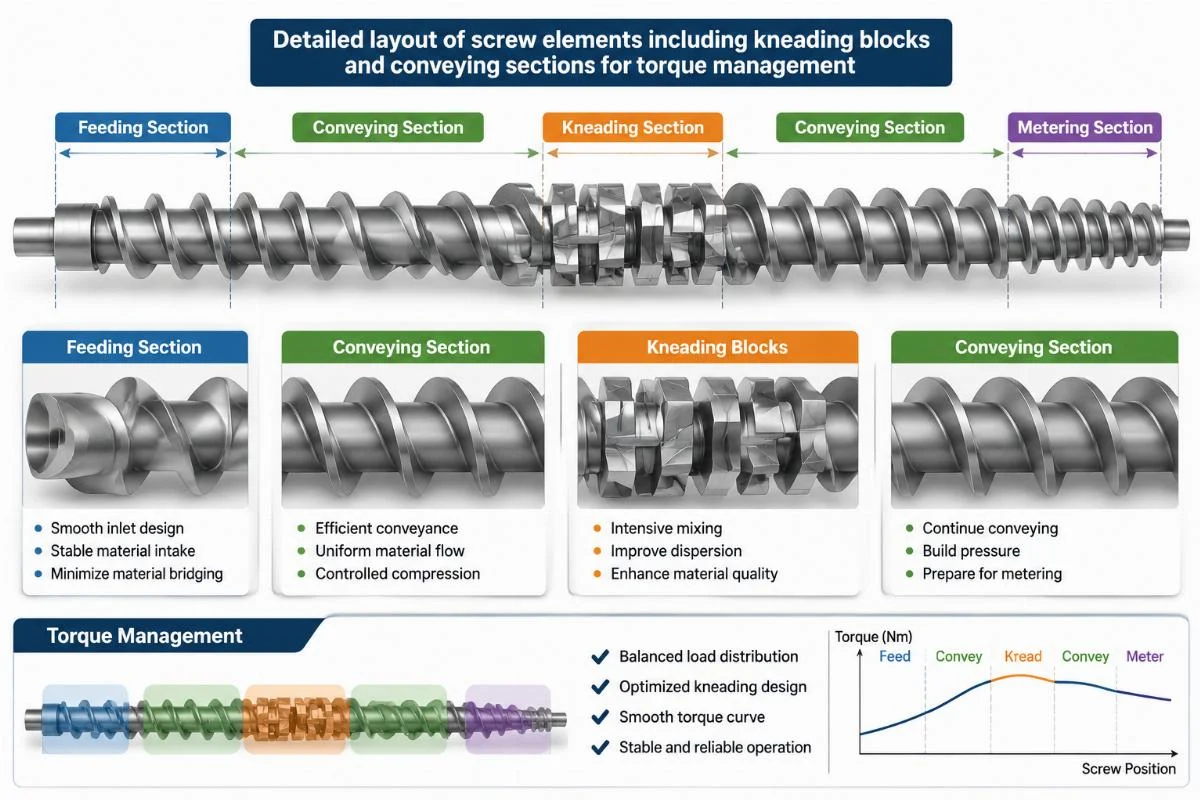
You need to ask the pet food extruder manufacturer for the specific screw configuration layout. Where are the kneading discs placed? What is the stagger angle? These details determine how the meat paste is mixed and pressurized before it reaches the die. A well-designed profile builds pressure gradually, keeping the motor load within safe operational boundaries while ensuring the meat is thoroughly emulsified with the carbohydrates.
Consider a startup in Southeast Asia that kept experiencing torque alarms on their line. They assumed the motor was underpowered. However, the real issue was that the screw profile lacked sufficient conveying elements in the melting zone, causing a material bottleneck that spiked the torque. By adjusting the screw combination to match their high-meat formula, the alarms disappeared, and the motor load stabilized.
- Kneading Block Placement: Must be positioned to generate adequate shear without overwhelming the motor.
- Conveying Element Pitch: Must match the feed rate of the high-meat pre-mix to prevent flooding.
- Torque Limit Monitoring: The control system must allow real-time adjustments to feed rate based on torque feedback.
How to Verify Real Throughput and Moisture Control?
You must demand actual output data tested with your specific die hole diameters and moisture levels, rather than accepting theoretical maximums.
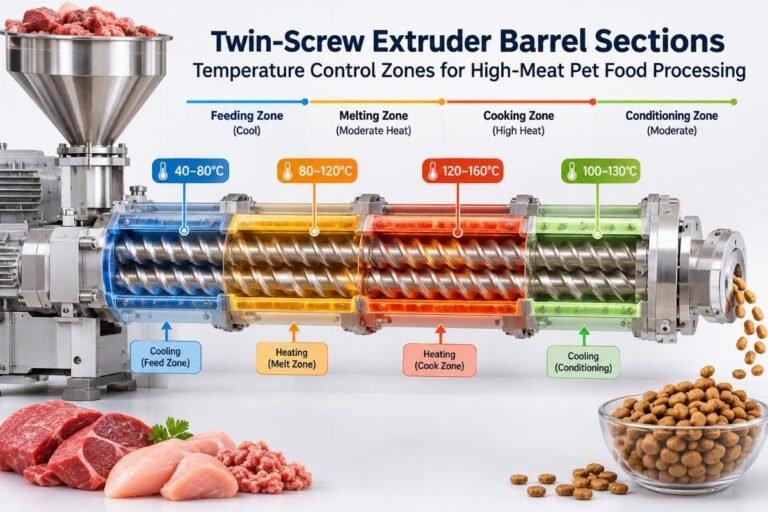
Moisture content drastically impacts the extrusion process. High moisture can cause unstable extrusion, leading to surging and inconsistent pellet density. When evaluating a pet food extruder manufacturer, you must verify how their machine handles barrel temperature zoning and L/D ratio adjustments to manage this moisture.
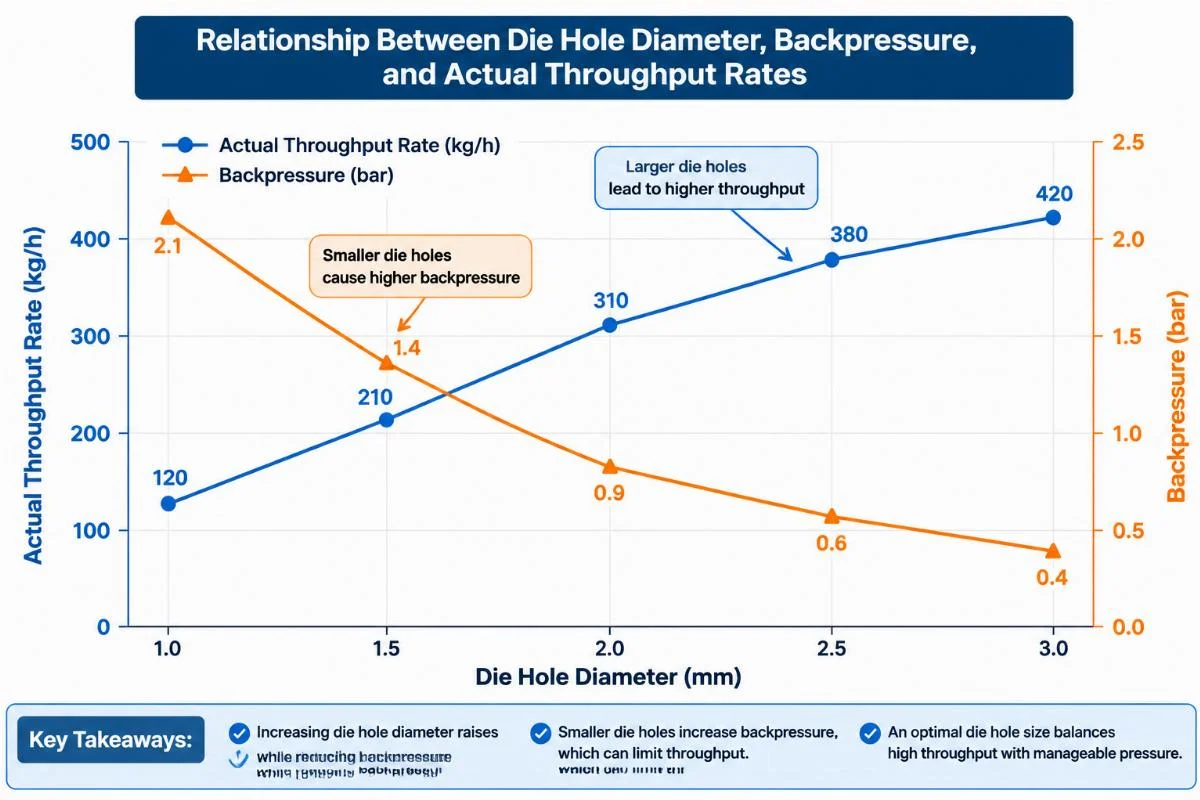
Theoretical capacity charts rarely account for the specific die hole diameters you intend to use. A small die diameter creates massive backpressure, which reduces throughput but increases shear heat. A large die diameter does the opposite. Therefore, the only way to know the real capacity is to test the machine with your exact die specifications.
A Middle East pet food producer struggled with unstable extrusion due to high moisture in their meat emulsion. The machine would surge, and the kibble would expand unevenly. By working with the pet food extruder manufacturer to adjust the barrel temperature zoning and modify the L/D ratio, they stabilized the process. The machine successfully managed the moisture, ensuring a consistent expansion rate and a uniform final product.
| Moisture Impact | Symptom in Extrusion | Required Machine Adjustment |
|---|---|---|
| High Moisture | Unstable extrusion, surging, uneven density | Barrel temperature zoning and L/D ratio adjustments |
| Low Moisture | High friction, excessive wear, hard core | Increased water injection, modified screw compression |
| Variable Moisture | Inconsistent pellet size, poor coating adhesion | Advanced moisture sensors and automated feed control |
Always ask for throughput rates per die size. If a pet food extruder manufacturer cannot provide data for your specific kibble size, they are guessing.
Which Manufacturer Qualities Guarantee Formula-Machine Fit?
You must look for on-site formula testing and custom screw design support to guarantee the machine perfectly matches your recipe.
The gap between a theoretical machine specification and a running production line is bridged only by rigorous testing and engineering support. A true pet food extruder manufacturer does not just sell a standard box; they provide turnkey line design, formula development support, and on-site commissioning.
This is where the DS70 and DS95 models prove their value. These machines are not just scaled-up versions of smaller units; they are engineered with specific torque limits and barrel configurations designed to handle the rigorous demands of modern pet food recipes. When you partner with a manufacturer like Meiteng, the process involves testing your exact formula on the equipment before purchase. This ensures that the screw combination, barrel length, and motor sizing are perfectly aligned with your meat content and moisture levels.
A North American startup launching a new high-protein, grain-free line faced severe expansion issues with their initial equipment. The kibble was too dense, and the throughput was a fraction of what was promised. By engaging a pet food extruder manufacturer that offered comprehensive formula development support, they completely redesigned the screw profile and adjusted the drying system integration. The result was a perfectly expanded, uniform kibble that met all nutritional and physical specifications.
- On-Site Formula Testing: Running your exact recipe to verify throughput and product quality.
- Custom Screw Design: Tailoring the screw elements to your specific meat and moisture parameters.
- Turnkey Line Integration: Ensuring the extruder works seamlessly with dryers, coaters, and coolers.
Choosing the right partner means ensuring that the DS70 or DS95 model is configured specifically for your business, eliminating the guesswork and ensuring a smooth, profitable production launch.
Conclusion
Matching screw configurations to your specific meat content and moisture formulas is the only way to avoid torque alarms and hard-core products. Do not rely on generic capacity charts; demand actual throughput data based on your specific die sizes and recipe friction. By focusing on custom screw design and on-site formula testing, you ensure the extruder perfectly aligns with your production goals.
Machines Mentioned in This Article

cat food machine
Pet Dog Food Extruder Manufacturer Production Line
View Machine
cat food machine
Pet Food Pellet Extruder Machine Manufacturer for Dog Cat
View Machine
cat food machine
Pet Food Extruder Machine Manufacturer Production Line
View Machine
cat food machine