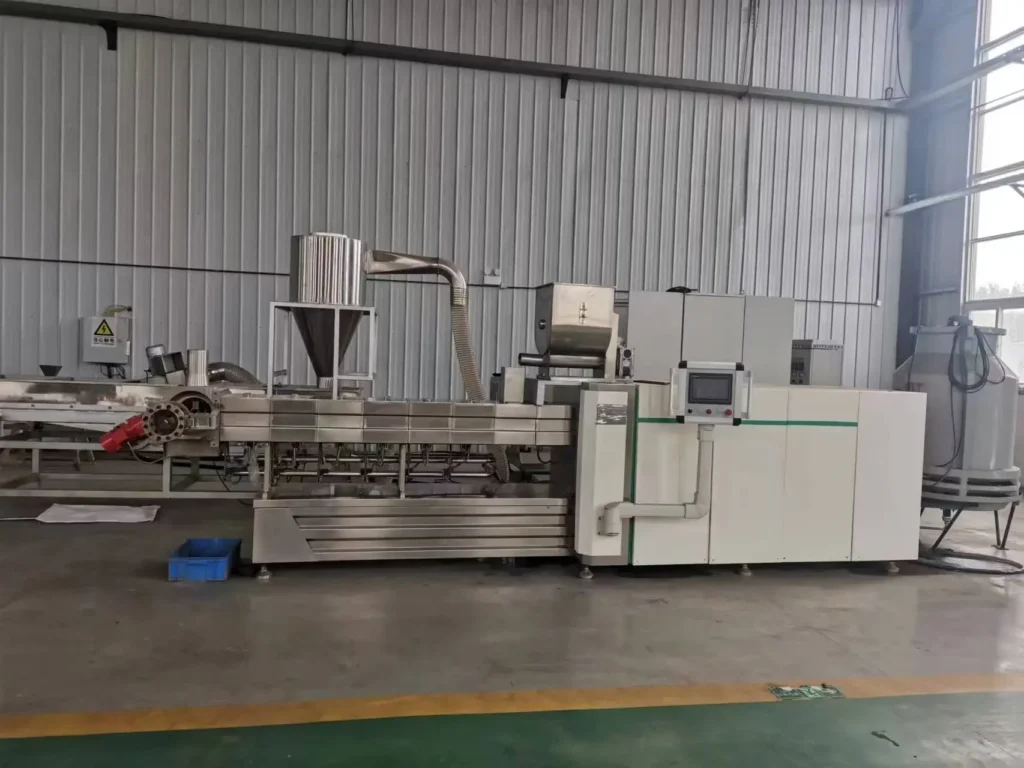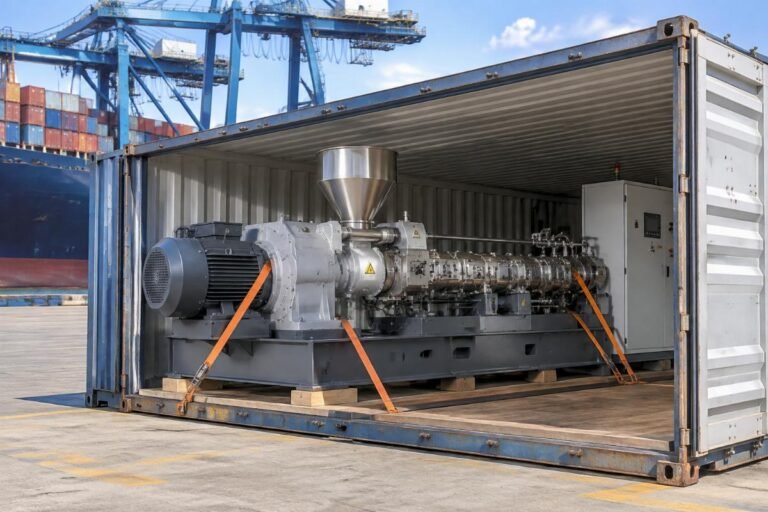
Most buyers assume a single high-cube container easily accommodates an entire small-capacity extrusion setup, but multi-layer drying sections routinely violate internal height limits.
A standard 1 ton per hour kibble line container calculation typically dictates one 40HQ for the extrusion and packaging sections, plus either one 20GP or an additional 40HQ for the drying and cooling segments, depending entirely on whether the multi-layer dryer is disassembled for optimal loading.
When I first transitioned from after-sales service at a machinery plant in Suzhou to handling international sales for extrusion equipment, I relied on standard dimensional assumptions. I quoted a buyer in Africa a single 40HQ for a complete 1t/h pet food line. The FOB price looked competitive, and the paperwork seemed straightforward. However, when the cargo arrived at the port in Taicang, the reality on the ground shattered my assumptions. The multi-layer dryer and the cooling bin, when fully assembled, exceeded the internal height clearance of the high-cube container. We had to hastily redesign the packaging into custom wooden crates, delaying the shipment by weeks and forcing us to absorb heavy less-than-container-load fees for the overflow. That costly mistake taught me that a precise 1 ton per hour kibble line container calculation requires breaking the line down into modular sections rather than treating it as a single monolithic block.
Understanding this spatial mismatch is the first step toward avoiding logistical nightmares and hidden freight costs.
Why Doesn’t 1x40HQ Fit a 1t/h Kibble Line?
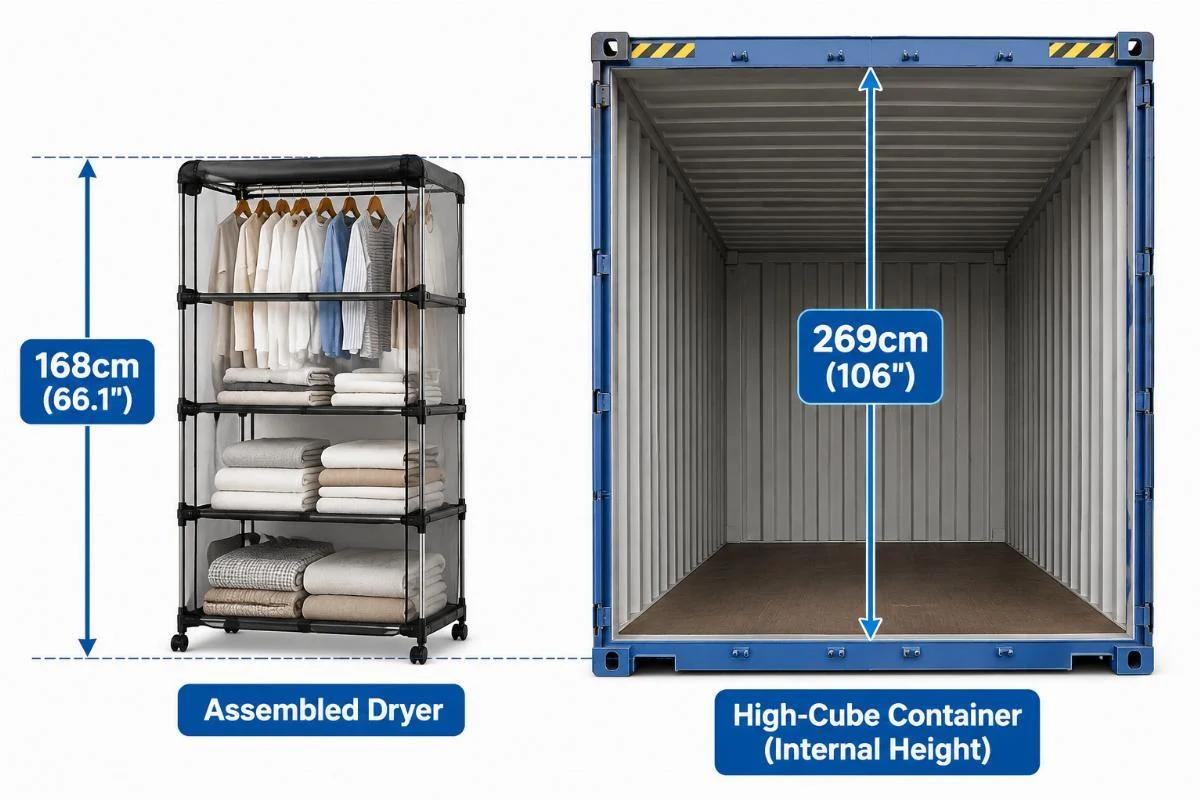
The core issue lies in the vertical footprint of the drying and cooling equipment, which often surpasses the maximum internal door height of standard high-cube units.
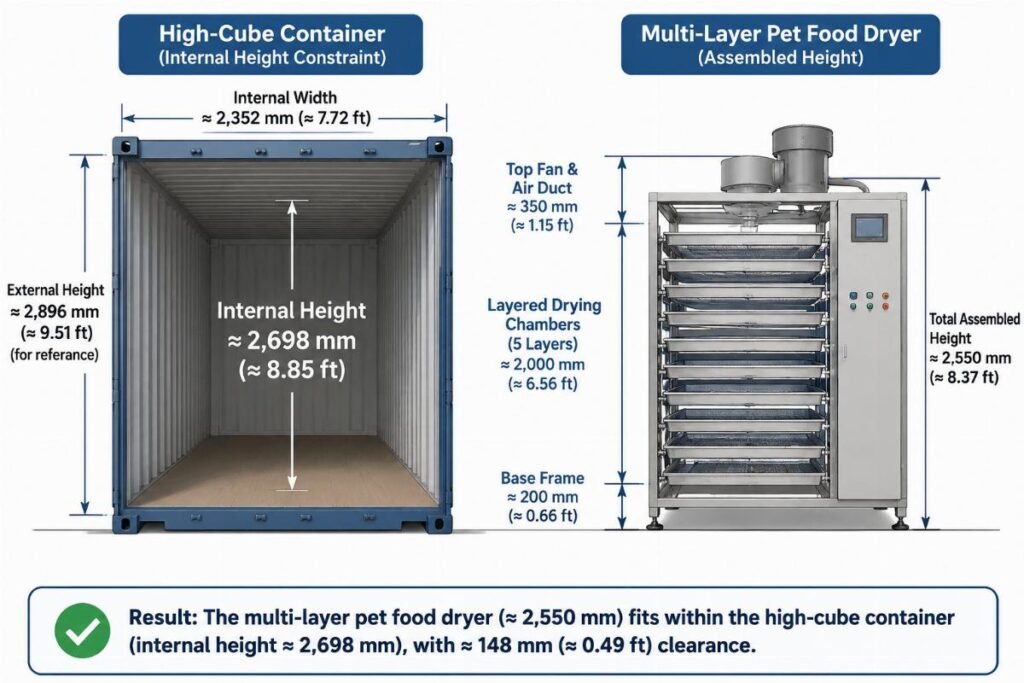
A 40HQ offers an internal height of roughly 2.69 meters. While this seems ample for most industrial machinery, the multi-layer dryers used in pet food and aquaculture feed production are designed vertically to maximize thermal efficiency and save floor space. When fully assembled, these dryers, along with the integrated cooling bins, frequently exceed this 2.69-meter threshold.
Many buyers operate under the misconception that a 1t/h capacity implies a compact, easily containerized footprint. They assume the 40HQ loading capacity extruder line will seamlessly swallow all components. However, suppliers often quote standard assembled dimensions without split-calculating the vertical constraints. If a buyer attempts to force an assembled multi-layer dryer into a 40HQ, the forklift simply cannot push it through the door, or the center of gravity becomes dangerously high, violating road transport regulations at the destination port.
Furthermore, the cooling section adds another layer of complexity. Extended cooling bins are necessary to bring the kibble temperature down safely for packaging, but their elongated or tall designs consume critical cubic meters. Ignoring these specific dimensions during the initial 1 ton per hour kibble line container calculation leads directly to volume versus dimension mismatches, resulting in unexpected LCL (less-than-container-load) fees.
How to Calculate Exact Container Volume?
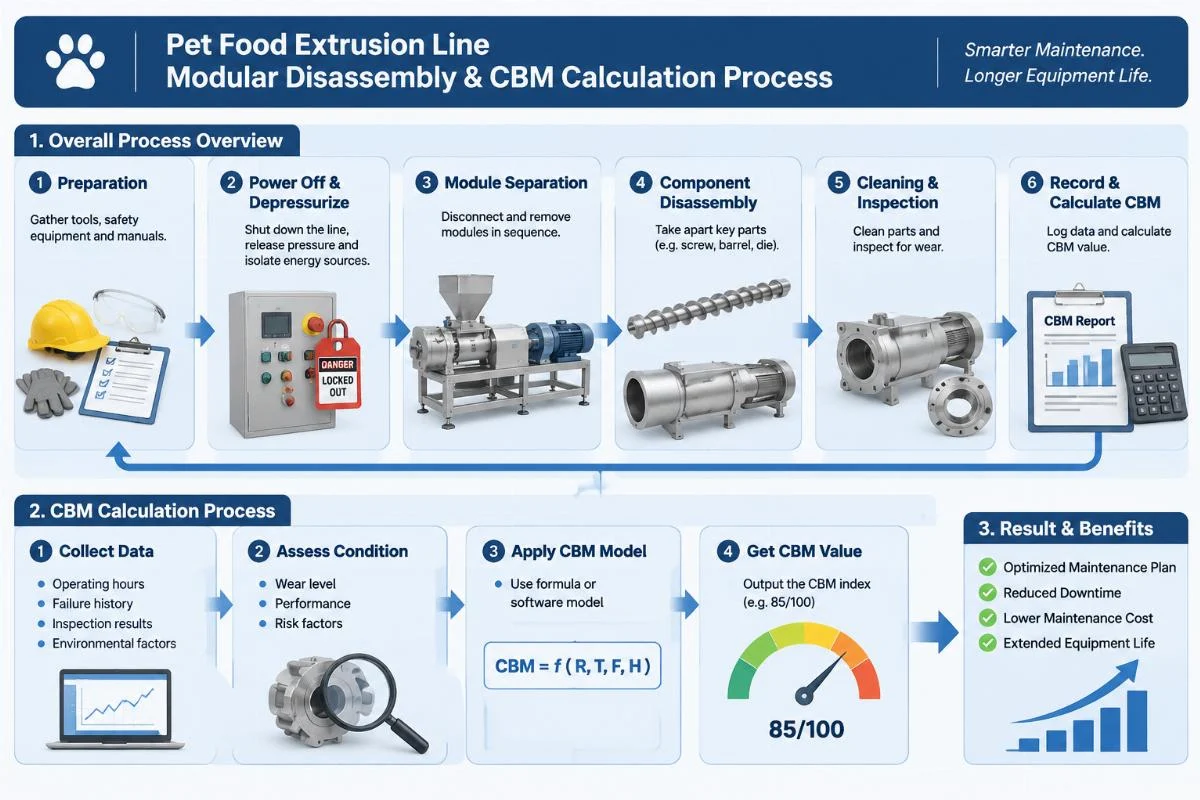
Accurate volume calculation requires disassembling the production line into distinct functional zones: extrusion, drying, and cooling, then computing the cubic meters for each module separately.
To execute a flawless 1 ton per hour kibble line container calculation, you must abandon the habit of calculating the total line volume as a single figure. Instead, treat each major section as an independent shipping unit.
First, isolate the extrusion section. This includes the mixer, the twin-screw extruder, and the initial conveying systems. These components are generally compact and dense, making them ideal for the bottom layer of a container.
Second, evaluate the drying section. This is where the 40HQ loading capacity extruder line faces its biggest test. You must calculate the volume of the dryer based on its disassembled modules. Multi-layer dryers are typically built in stacked sections. By calculating the CBM (cubic meters) of each individual layer, you can stack them efficiently within the container’s height limit, leaving room for other components.
Third, assess the cooling and coating sections. Cooling bins and flavor coating drums have irregular shapes. Their CBM must be calculated based on their outermost packaging dimensions, not just the machine body.
Finally, sum the CBM of all disassembled modules. Compare this total against the usable volume of your chosen containers, factoring in a margin for wooden pallets and securing materials. A precise 1 ton per hour kibble line container calculation always leaves a buffer; stuffing a container to the exact mathematical limit guarantees that real-world packaging variations will cause a spill-over.
What Are Typical Container Configurations for 1t/h Lines?
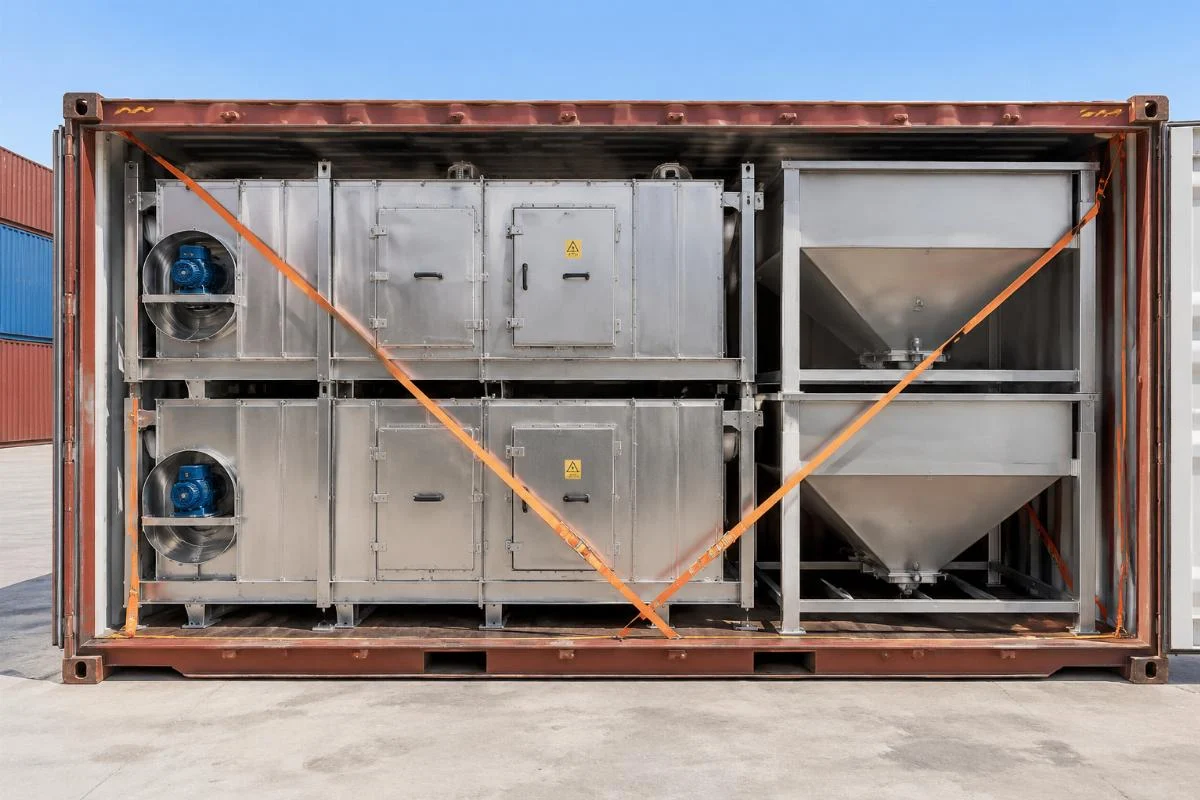
The industry standard configuration usually involves one 40HQ dedicated to the extruders and packaging systems, paired with one 20GP or a second 40HQ specifically for the drying and cooling sections.
When conducting a 1 ton per hour kibble line container calculation, the physical reality of the equipment dictates the container split.
The extrusion section, comprising the mixer, extruder, and packaging scales, is heavy and relatively compact. These machines are loaded into a 40HQ. The weight distribution is critical here; placing the heaviest extruder components directly over the container’s axles prevents overweight penalties during inland transport.
The drying and cooling sections, however, are voluminous but relatively light. If the multi-layer dryer is split into its modular layers, a single 20GP might suffice for a highly compact 1t/h design. However, in most practical scenarios, especially when dealing with aquaculture floating feed lines that require longer retention times in the dryer, the volume expands. In these cases, a second 40HQ is necessary to accommodate the disassembled dryer layers and the cooling bins.
A buyer in Southeast Asia once ordered a 1t/h floating fish feed line. Initially, they planned to use a single 40HQ and a 20GP. During the 1 ton per hour kibble line container calculation, we realized the extended cooling bin for their specific pellet size would not fit in the 20GP alongside the dryer modules. We adjusted the configuration to two 40HQs, ensuring the cooling bin was fully enclosed without compromising the structural integrity of the load.
How to Avoid Hidden Shipping Costs?
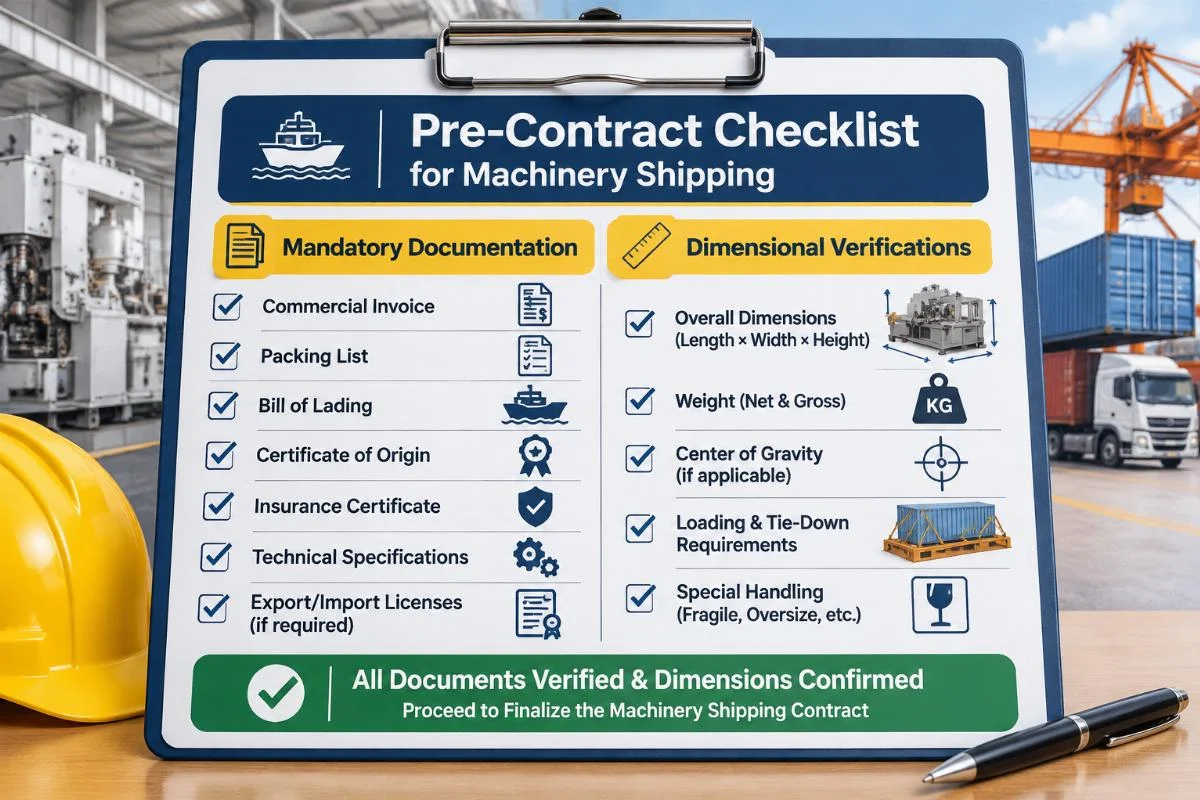
Buyers must mandate detailed CBM breakdowns and three-dimensional loading diagrams from suppliers before signing the contract, ensuring every dimension is verified against container internal limits.
Hidden shipping costs do not appear out of thin air; they are the direct result of a flawed 1 ton per hour kibble line container calculation. The most common trap is assuming the FOB quote includes optimal loading. Suppliers often provide standard dimensional drawings that reflect the assembled machine, not the shipping dimensions.
To avoid this, you must require a comprehensive packing list that details the length, width, and height of every single crate and pallet. Do not accept total CBM figures alone. You need the exact dimensions of the largest single piece of equipment to verify it can pass through the container door.
Furthermore, request a 3D loading simulation or a detailed loading diagram. This visual proof demonstrates how the supplier intends to stack the disassembled dryer modules, the extruder, and the packaging section. If the supplier cannot provide this, they have not performed a rigorous 1 ton per hour kibble line container calculation.
Consider the case of a producer in the MENA region who ordered a 1t/h line with an extended cooling bin. The supplier initially quoted based on standard bulk loading volumes. Upon reviewing the detailed CBM breakdown, we identified that the custom crate packaging required for the extended bin would consume an extra cubic meter, pushing the total volume beyond the 20GP limit. By catching this during the calculation phase, we adjusted the container count to include an additional 20GP, preventing the buyer from facing exorbitant demurrage and LCL repacking fees at the destination port.
Conclusion
Accurate logistics planning relies on modular disassembly and precise volumetric analysis, not on assumptions about container capacity.
A successful 1 ton per hour kibble line container calculation demands that buyers and suppliers treat the drying and cooling sections as independent variables. By breaking the line down, verifying every dimension against internal container limits, and securing detailed loading diagrams, you eliminate the risk of hidden freight costs and ensure your production line arrives ready for installation.