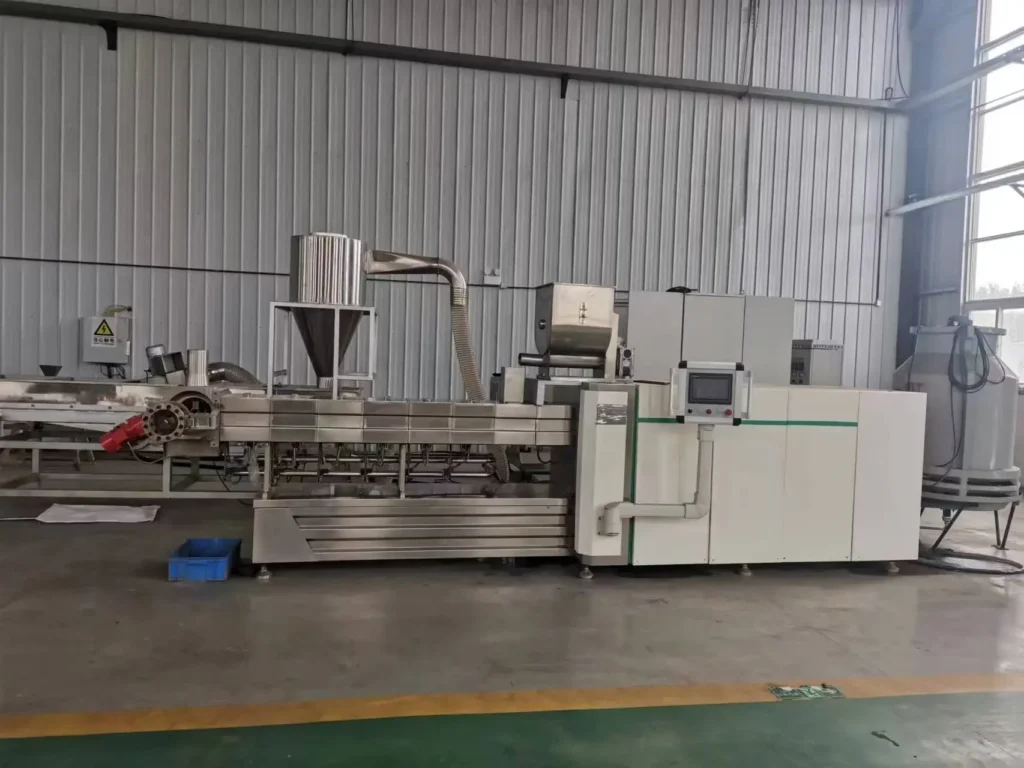

Higher throughput never guarantees better kibble quality if the drying mechanism destroys the pellet structure.
When evaluating Belt Dryer vs Fluidized Bed Dryer for Pet Food, the ultimate decision relies on material stress tolerance and fat content rather than mere processing volume. Belt dryers utilize static conveyance suitable for standard formulas, while fluidized beds suspend particles in air to eliminate mechanical friction, making them superior for fragile, high-fat extruded kibble.
I still remember a sweltering night in a factory in Thailand years ago. We were commissioning a new pet food line, and the图纸 specified a standard belt dryer. As the high-fat extruded kibble hit the mesh belt, it didn’t just dry; it stuck, smeared, and shattered. The breakage rate skyrocketed, and the entire line was on the verge of a complete shutdown. We had to rip out the conveyor concept overnight and rig up a fluidized bed to suspend the particles in hot air. Only then did the breakage drop to acceptable levels. That现场 trial burned into my mind that selecting pet food extrusion drying equipment is never just about moving tons of product per hour; it is about how the material behaves under thermal and physical stress.
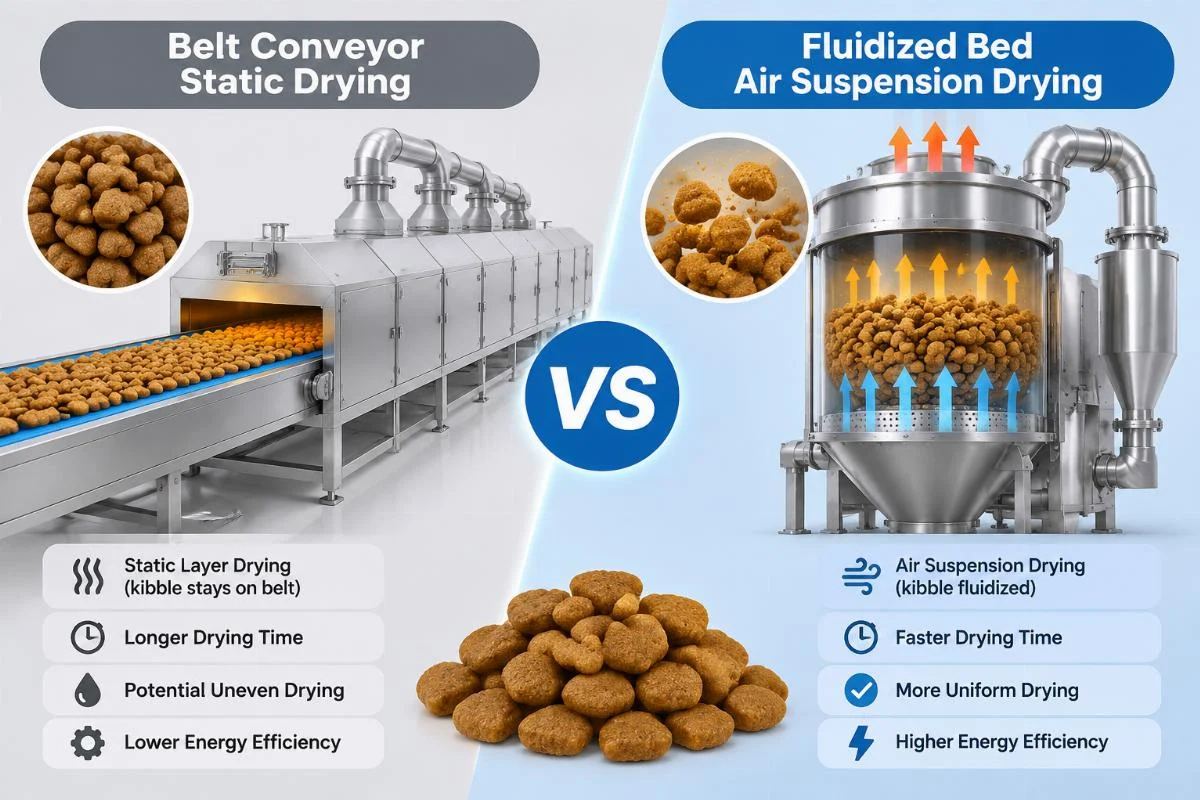
Let us break down the engineering realities behind these two systems to help you make the right choice for your production line.
How Do Belt and Fluidized Bed Dryers Actually Work?
The fundamental difference lies in how the kibble interacts with the heat source: static friction versus dynamic air suspension.
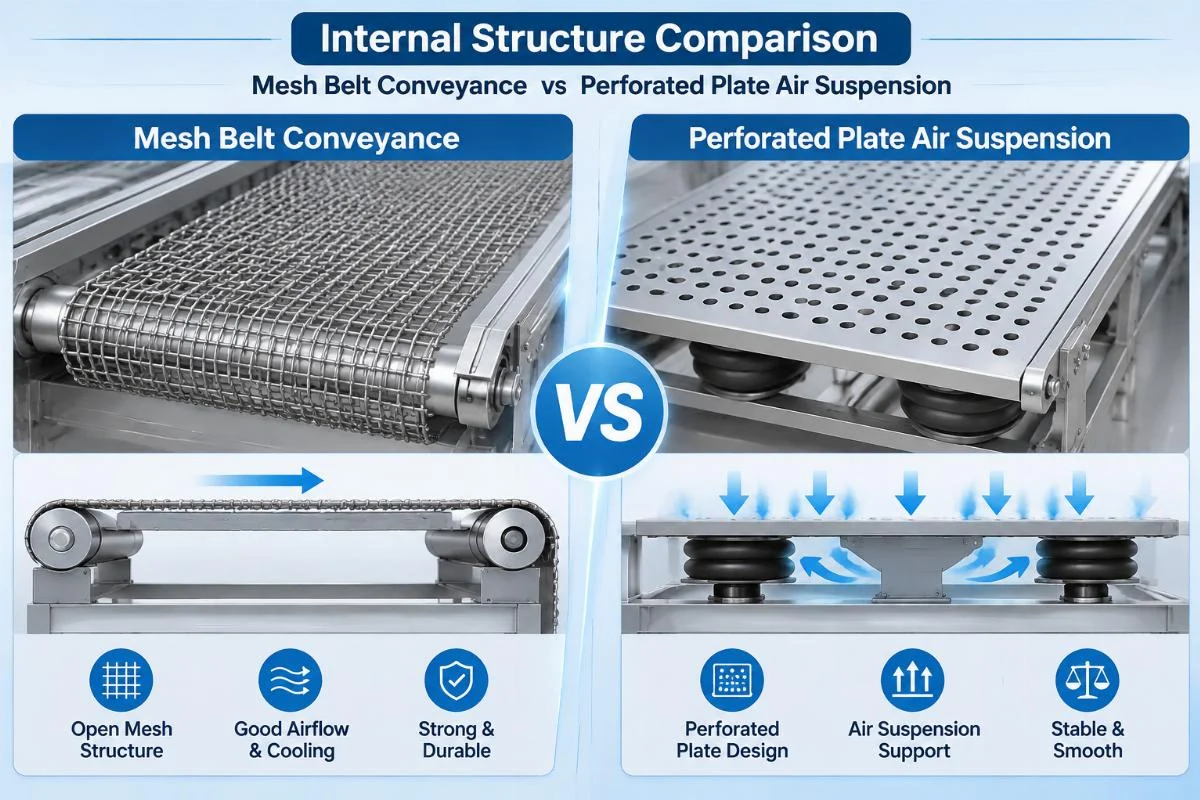
In a belt dryer, the extruded kibble rests on a continuous mesh belt that slowly carries it through a heated tunnel. The material remains stationary relative to the belt, relying on convection and conduction from the bottom and top airflows. This method is straightforward but subjects the kibble to constant mechanical contact.
Conversely, a fluidized bed dryer for extruded pet food forces hot air upward through a perforated plate at a velocity that perfectly balances the weight of the kibble. The particles literally float and boil in the air stream. This creates a massive surface area for heat exchange without the kibble ever touching a solid surface.
| Operational Parameter | Belt Dryer | Fluidized Bed Dryer |
|---|---|---|
| Material Movement | Static conveyance on mesh | Dynamic air suspension |
| Heat Transfer Mode | Conduction and Convection | Pure Convection |
| Mechanical Contact | Continuous friction | Zero solid contact |
| Moisture Evaporation | Surface-to-core gradient | Uniform volumetric |
Understanding this mechanical divergence is the first step in analyzing Belt Dryer vs Fluidized Bed Dryer for Pet Food, as it dictates everything from breakage rates to final product integrity.
Which Dryer Handles High-Fat Extruded Kibble Better?
High-fat formulations will rapidly clog a belt dryer, whereas a fluidized bed keeps particles separated and surface oils contained.
When a pet food recipe is loaded with animal fats or oils for palatability, the kibble surface becomes highly tacky during the initial drying phase. If you run this through a belt dryer, the sticky pellets adhere to the mesh belt. As the belt moves, the kibble drags, tearing its surface and causing severe oil leakage. This not only ruins the visual appeal but also creates a rancidity risk.
A fluidized bed completely bypasses this issue. Because the kibble is suspended in the air, the sticky particles never touch a metal surface. The turbulent air keeps them separated, allowing the surface moisture to evaporate quickly and set the structure before the internal fats can migrate and cause sticking.
I once consulted for a contract manufacturer in Europe who was struggling with a premium salmon formula. Their belt dryer pet food kibble output looked like crushed gravel coated in grease. By switching to a fluidized bed, the particles maintained their perfect spherical shape, and the surface oil leakage was virtually eliminated. This proves that when comparing Belt Dryer vs Fluidized Bed Dryer for Pet Food for high-fat recipes, the fluidized approach is non-negotiable.

How Does Material Stress Impact Kibble Breakage Rates?
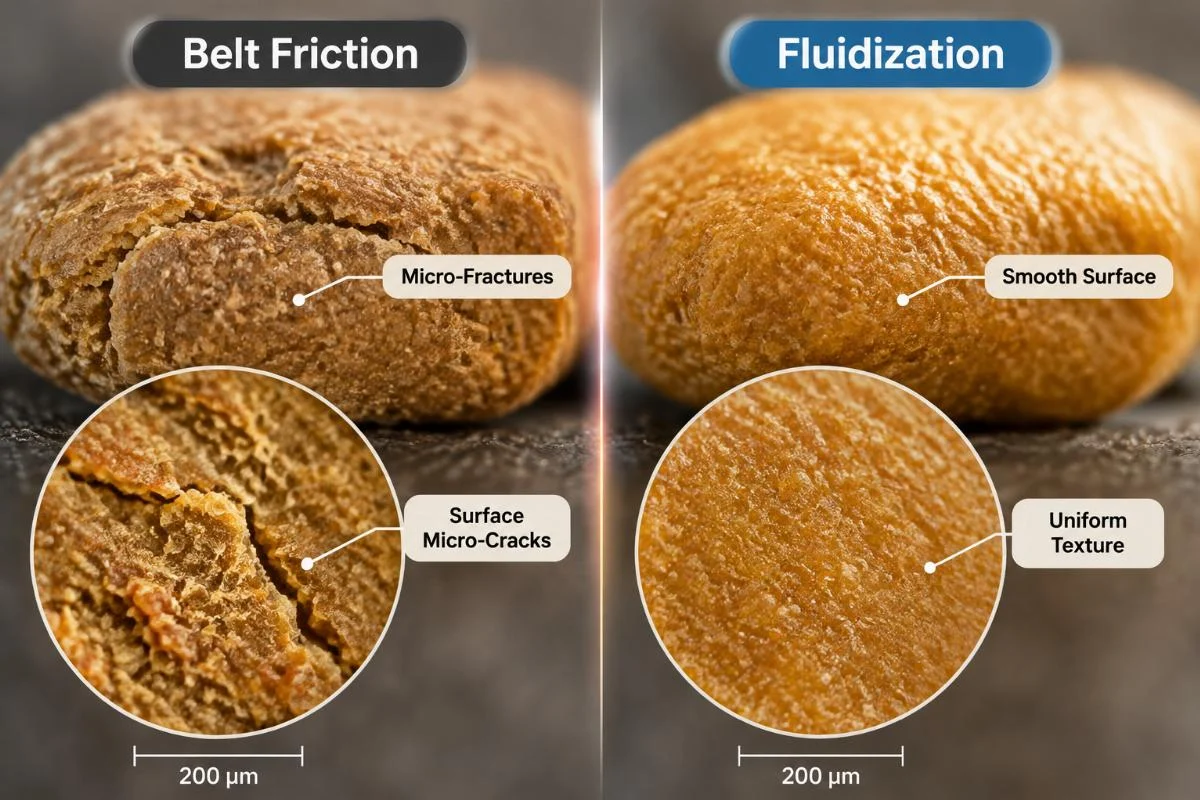
Mechanical friction in belt dryers generates micro-fractures, while fluidized beds preserve pellet structural integrity.
Extruded kibble, especially smaller sizes or those with delicate textures, is highly susceptible to physical stress. In a belt dryer, the vibration of the drive mechanism and the friction against the mesh belt cause the pellets to rub against each other and the equipment. Over a long drying cycle, this continuous abrasion creates micro-fractures. By the time the kibble reaches the cooling zone, a significant portion is already compromised, leading to high fines generation.
In a fluidized bed, the absence of mechanical contact means the kibble experiences minimal physical stress. The particles collide gently in the air stream, which is far less destructive than sliding across a metal mesh. This is particularly critical for sensitive aquatic feed or small-breed dog kibble where dust and fines can ruin the packaging and affect shelf life.
| Stress Factor | Belt Dryer Impact | Fluidized Bed Impact |
|---|---|---|
| Surface Abrasion | High (mesh friction) | Negligible (air suspension) |
| Inter-particle Collision | Moderate (vibration) | Gentle (fluid dynamics) |
| Micro-fracture Risk | Substantially extended | Noticeably reduced |
| Fines Generation | High volume | Minimal |
When you evaluate Belt Dryer vs Fluidized Bed Dryer for Pet Food, you must calculate the hidden cost of fines. A system that produces high breakage rates forces you to rework or discard product, eroding your profit margin regardless of the initial equipment cost.
What Are the Maintenance and Footprint Differences?
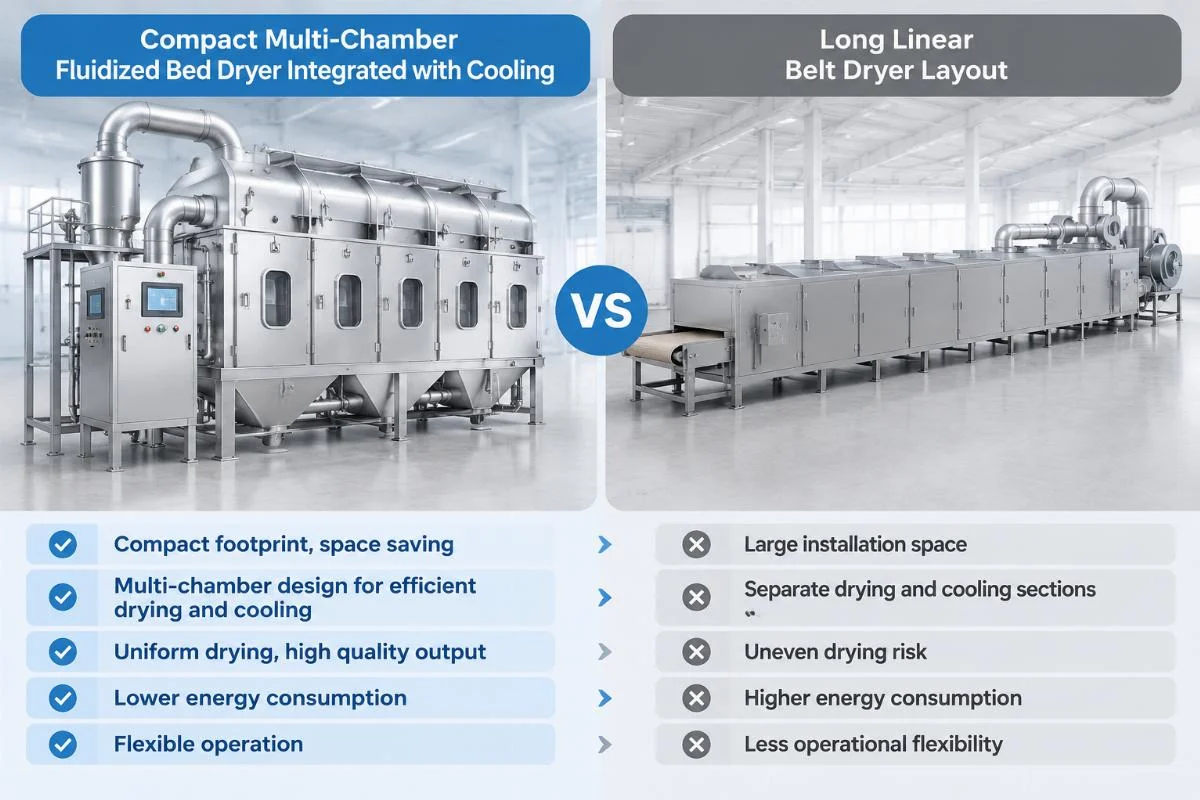
Fluidized beds offer a compact, integrated footprint, while belt dryers demand extensive linear space and frequent mesh cleaning.
Space is always a premium in a production facility. A belt dryer requires a massive linear footprint to achieve the necessary retention time for proper drying and cooling. Furthermore, the mesh belts require constant tension adjustment, tracking alignment, and rigorous cleaning to prevent the buildup of stuck material and bacterial growth.
A fluidized bed dryer, on the other hand, utilizes the intense heat transfer of suspension to dry the product much faster. This allows for a significantly more compact vertical design. Many modern fluidized systems integrate the drying and cooling zones into a single multi-chamber unit, drastically reducing the floor space required. Maintenance is also streamlined, focusing primarily on the air filtration system and the perforated plate, rather than a massive, continuous moving belt.
This is where turnkey engineering becomes critical. Designing a facility requires matching the equipment to the specific formula and spatial constraints. At Meiteng, we approach every project by analyzing the exact rheology of your dough and the physical limits of your final kibble. We do not just sell a machine; we engineer the entire pet food extrusion drying equipment layout to ensure the thermal profile matches your recipe. Whether you are a startup launching your first brand or a contract manufacturer scaling up, our integrated drying and cooling systems are designed to minimize physical stress and maximize yield from day one.
Conclusion
The choice between these two technologies is dictated by physics, not just production volume.
Selecting the right Belt Dryer vs Fluidized Bed Dryer for Pet Food hinges entirely on your formula’s fat content and the physical fragility of your kibble. While belt dryers have their place for robust, low-fat products, fluidized beds are the definitive solution for preserving the integrity of high-fat, delicate extruded pellets. Aligning your drying mechanics with your material science is the only way to ensure a profitable, high-quality production line.
Machines Mentioned in This Article

cat food machine
Pet Food Processing Equipment Plant Manufacturer Dog Food
View Machine
cat food machine
Dry Dog Food Production Line Pet Food Pellet Machine
View Machine
cat food machine
Pet Food Production Line Manufacturer
View Machine
cat food machine