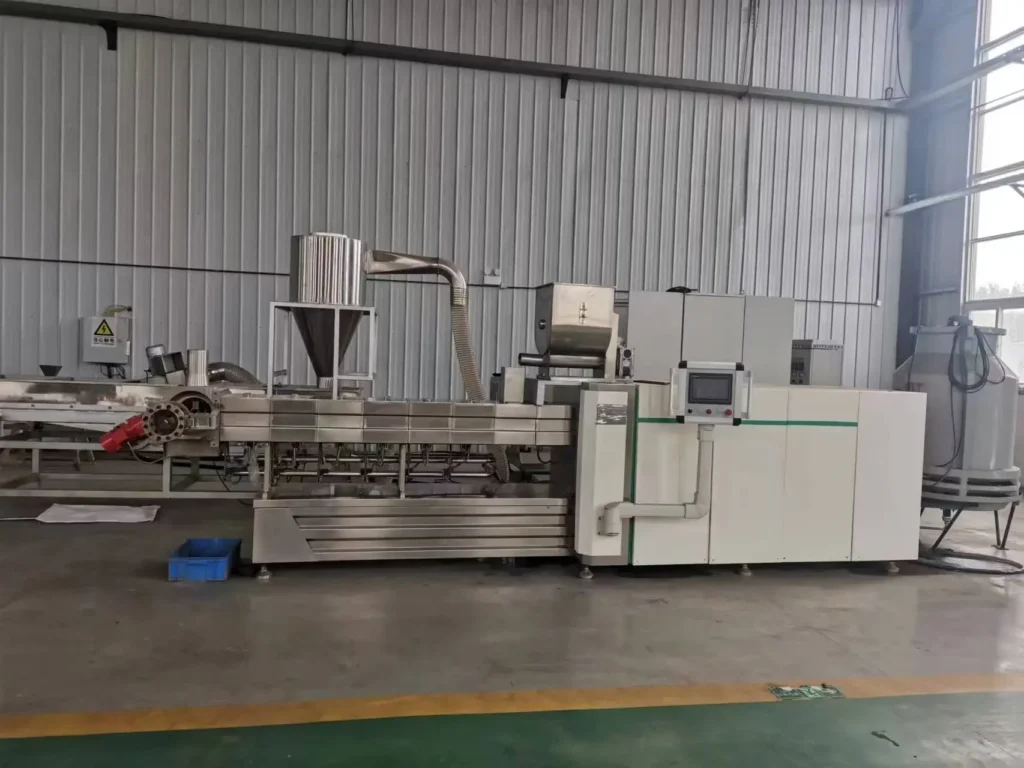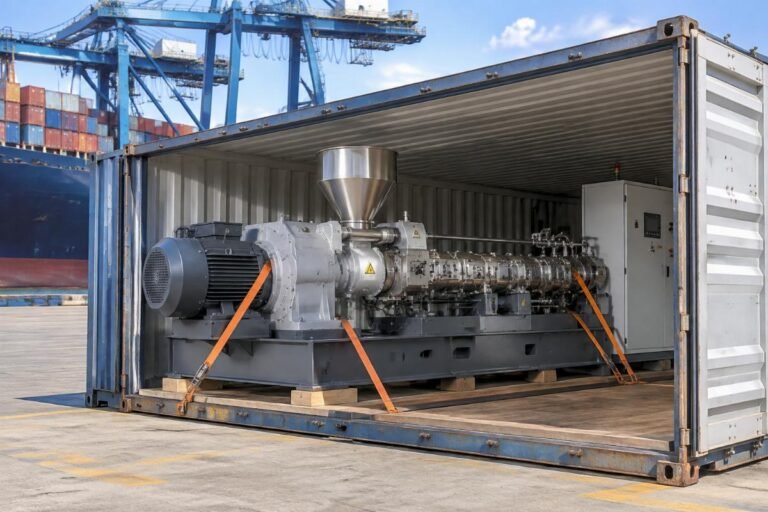

Customs officers do not just check your commercial invoice; they scrutinize the metallurgical traceability of every food-contact surface.
Successfully Importing pet food machinery into Canada requires strict alignment with Canadian Food Inspection Agency (CFIA) material documentation and precise electrical adaptations for the North American grid before the equipment leaves the factory floor.
Early in my career, while overseeing a feed line installation in Thailand, I transitioned from quality control to sales. We shipped a DS70 twin-screw extruder to North America, assuming the standard export paperwork was sufficient. The machine arrived at the Port of Vancouver and was immediately impounded. The delay lasted weeks because we failed to provide the specific 304 stainless steel mill certificates aligned with local sanitary standards. That port delay scenario taught me to obsess over clearance documents and moisture content formulas before discussing screw speeds. When evaluating equipment selection today, I always inspect the site conditions and material proofs first. The machine runs smoothly only if those出厂 details are flawless. If you are Importing pet food machinery into Canada, understanding these hidden compliance layers is your only way to avoid similar port delays.

What are the CFIA customs requirements for food machinery?
Material certificates and food-grade compliance are mandatory for clearance, extending far beyond basic commercial invoices.
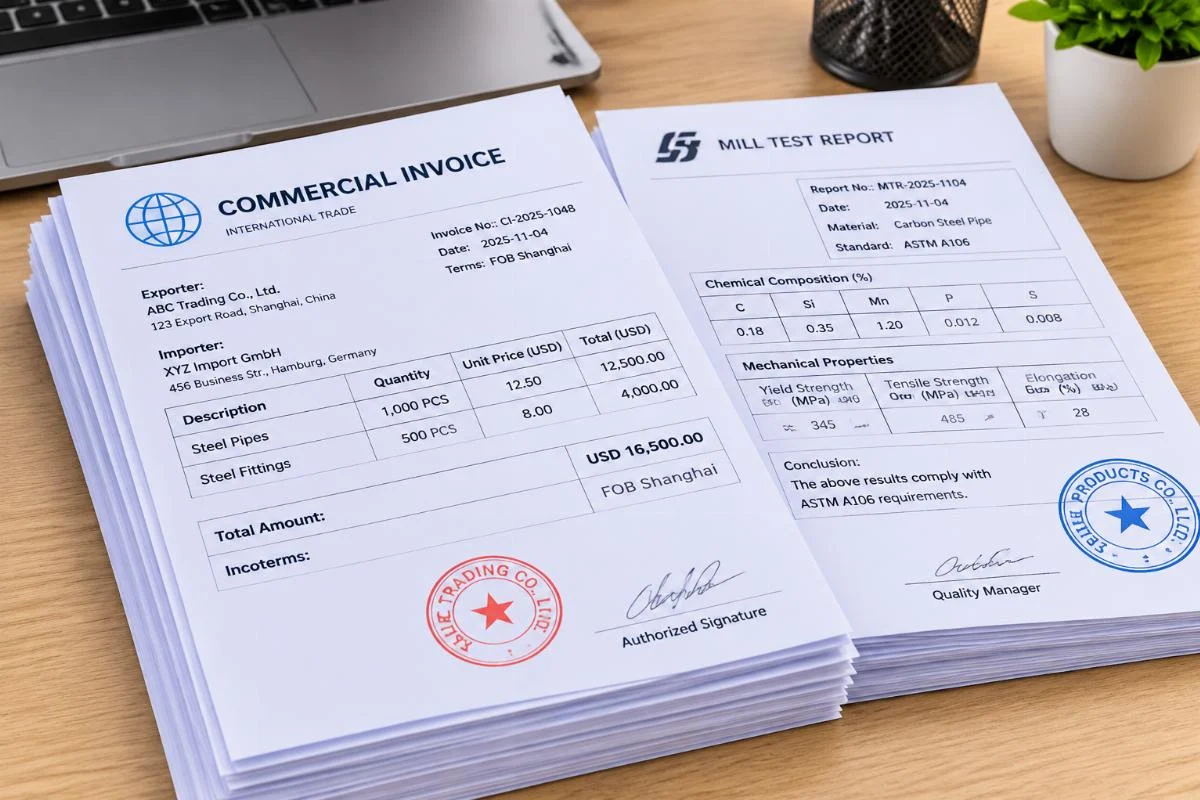
Most buyers assume customs only check invoices and packing lists. In reality, the CFIA scrutinizes material traceability for any food-contact machinery. When Importing pet food machinery into Canada, you must prove that every surface touching the pet food recipe meets strict sanitary standards. The CFIA requires verifiable Mill Test Reports (MTRs) for 304 or 316 stainless steel components. Without these, the equipment is treated as a potential biological or chemical hazard.
A European contract manufacturer once faced a hygiene audit scenario where the CFIA inspector rejected the machine surface finish. The rejection was not due to poor polishing, but because the unverified food-grade material alignment could not be traced back to the original smelter. The sanitation standard rejection rate spikes when suppliers provide generic “food-grade” claims instead of batch-specific MTRs. To prevent this, your supplier must provide complete 304/316 stainless steel material certificates that match the exact batch used in your extruder’s barrel and screws. Meiteng’s turnkey service naturally integrates this by providing full MTR documentation alongside the DS70 extruder, ensuring your Canada customs clearance for food extruders proceeds without metallurgical disputes.

How to handle Canada’s 60Hz voltage and electrical standards?
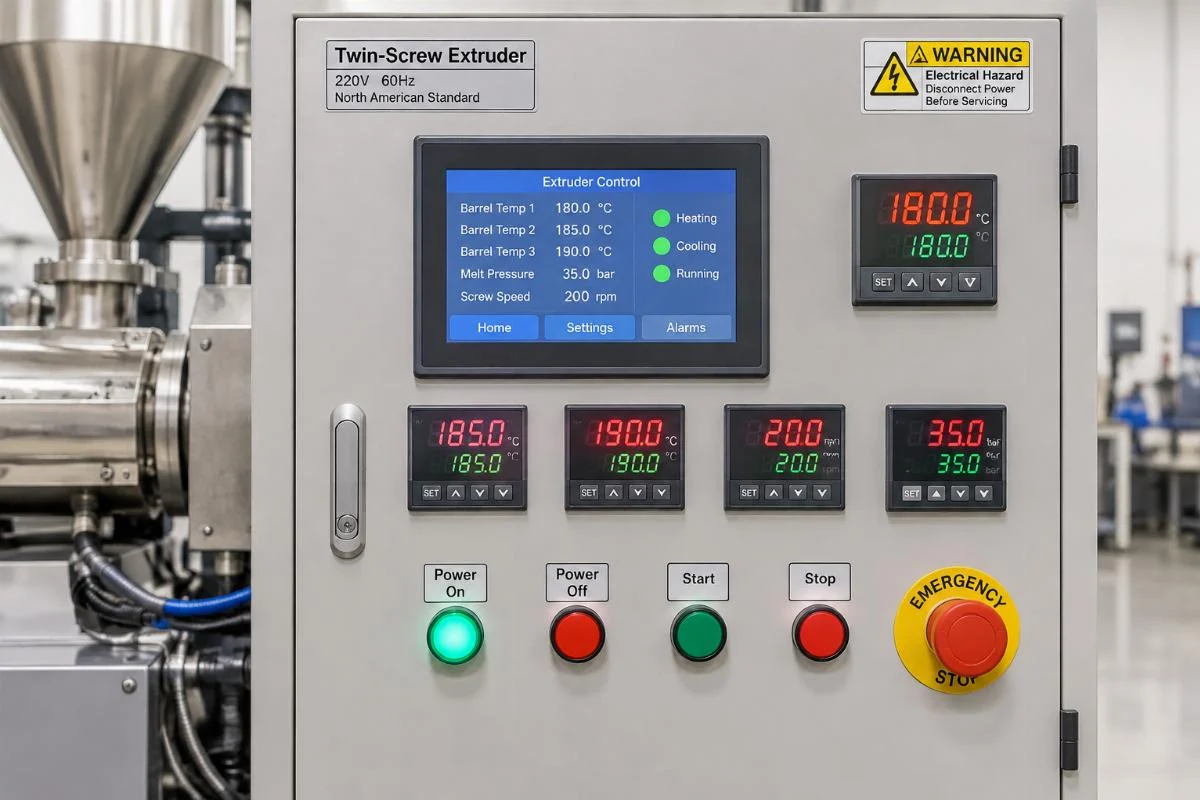
Motors and heaters must be customized for 220V/440V 60Hz to prevent overheating, as simple converters cannot fix frequency mismatches.
A common misconception is that voltage converters can fix power issues on the factory floor. The true cause of failure lies in motor cooling fan efficiency dropping at 60Hz if the motor is not spec-matched. When you are Importing pet food machinery into Canada, the local grid operates on 60Hz. If a machine designed for 50Hz is simply plugged in or run through a basic transformer, the motor RPM deviation occurs, and the internal cooling fan spins slower than required. This leads to motor burnout or sensor failure during commissioning.
Consider a voltage mismatch scenario where a startup owner in Ontario experienced repeated thermal trips. They tried using external converters, but the root cause was the 50Hz motor’s inability to dissipate heat at 60Hz frequencies. The replacement lead time for custom-wound motors cost them a full production season. Proper electrical load calculation for 60Hz is non-negotiable. The 220V 60Hz pet food machinery Canada setup requires motors and heaters specifically wound and tested for the North American frequency. Meiteng addresses this by conducting pre-shipment 60Hz factory testing, simulating the local power environment to guarantee immediate production upon arrival.
Which documents prevent port delays in Vancouver or Toronto?
Commercial invoices, packing lists, and verified MTRs must be perfectly aligned to avoid weeks of impoundment.
When Importing pet food machinery into Canada, the documentation package must be bulletproof. A missing signature or a mismatched serial number on a material certificate can halt your shipment at the border. The CFIA and Canada Border Services Agency (CBSA) cross-reference the declared machinery parts with the provided sanitary proofs.
In the port delay scenario I witnessed, the twin-screw extruder was stuck at the Vancouver port because the 304 stainless steel mill certificates were missing the specific heat numbers corresponding to the machine’s barrel. The document re-issuance process took weeks, demurrage fees accumulated, and the startup’s launch window was missed. To avoid this, your documentation must include a perfectly aligned commercial invoice, detailed packing lists, and the verified MTRs. Meiteng’s export documentation process ensures that every container-load consolidation includes these precise, cross-verified certificates, eliminating the guesswork for your customs broker.
How to ensure smooth on-site installation and commissioning?
Pre-shipment factory testing with local power simulation guarantees immediate production and avoids costly field modifications.
The final hurdle in Importing pet food machinery into Canada is the physical commissioning. If the machine arrives and the sensors fail or the heaters cannot reach the required thermal profile for the pet food recipe, you are stranded. On-site installation and operator training are critical, but they cannot fix fundamental design mismatches.
During a past project, a client had to halt production because the moisture content of their specific recipe caused the dough to slip inside the barrel, a issue that only appeared during the first real-world run. By focusing on formula development support and recipe moisture analysis before shipping, such issues are resolved in the lab, not on your factory floor. Meiteng provides comprehensive formula development and R&D support for new product startups. We run your specific recipe through the DS70 or DS65 extruder in our Jinan facility, adjusting the screw configuration and thermal profiles to match your exact needs. This turnkey approach, combined with multi-language technical support and remote diagnostic assistance, ensures that when the machine lands in Canada, it is ready to extrude from day one.

Conclusion
Navigating Canadian import regulations demands rigorous material traceability and precise electrical engineering.
Importing pet food machinery into Canada is a complex process where metallurgical proofs and 60Hz electrical adaptations dictate your success. By securing verified 304/316 stainless steel certificates and ensuring factory-tested frequency compatibility, you bypass port delays and guarantee seamless on-site commissioning.
Machines Mentioned in This Article

cat food machine
Pet Dog Food Extruder Manufacturer Production Line
View Machine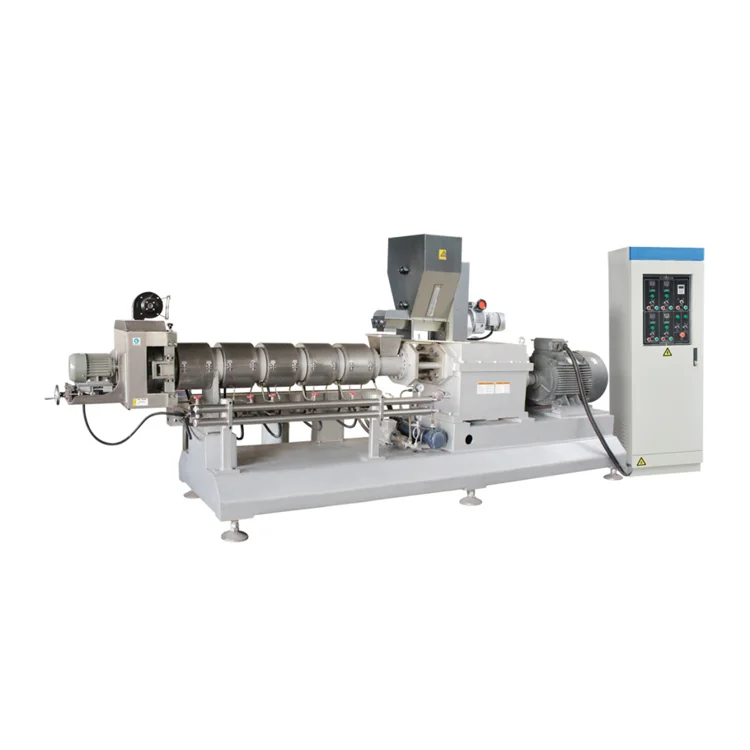
cat food machine
Pet Food Pellet Extruder Machine Manufacturer for Dog Cat
View Machine
cat food machine
Pet Food Extruder Machine Manufacturer Production Line
View Machine
cat food machine