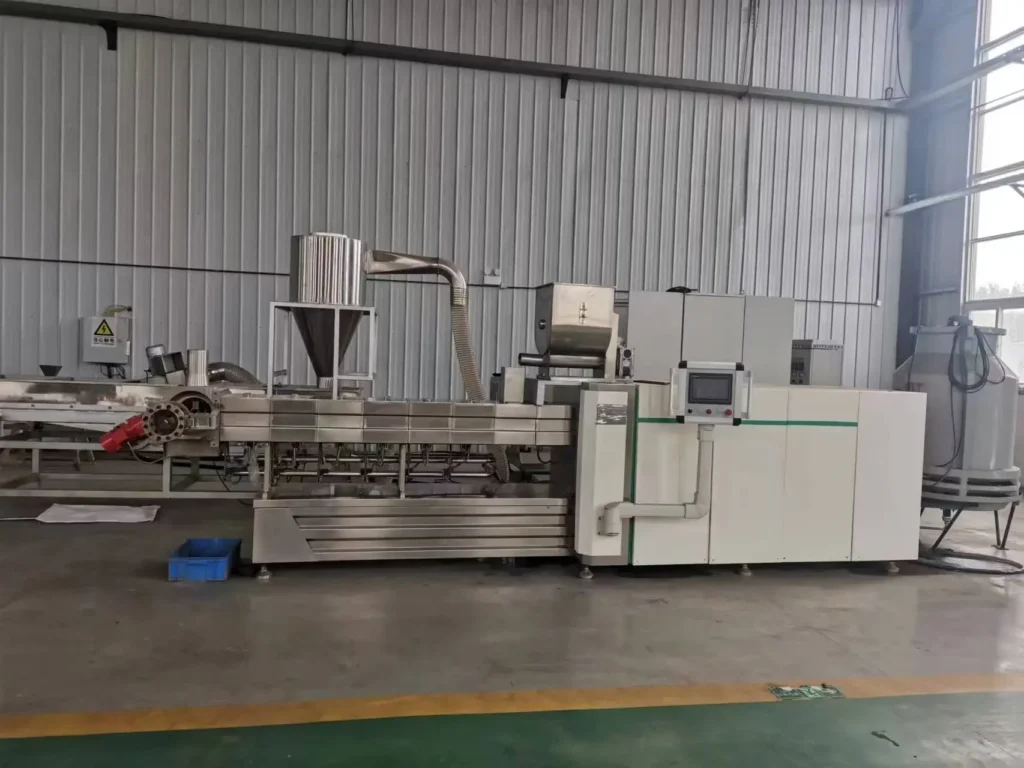
Premium European nameplates do not automatically guarantee stable extrusion when processing high-meat pet food formulations.
When evaluating Clextral vs Buhler twin screw extruders pet food options, the true bottleneck is never the rated nameplate capacity; it is the actual plasticization state inside the barrel under high-fat loads, where screw self-cleaning efficiency and torque distribution dictate whether a line runs continuously or jams repeatedly.
Working the quality inspection floor in Jinan years before transitioning to international trade, I watched countless buyers unbox premium European twin-screw extruders, only to face frequent line stops when pushing high-meat pet food recipes through them. The machinery looked flawless, but the standard screw configurations simply could not handle the dense, greasy dough. I often remind clients today that reading a spec sheet is not the same as understanding material flow. A startup owner in Southeast Asia once faced crippling downtime because the standard flight clearances on their imported machine allowed high-fat paste to carbonize and build up. We resolved the issue not by replacing the machine, but by redesigning the screw elements to improve the twin screw extruder torque distribution pet food performance and restore self-cleaning action.

The transition from standard recipes to high-meat inclusion twin screw extruder applications requires a fundamental shift in how we evaluate equipment. Let us break down the mechanical realities behind these premium brands and how pragmatic alternatives solve the same engineering challenges.
How Do Clextral and Bühler Handle High-Meat Pet Food Formulations?
The handling of high-meat formulations relies entirely on screw self-cleaning mechanics and material flow control, rather than sheer motor power.
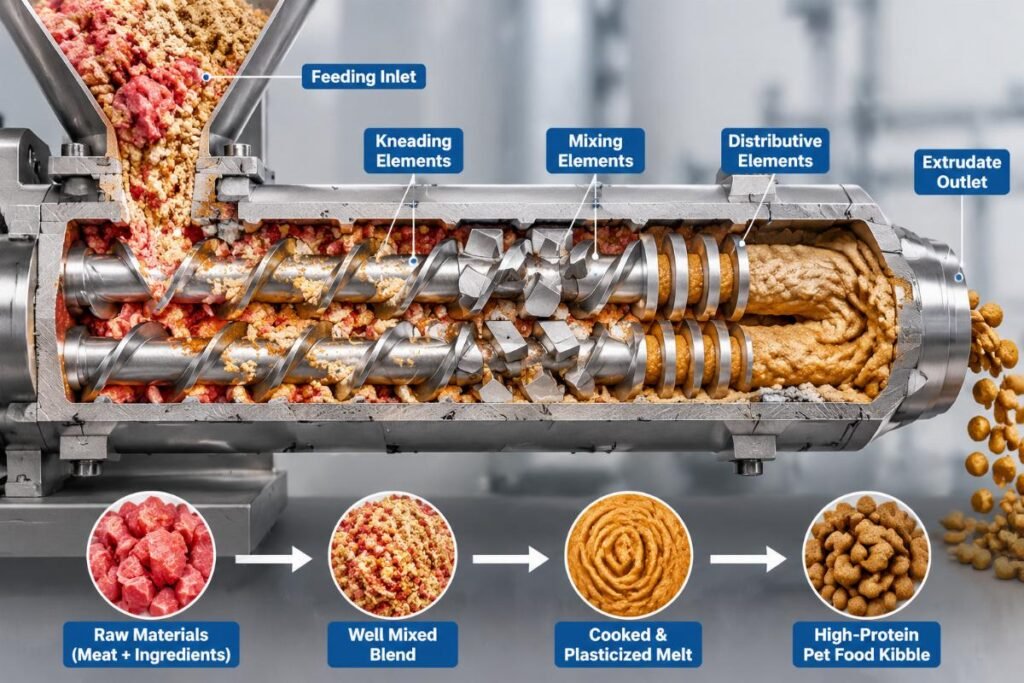
When processing recipes with heavy fresh meat inclusions, the dough behaves less like a dry powder and more like a dense, sticky paste. If the screw elements lack precise self-cleaning flight clearances, the material adheres to the barrel wall, degrades thermally, and eventually blocks the discharge.
| Technical Factor | Standard European Configurations | Custom High-Meat Configurations |
|---|---|---|
| Screw Self-Cleaning | Vulnerable to high-fat buildup | Resistant via optimized clearance |
| Material Flow | Uncontrolled under heavy meat loads | Controlled via specialized conveying elements |
| Thermal Degradation | Noticeably reduced residence time control | Substantially extended stability |
| Recipe Adaptability | Basic | Full batch-level flexibility |
A contract manufacturer in Latin America initially struggled with a well-known European brand when introducing a recipe with massive fresh meat inclusion. The standard screws caused frequent jamming, leading to a mid-six-figure loss in wasted ingredients and halted production. By switching to a custom-designed screw profile that prioritized aggressive self-cleaning and forward conveying, the Clextral vs Buhler twin screw extruders pet food debate became irrelevant; the line finally achieved stable output.

The lesson is clear: the brand on the nameplate matters far less than the metallurgical precision of the screw elements inside the barrel.
Torque Distribution: The Hidden Metric That Prevents Line Jams
Torque distribution is the hidden metric that separates a smooth continuous run from a catastrophic line jam when processing dense pet food doughs.
High-meat recipes demand immense mechanical energy to plasticize the proteins and emulsify the fats. If the twin screw extruder torque distribution pet food capability is poorly managed, the gearbox will trip, or the screws will fracture under the sudden load spikes.
| Torque Characteristic | Off-the-Shelf Standard Screws | Application-Specific Screw Design |
|---|---|---|
| Load Distribution | Uncontrolled during meat paste transitions | Controlled via staggered kneading blocks |
| Shear Heat Generation | Noticeably reduced predictability | Substantially extended thermal stability |
| Gearbox Stress | Vulnerable to sudden torque spikes | Resistant via optimized energy input |
| High-Fat Adaptability | Basic | Certified for heavy lipid emulsification |
I recall a pet food startup in the Middle East that kept tripping the main drive on their premium European extruder every time they increased the fat content in their kibble base. The issue was not the motor size; it was the torque density distribution across the screw profile. By reconfiguring the kneading blocks to distribute the mechanical work more evenly, we eliminated the torque spikes. This engineering adjustment is exactly why evaluating Clextral vs Buhler twin screw extruders pet food capabilities must always include a deep dive into the gearbox torque limits and screw adaptability.

Without proper torque management, even the most expensive European machinery will fail under the demands of modern, high-meat pet food recipes.
Beyond the Nameplate: Evaluating Actual Plasticization and Turnkey Support
Actual plasticization inside the barrel is the ultimate truth of extrusion, completely independent of the marketing brochures.
Most buyers assume that a higher nameplate capacity translates directly to better output. This is a dangerous fallacy. The real bottleneck is the actual plasticization state of the物料 inside the barrel under high-meat loads. If the material is not uniformly plasticized, the resulting kibble will have inconsistent densities, poor coating retention, and unacceptable shelf stability.
In my early days inspecting machines in Jinan, I learned to listen to the sound of the gearbox and watch the ammeter fluctuations to judge plasticization quality. A smooth, steady ammeter reading indicates uniform melt; violent fluctuations mean the screws are struggling with unmelted meat particles.
Furthermore, premium brands often leave the buyer to figure out the formula adaptation alone. A turnkey approach changes everything. When a European wind farm operator needed specialized textured protein lines, they required more than just a machine; they needed formula development support and on-site operator training. Similarly, in the pet food sector, moving from installation to stable output requires months of collaborative recipe tweaking. Our DS series twin-screw extruders address this by providing comprehensive formula R&D support, ensuring that the high-meat inclusion twin screw extruder process is optimized from day one, rather than leaving the startup to guess the barrel temperature profiles.

Evaluating a supplier means looking past the polished steel of the barrel and focusing on the engineering support that guarantees actual plasticization.
Choosing the Right Twin-Screw Extruder for Your Pet Food Startup
How do you balance budget constraints with the technical demands of high-meat pet food extrusion?
You prioritize custom screw design capabilities and comprehensive turnkey support over the prestige of a European nameplate.
When launching a new pet food line, the capital expenditure is massive. Spending a fortune on a premium brand only to discover their standard screws cannot handle your specific high-fat recipe is a mistake many startups make.
Here is the practical risk checklist for your procurement process:
- Screw Metallurgy: Are the screw elements made from standard tool steel, or are they treated for wear resistance against abrasive bone meals and high-meat pastes?
- Turnkey Integration: Does the supplier offer integrated drying, cooling, and flavor-coating systems, or are you forced to source them separately?
- Formula R&D: Will the supplier run your exact high-meat recipe on their test machines before shipping the equipment?
- After-Sales Support: Is there multi-language technical support and remote diagnostic assistance available across multiple regions?
A startup owner in Africa once bought a cheap, unbranded extruder that lacked proper barrel self-cleaning efficiency. The greasy recipes destroyed the product quality, and the flavor-coating uniformity was nonexistent. They eventually upgraded to a pragmatic, high-ROI alternative like our DS series, which offers food-grade stainless construction and custom screw design specifically for high-meat recipes. This decision transformed their Clextral vs Buhler twin screw extruders pet food dilemma into a solved equation, delivering stable output without the premium price tag.

The right choice is not about finding the most famous brand; it is about finding a partner who understands the rheology of high-meat dough and provides the engineering backing to make it run smoothly.
Conclusion
Equipment selection in high-meat pet food extrusion is an engineering challenge, not a branding exercise. The true determinants of success are screw self-cleaning efficiency, precise torque distribution, and robust turnkey support. By focusing on actual plasticization and custom screw design rather than nameplate prestige, manufacturers can achieve stable, high-quality production while avoiding the hidden costs of premium European machinery.
Machines Mentioned in This Article

cat food machine
Pet Food Processing Equipment Plant Manufacturer Dog Food
View Machine
cat food machine
Dry Dog Food Production Line Pet Food Pellet Machine
View Machine
cat food machine
Pet Food Production Line Manufacturer
View Machine
cat food machine