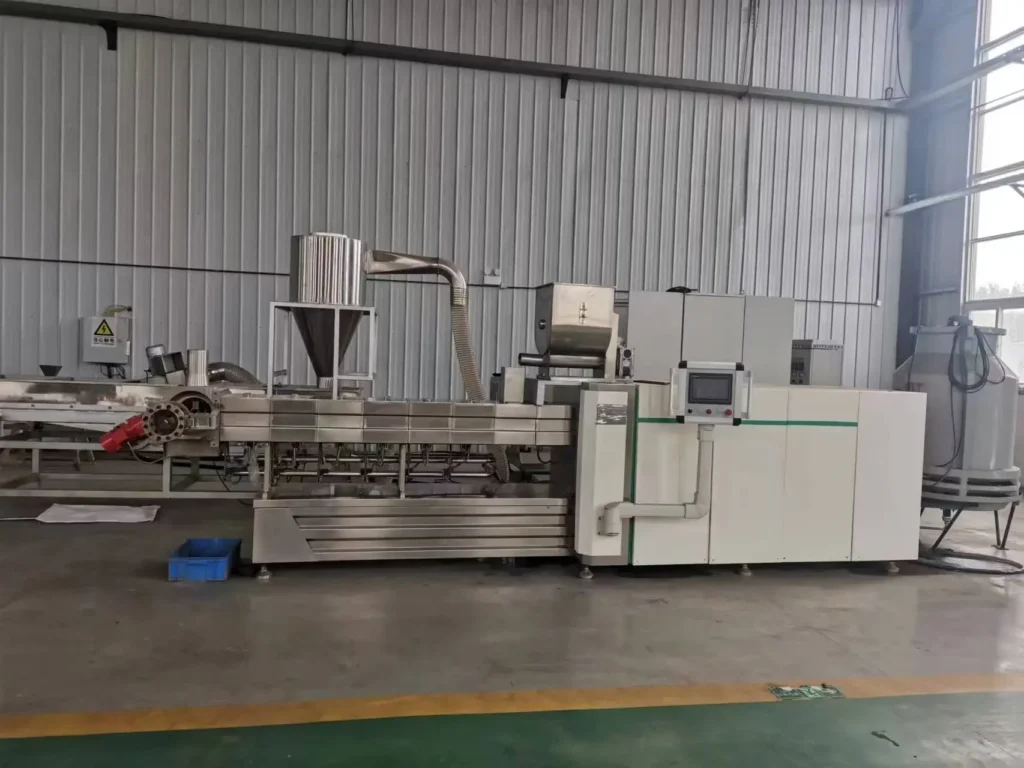

Buying a bigger extruder does not automatically double your output.
Scaling to a DS95 high-capacity extruder requires holistic line matching, especially front-end preprocessing and screw configuration, rather than just upgrading the main machine.
I still remember the smell of burnt starch and the sound of a tripped circuit breaker from a factory visit years ago. A startup owner had just installed a massive twin-screw machine to chase higher tonnage, but the upstream hammer mill was sized for a much smaller unit. The feeder starved the barrel within minutes, the motor drew peak current, and the shear heat scorched the dough before it even reached the die. Watching the crew spend hours digging out carbonized material from the barrel taught me a hard lesson about system balance. When evaluating a DS95 extruder pet food production setup, I always check the raw material prep section and the die open-area ratio before looking at the main motor size.
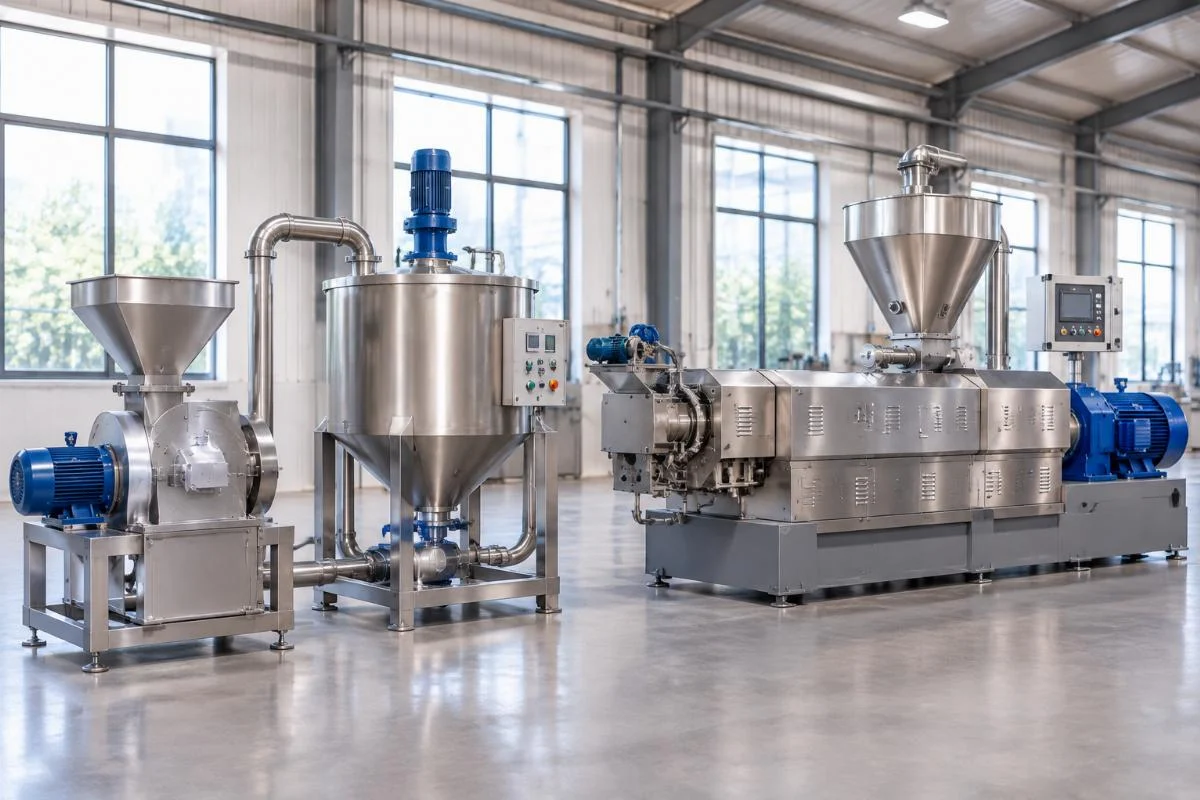
If the upstream cannot deliver a consistent, pre-conditioned mash at the required feed rate, the main machine will simply choke or run inefficiently.
Why Does the DS95 Extruder Need Perfect Front-End Matching?
Upstream preprocessing dictates the actual capacity of the DS95.
Many buyers assume that installing a high-capacity DS95 extruder pet food production line means they only need to focus on the extruder itself. In reality, the front-end grinding and mixing stages set the physical limits of the entire system. If the particle size from the grinder is too large, the conditioner cannot hydrate the core of the particles, leading to uneven gelatinization. If the mixer lacks precision, minor ingredients like vitamins and binders distribute poorly, causing localized weak spots in the final kibble.
A contract manufacturer in Southeast Asia once upgraded to a larger twin-screw setup but kept their old ribbon blender. The batch-to-batch variation in moisture content caused the extruder torque to fluctuate wildly. They experienced frequent jamming and had to constantly adjust the steam valves, which ruined their throughput targets. We had to redesign their front-end dosing and install a high-shear mixer to ensure a homogeneous blend before the material entered the preconditioner.
Here is a comparison of how front-end matching impacts the line:
| Preprocessing Stage | Poor Matching | Standard Matching | Optimized Matching |
|---|---|---|---|
| Particle Size | Uncontrolled | Standard | Noticeably reduced |
| Moisture Distribution | Vulnerable | Resistant | Robust |
| Feeder Stability | Uncontrolled | Standard | Controlled |
| Final Torque Stability | Vulnerable | Resistant | Robust |
Without a properly calibrated front-end, even the most powerful DS95 extruder pet food production setup will suffer from starvation feeding, where the screw channels are only partially filled, destroying the shear history required for proper cooking.

How to Configure Screws and Dies for High-Capacity Pet Food?
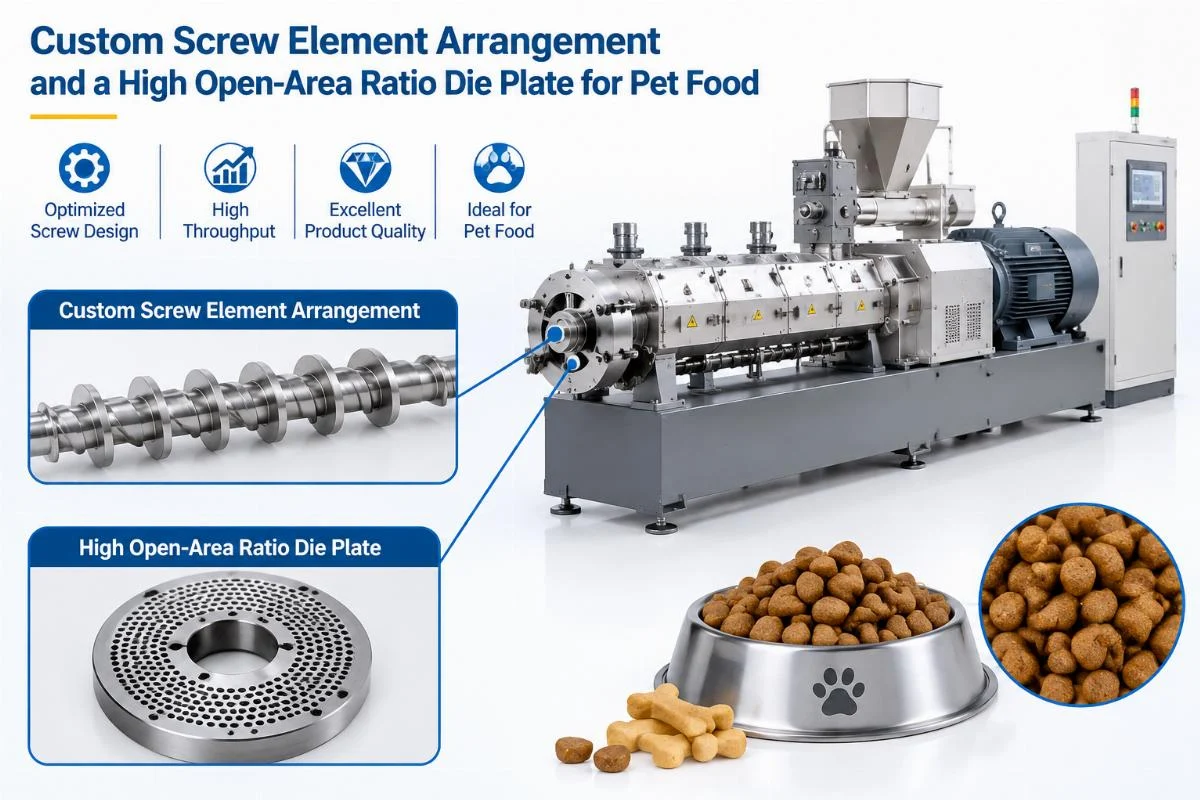
Custom screw elements and die open-area ratios prevent motor overload and ensure pellet quality.
There is no universal screw profile that works for every recipe. A high-meat formula requires a completely different shear and residence time profile compared to a high-starch cereal base. When scaling up to a DS95 extruder pet food production line, the length-to-diameter ratio and the sequence of conveying, kneading, and reverse elements must be tailored to the specific formulation.
Consider a high-volume treat line that switched from a standard poultry recipe to a novel protein blend with higher fat content. The existing screw configuration, designed for high-starch friction, failed to generate enough shear to emulsify the fats. The result was a greasy, poorly formed pellet that broke easily during cooling. By reconfiguring the screw elements to include more intensive kneading blocks and adjusting the compression ratio, the material achieved the necessary specific mechanical energy without exceeding the barrel temperature limits.
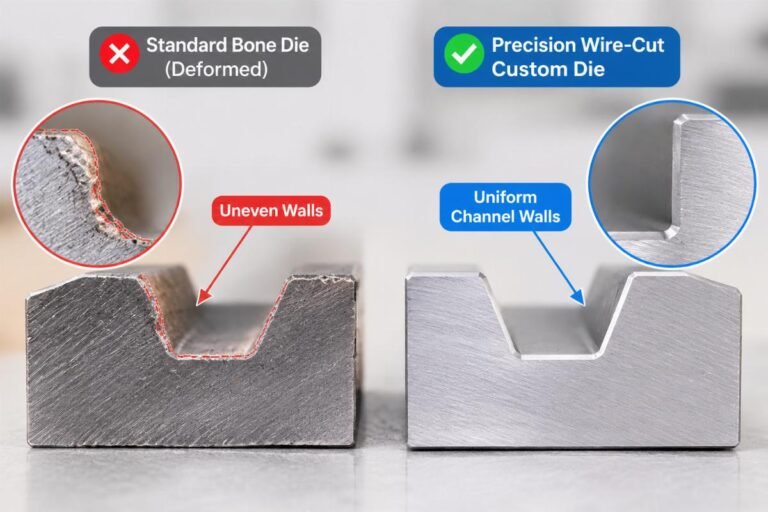
The die plate is equally critical. The open-area ratio—the percentage of the die face that is actually hole space—must match the volumetric output of the screw. If the open area is too small, the backpressure spikes, the motor overloads, and the die temperature rises uncontrollably. If it is too large, the pellets lack the necessary density and sink in the water or float poorly, depending on the target species.
| Die Configuration Factor | Incorrect Setup | Correct Setup |
|---|---|---|
| Open-Area Ratio | Uncontrolled | Controlled |
| Hole L/D Ratio | Vulnerable | Robust |
| Motor Load | Vulnerable | Resistant |
| Pellet Durability | Vulnerable | Robust |
A Middle East pet food producer learned this the hard way when their new large extruder kept tripping the main breaker. The die they were using had a low open-area ratio meant for a smaller machine. By drilling a new die with a higher open-area ratio and optimizing the hole length-to-diameter ratio, they reduced the backpressure significantly and stabilized the motor load.
What Are the Common Bottlenecks in Large-Scale Pet Food Lines?
Conditioning time and dryer mismatch cause downstream failures despite a powerful extruder.
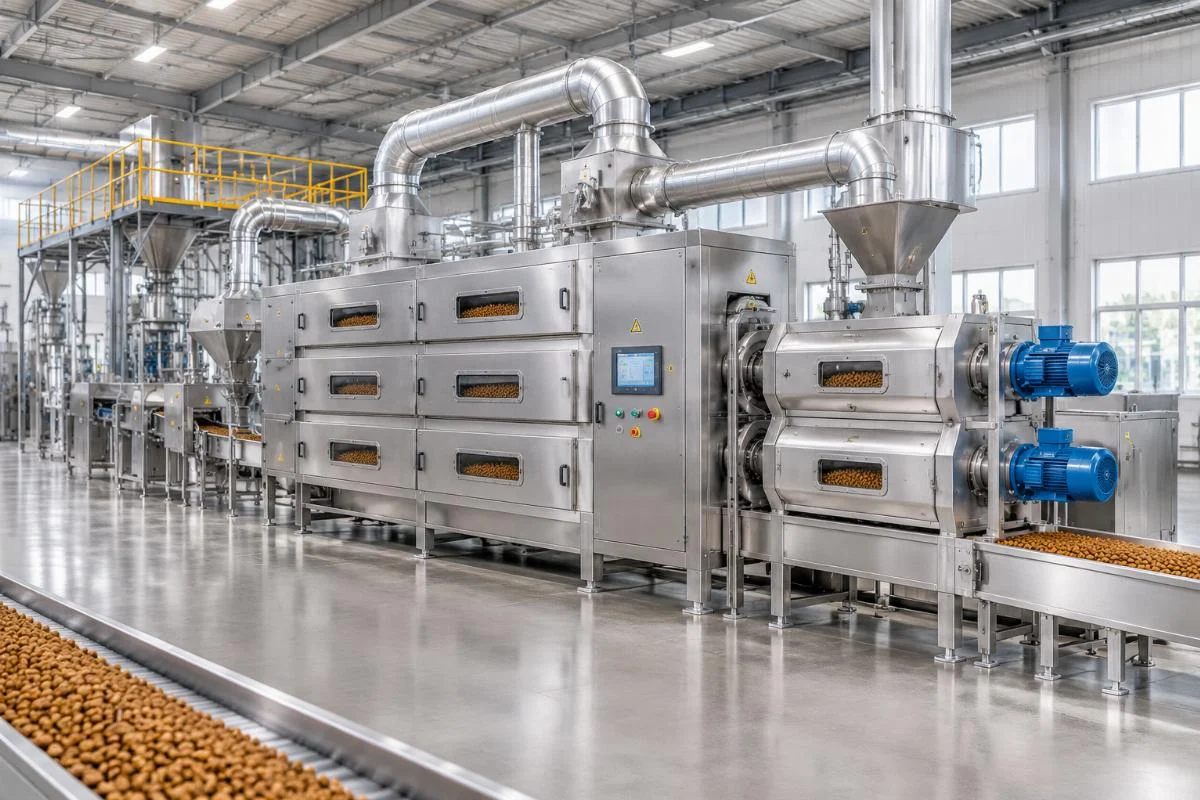
The extruder is just the heart of the line; the veins and arteries are the dryers, coolers, and coaters. A common bottleneck in any DS95 extruder pet food production project is the dryer capacity. High-capacity extruders produce a massive volume of wet pellets that must be dried to a safe moisture level for storage. If the dryer is too short or lacks proper airflow distribution, the center of large kibble pieces remains moist, leading to mold growth during storage.
Another hidden bottleneck is the conditioner retention time. To achieve proper starch gelatinization and protein denaturation, the raw meal must be held at a specific temperature with added steam for a sufficient duration. Many lines use a simple single-shaft conditioner that pushes material through too quickly. The material exits under-cooked, resulting in poor pellet durability and high fines generation in the packaging bags.
A European startup scaling up their puppy food line noticed that their kibble was disintegrating during the coating process. The extruder was running perfectly, but the single-shaft conditioner was only providing a fraction of the required retention time. By upgrading to a double-shaft differential speed conditioner, they extended the retention time and increased the steam addition, which dramatically improved the starch gelatinization degree and the final pellet durability.
How to Evaluate a Turnkey DS95 Production Line Supplier?
Look for whole-line integration capabilities, formula R&D support, and on-site commissioning.
When sourcing a DS95 extruder pet food production line, you are not just buying a piece of metal; you are buying a process guarantee. A supplier who only sells the main extruder and leaves you to figure out the dryer, cooler, and front-end mixing is setting you up for failure. You need a partner who understands the rheology of pet food dough and the thermodynamics of the entire drying cycle.
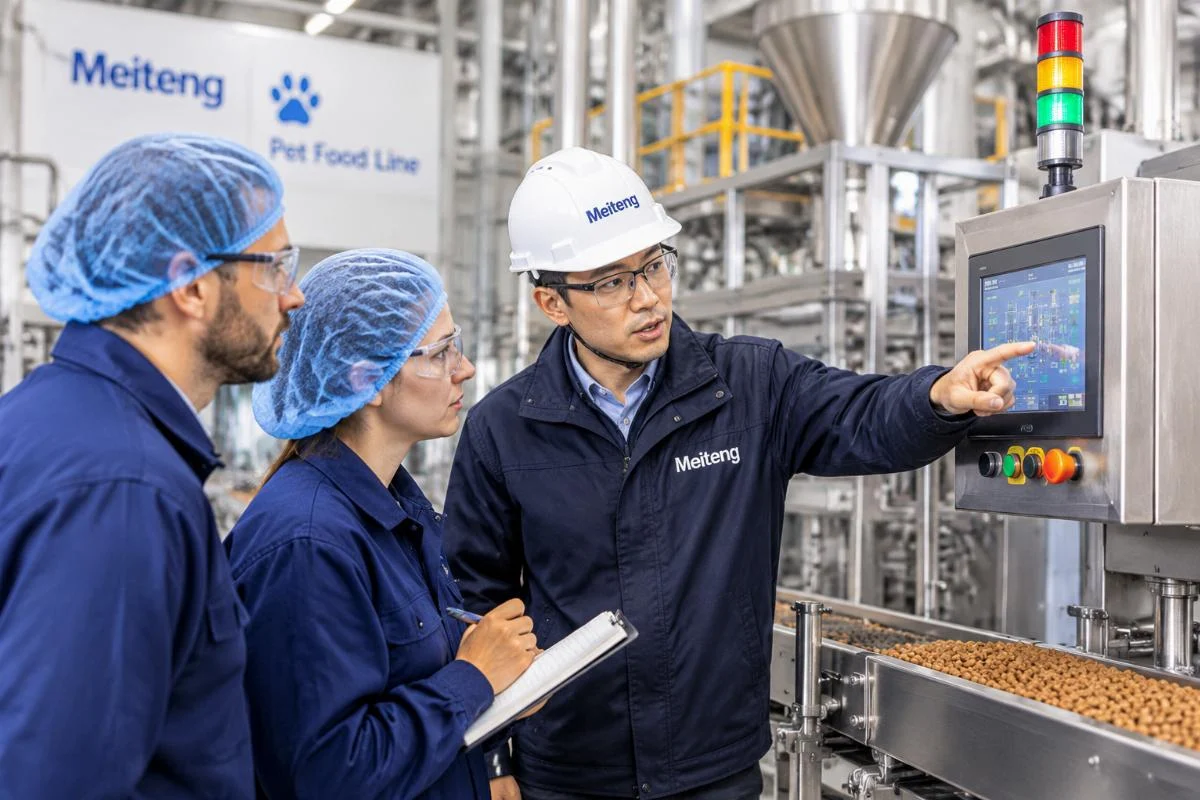
Meiteng approaches every DS95 extruder pet food production project as a holistic system. Our engineering team starts by analyzing your target recipes and throughput goals, then designs the front-end preprocessing to ensure a perfectly conditioned mash enters the barrel. We custom-configure the screw elements and die plates based on your specific protein and starch ratios, ensuring the motor runs within its optimal load range.
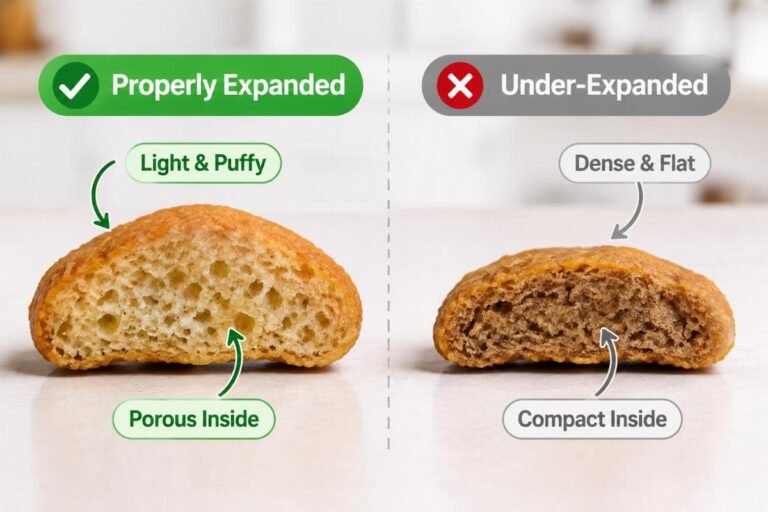
Furthermore, we provide comprehensive formula development support. If you are launching a new high-meat treat or a specialized diet, our R&D team helps you balance the ingredients to achieve the right expansion and density. Our turnkey service includes on-site installation, commissioning, and operator training, ensuring your local team knows exactly how to manage the steam valves, adjust the feeder, and change the dies efficiently. We build the line in food-grade stainless steel, meeting strict sanitary standards, and back it up with remote diagnostic assistance to keep your production running smoothly across multiple regions.
Conclusion
Scaling up requires system thinking, not just a bigger motor.
Successfully running a DS95 extruder pet food production line depends entirely on balancing the front-end preprocessing, custom screw and die configurations, and downstream drying capacity. Ignoring any of these interconnected stages will turn a high-capacity machine into a bottleneck, while a fully integrated approach ensures consistent quality and maximum throughput.