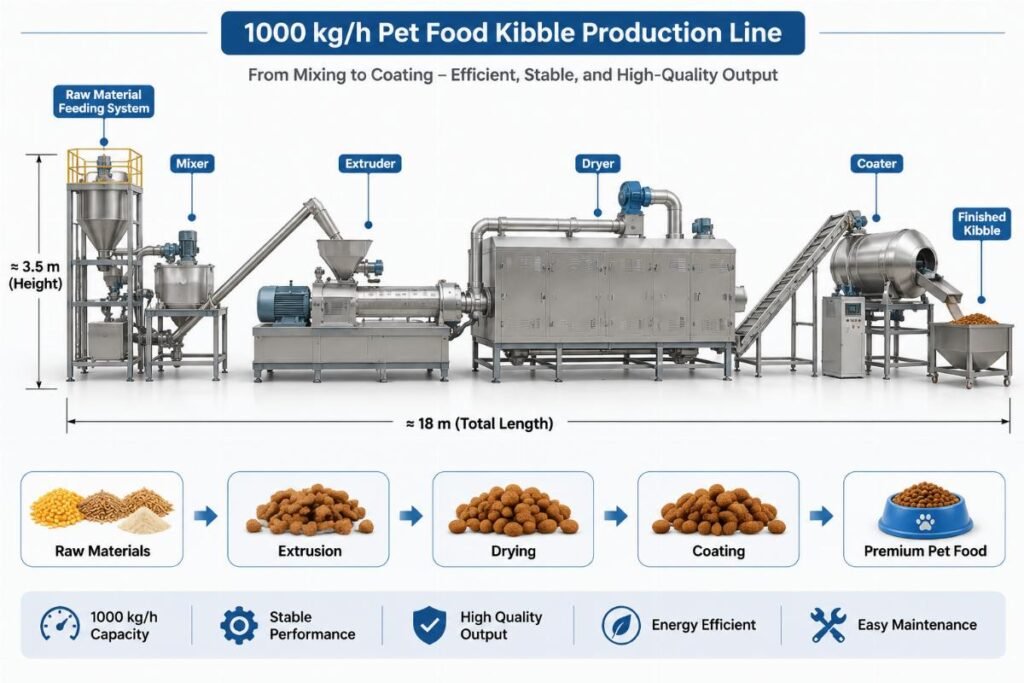
Buying the biggest extruder is useless if the downstream dryer cannot handle the moisture load.
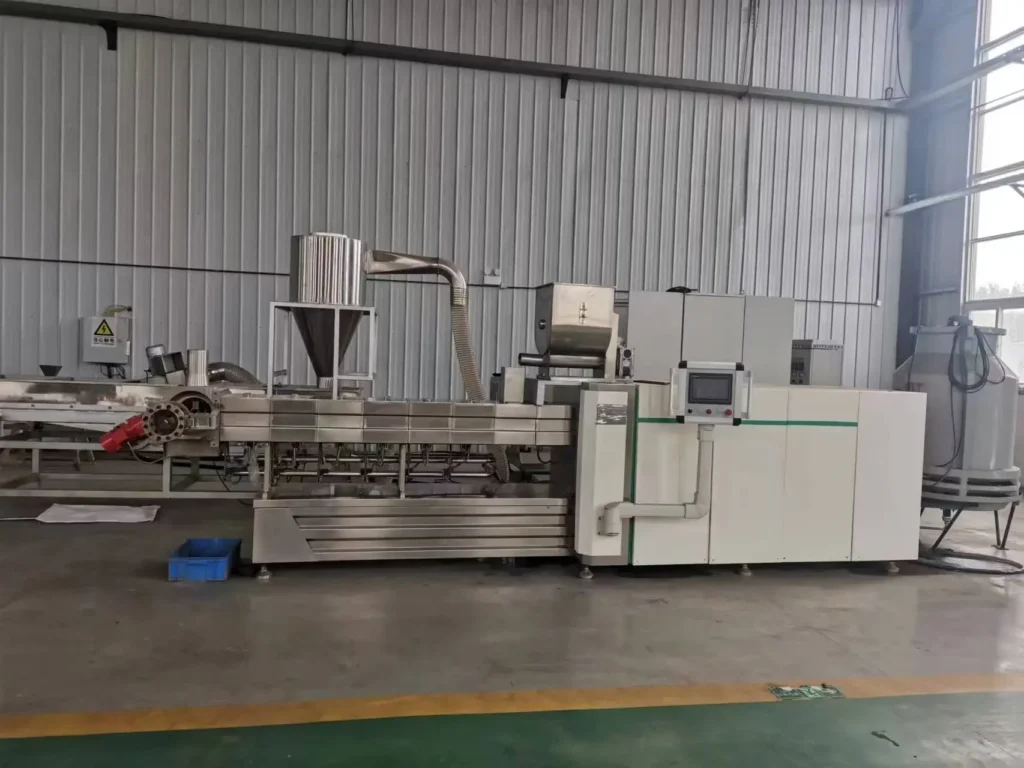
The success of a 1000 kg/h kibble production line relies entirely on strict parameter matching between the extruder, dryer, and coater, rather than just maximizing individual machine capacities.
Back when I handled shipping documents in Ningbo, I processed a 1000 kg/h kibble production line order without double-checking the technical layout with the engineering team. The client requested an extended drying section to ensure thorough moisture removal, but nobody calculated the total line length against the container limits. When the equipment arrived at the port, the 40HQ container simply could not swallow the extended dryer section. We had to dismantle the machinery, rebuild the frames, and switch to wooden pallets, which ended up costing us a mid-six-figure sum in extra ocean freight and port miscellaneous fees. That painful lesson shifted my entire career toward business development, where I now obsess over production line configurations and loading plans. A 1000 kg/h kibble production line demands a dryer with sufficient heat exchange area and a coating drum with precise temperature control. Missing a single meter in length or a set of heating pipes means the moisture content stays dangerously high on-site, and the fat coating simply slides off the kibble. Data does not lie, and parameter matching is the absolute baseline for a smooth-running line.
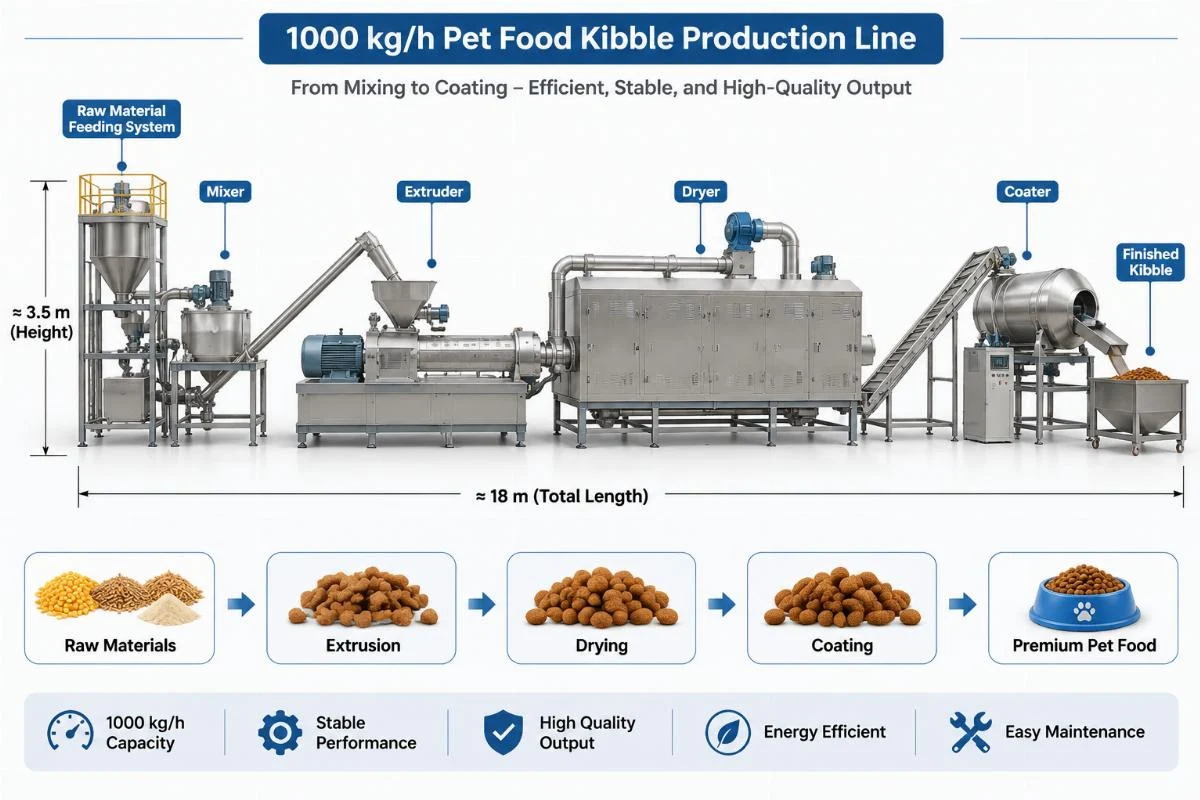
Transitioning from document errors to system design reveals a universal truth in pet food manufacturing: the line is a single organism, and mismatched components will inevitably ruin the extruder’s output.
Why Parameter Matching Beats Individual Machine Specs?
A production line operates as a closed thermodynamic system, where the weakest link dictates the final product quality.
Many startup owners assume that upgrading to a more powerful twin-screw extruder automatically guarantees higher output. However, if the downstream equipment is not scaled proportionally, the entire batch is compromised. When you push more raw material through the barrel, the moisture evaporation load increases exponentially. If the dryer’s heat exchange capacity remains static, the kibble exits the cooling belt with a moisture content that invites mold growth within weeks. According to industry benchmarks, the majority of quality complaints in extruded pet food stem from downstream processing mismatches rather than extrusion failures.
I once consulted for a contract manufacturer who scaled up their extruder output but kept the original dryer length to save on capital expenditure. The result was a disaster. The kibble felt dry to the touch but retained internal moisture pockets. Within a short retention period in the warehouse, the entire batch showed signs of microbial spoilage. The extruder was working perfectly, but the system was fundamentally unbalanced. To fix this, we had to redesign the twin-screw kibble line configuration to ensure the thermal mass of the dryer matched the exact throughput of the extruder.
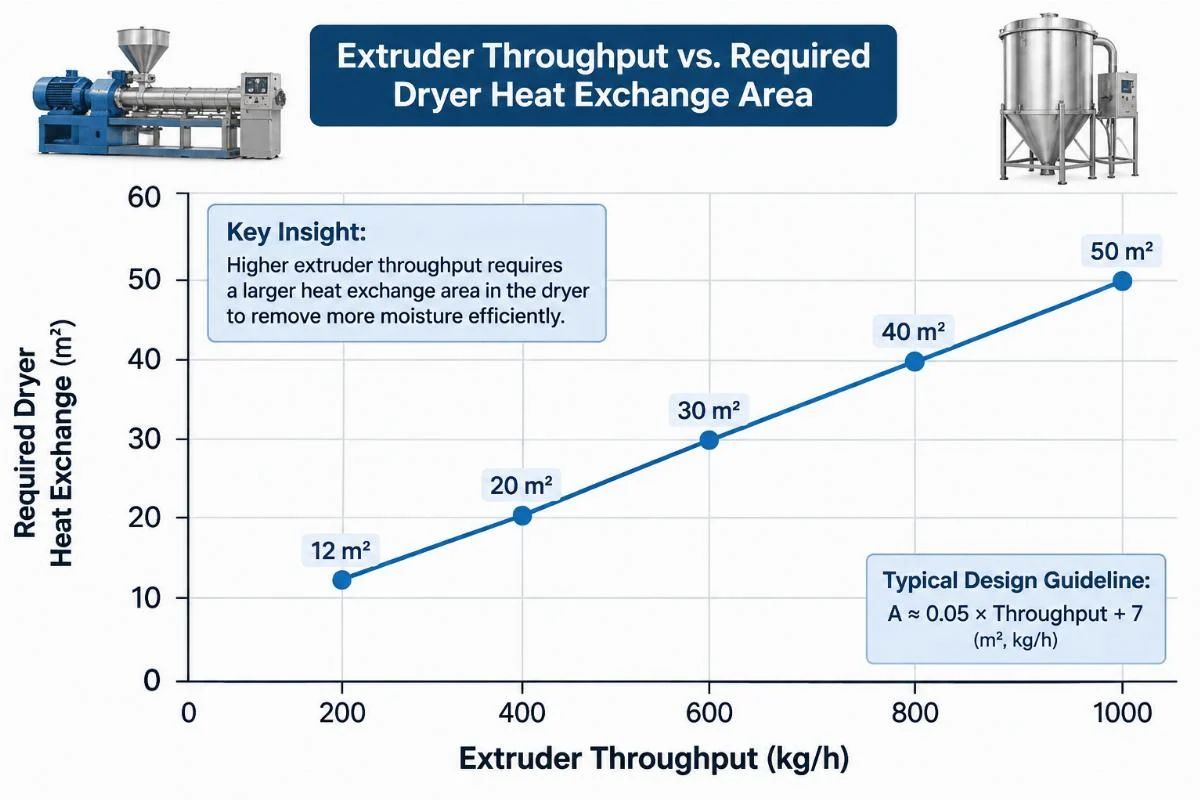
How to Size the Dryer for 1000 kg/h Extruder Output?
Sizing the dryer requires calculating the required heat exchange area and retention time, not just measuring physical length.
When configuring a 1000kg pet food extruder dryer coating setup, the physical length of the dryer is merely a byproduct of the thermodynamic requirements. The core methodology involves mapping the moisture reduction curve of the specific formula against the available thermal energy. Different recipes—whether high-meat, grain-based, or starch-heavy—release bound water at different temperature thresholds. A generic dryer length will fail to account for these specific evaporation peaks.
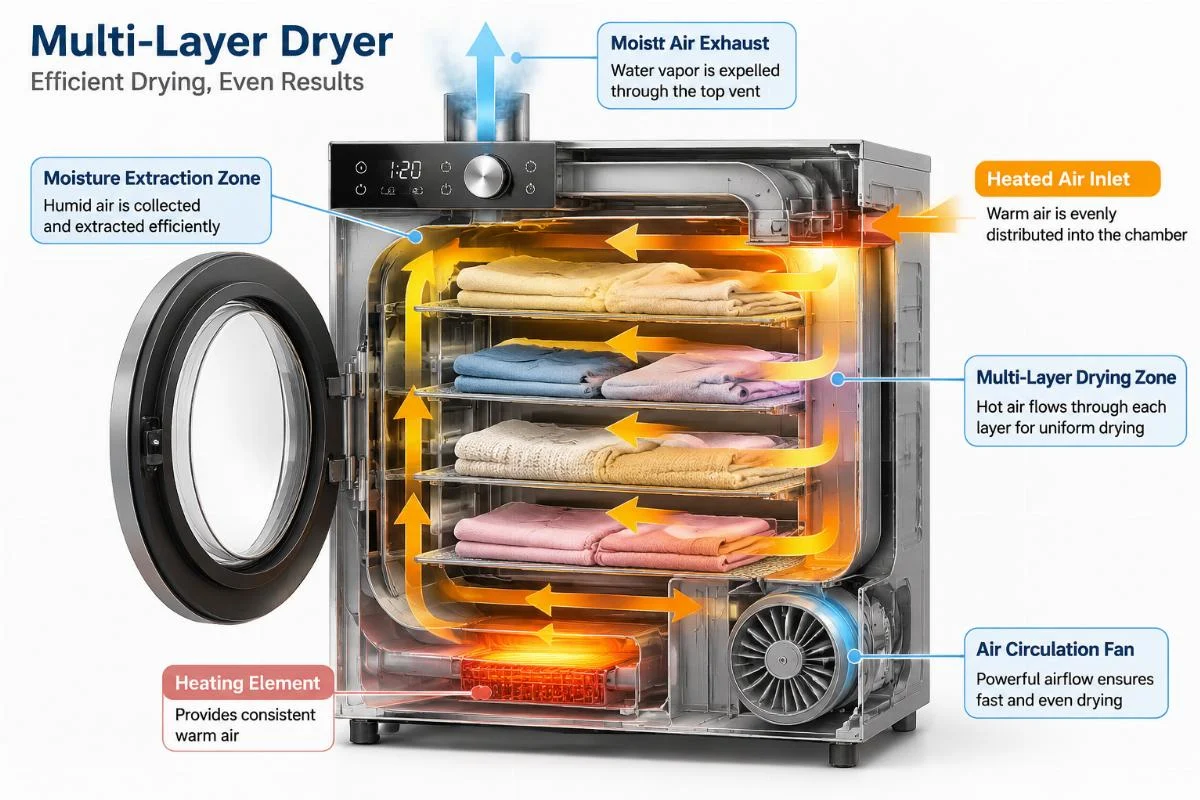
The engineering team must calculate the exact volume of air required to carry away the evaporated moisture without saturating the drying chamber. If the airflow is insufficient, the humidity inside the dryer spikes, creating a sauna effect that halts evaporation. Furthermore, the retention time must be long enough to allow the core of the kibble to reach the target temperature. We utilize heat exchange area calculations to determine the optimal number of heating layers and the specific airflow velocity.
During a project for a Southeast Asian aquaculture feed producer, they initially wanted the shortest possible dryer to fit into a cramped factory space. By running the moisture reduction curve, we proved that a shorter dryer would require excessively high inlet temperatures, which would scorch the outer layer of the fish feed while leaving the core raw. We adjusted the 1 ton per hour pet food manufacturing equipment layout to include a multi-pass drying strategy, ensuring gentle, uniform heat penetration without compromising the factory footprint.
What Makes the Coating Drum Ensure Even Fat Adhesion?
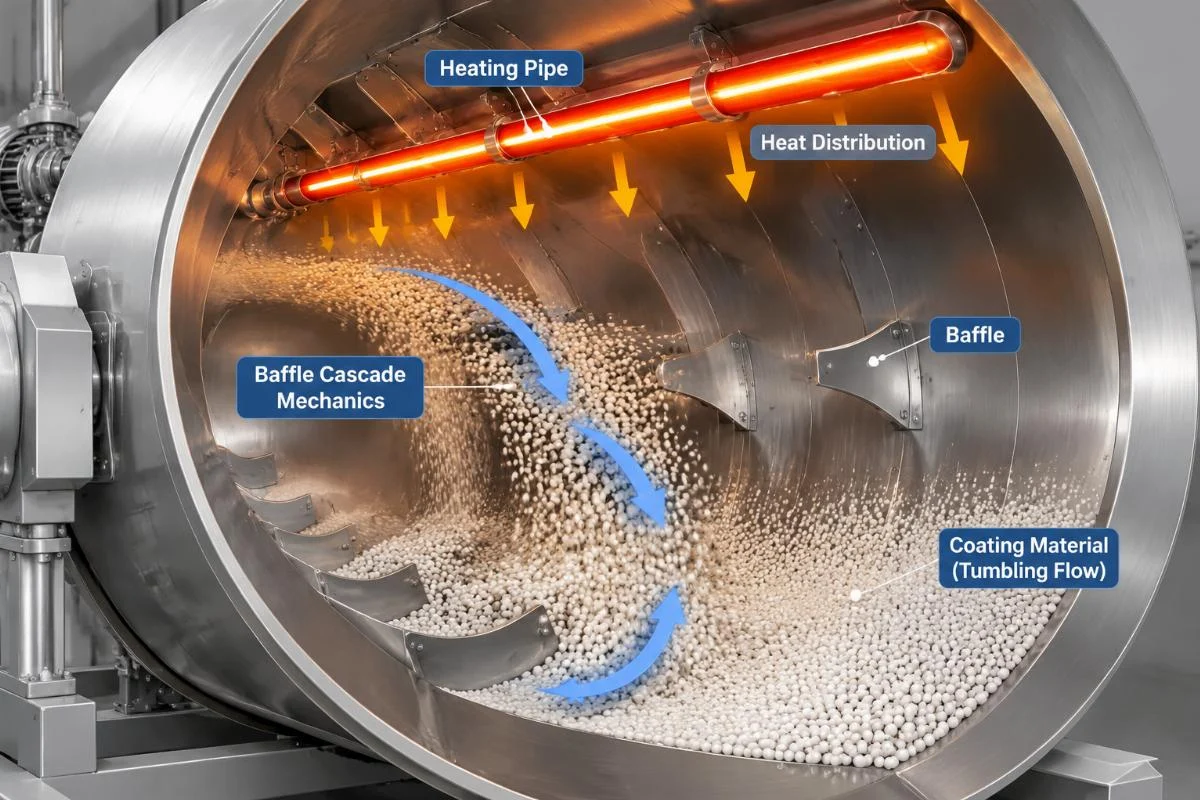
Precise temperature control and internal baffle design are critical for coating retention and uniform fat distribution.
The coating stage is where the kibble gains its palatability and nutritional fat content. However, applying liquid fat or flavoring to a porous, warm kibble surface is highly sensitive to thermal shock. If the coating drum is too cold, the fat solidifies instantly upon contact, creating uneven clumps and leaving large areas of the kibble uncoated. If the drum is too hot, the fat oxidizes rapidly, ruining the flavor profile and reducing the shelf life.
The secret lies in the heating tube count and the drum’s temperature uniformity mapping. A standard coating drum might rely on a few external heating elements, which creates hot spots and cold zones. In a properly engineered 1000 kg/h kibble production line, the drum is equipped with an optimized array of internal heating pipes that maintain a stable, consistent wall temperature. Additionally, the internal baffles must be angled perfectly to lift and cascade the kibble through the fat mist repeatedly, ensuring every piece receives a micro-thin, even layer.
I recall a case where a client complained about poor fat adhesion and a greasy bag bottom. Upon inspecting their 1000kg pet food extruder dryer coating setup, we found the coating drum lacked adequate heating pipes, causing the fat to pool at the bottom rather than atomize and adhere. We retrofitted the drum with a denser heating tube configuration and adjusted the baffle angles. The fat adhesion improved drastically, and the bag bottom remained completely clean. Industry standards emphasize that drum temperature uniformity is the primary driver of coating efficiency.
How to Plan the Layout for 40HQ Container Shipping?
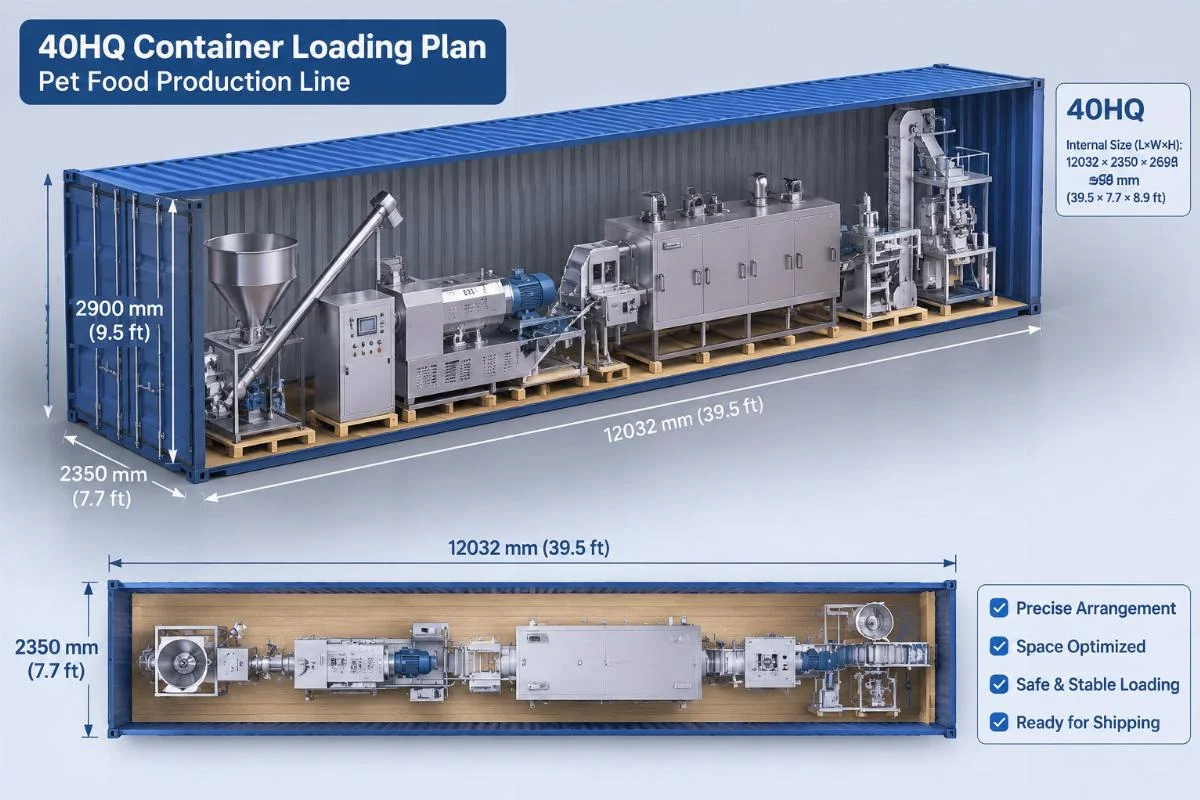
Mapping the total line length against container internal limits is mandatory to avoid costly on-site disassembly and freight surcharges.
This is where my Ningbo document days come back to haunt me. Exporting a twin-screw kibble line configuration requires a meticulous marriage between engineering design and logistics reality. A standard 40HQ container has strict internal length and door opening dimensions. If the production line exceeds these limits by even a fraction, the equipment will not fit, or worse, it will get stuck at the door during loading.
When designing a 1000 kg/h kibble production line for overseas clients, the layout must be consolidated and optimized for container-load consolidation. This means positioning the extruder, dryer, and coater in a way that minimizes the overall footprint without compromising the workflow or maintenance access. Sometimes, this requires elevating the cooler or stacking the control cabinets. Every single meter counts. If the dryer section is unnecessarily elongated due to poor thermal design, it will inevitably cause a 40HQ overflow.
The consequences of ignoring this are severe. Disassembling heavy machinery at the port, custom-building wooden crates, and paying for broken stowage space will multiply the shipping budget exponentially. By pre-calculating the exact dimensions and creating a detailed 3D loading plan, we ensure that the 1 ton per hour pet food manufacturing equipment slides into the container seamlessly. This export-optimized layout consolidation not only saves freight costs but also ensures that the client receives a fully integrated system that is ready for rapid assembly on-site.
Conclusion
System synergy dictates the final product quality, not isolated machine specifications.
A successful 1000 kg/h kibble production line demands rigorous thermodynamic matching between the extruder, dryer, and coater, alongside a logistics-aware layout that respects container boundaries. Ignoring these parameters leads to moisture failures, poor coating adhesion, and severe freight penalties, proving that holistic engineering is the only path to profitable manufacturing.
Machines Mentioned in This Article

cat food machine
Pet Food Processing Equipment Plant Manufacturer Dog Food
View Machine
cat food machine
Dry Dog Food Production Line Pet Food Pellet Machine
View Machine
cat food machine
Dog Food Pellet Making Machine Line, Automatic Pet
View Machine
cat food machine