Most buyers obsess over the extruder motor power, completely ignoring that the facility exhaust capacity actually dictates the final pellet quality and mold prevention.
A successful 200 kg/h pet food production line relies not just on extruder specs, but on matching component sequencing with facility environmental constraints like ventilation and spatial flow. Every module from the mixer to the coating drum must synchronize with the twin-screw extruder’s throughput, while the physical layout must accommodate maintenance clearances and moisture exhaust to prevent catastrophic production failures.
I spent years turning screws on the shop floor in Jinan before heading to Latin America to run equipment installations. A couple of years ago, I was in Monterrey, Mexico, setting up a 200 kg/h pet food production line for a local facility. We strictly followed the blueprint for equipment placement but neglected to thoroughly evaluate the existing厂房 ventilation conditions. When the rainy season hit, the dryer could not exhaust moisture fast enough due to the high ambient humidity ratio. The freshly extruded dog food went moldy within days, and the final payment was completely frozen. Since that disaster, I have obsessed over matching on-site environmental parameters with equipment specs. Writing this component and layout guide is my way of helping you avoid those exact same pitfalls before they drain your capital.

Let us break down the exact components, spatial logic, and environmental integrations required to make this capacity run smoothly.
What Are the Core Components of a 200 kg/h Pet Food Line?
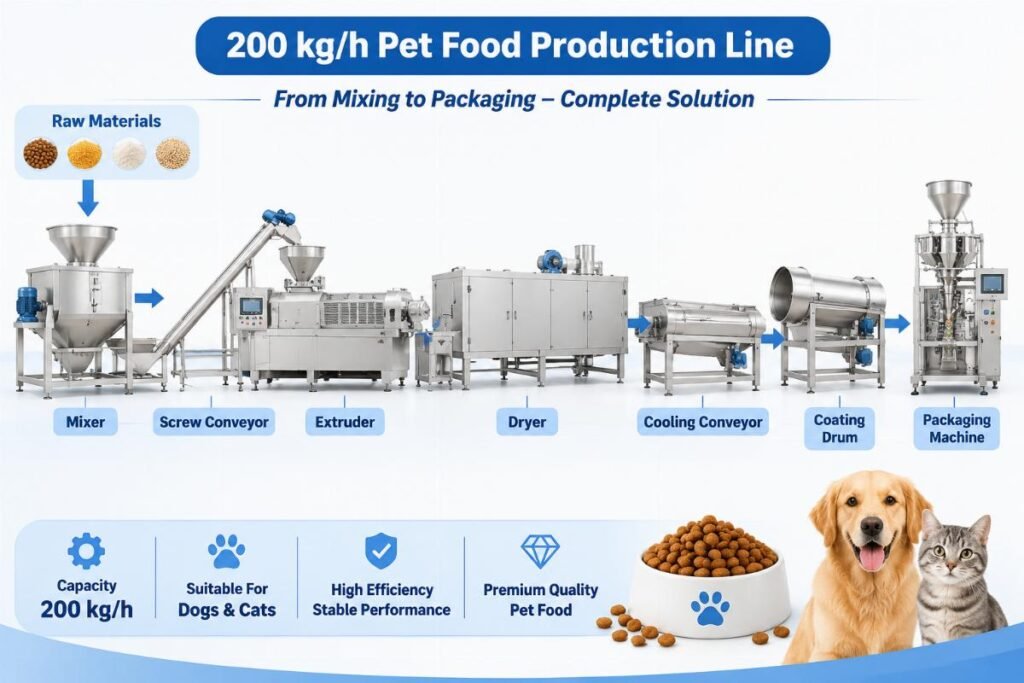
From the initial mixing stage to the final flavor coating drum, every single module must synchronize perfectly with the twin-screw pet food extruder setup to maintain a steady throughput without bottlenecks.
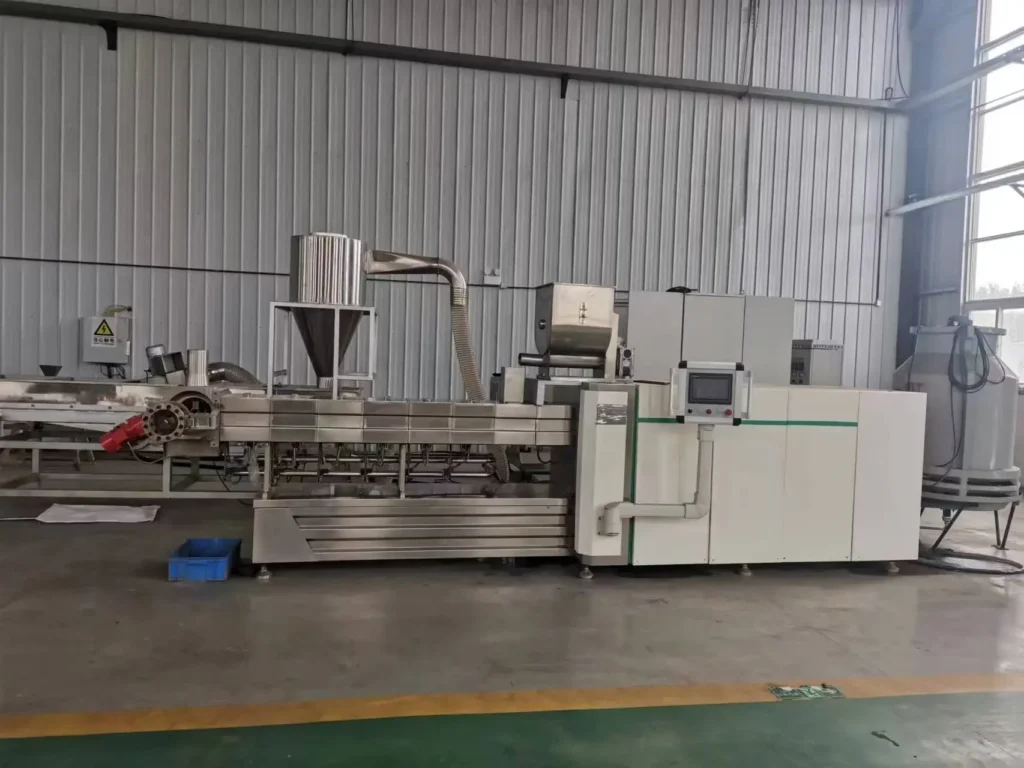
A 200 kg/h pet food production line is not just a standalone extruder; it is a carefully orchestrated sequence of pet food extruder line components. The process begins with the hammer mill and ribbon mixer, where raw materials are pulverized and homogenized. If the mixer batch size is too large for the extruder’s continuous feed requirement, you will experience starvation feeding, leading to unstable pressure inside the barrel and inconsistent pellet expansion.
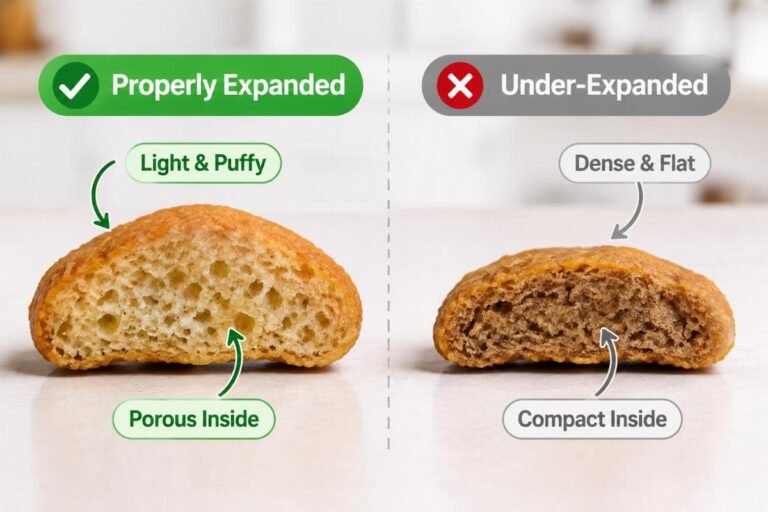
Following the mixer, the twin-screw extruder is the heart of the operation. At this capacity, the screws and barrels must handle high shear and precise temperature control to gelatinize starches properly. The extruded product then enters the dryer. Here is a counter-intuitive truth: most startups think bigger dryers are inherently better. The actual reason for failure is mismatching the dryer residence time to the exact extruder output. Over-drying makes the pellets brittle and destroys nutritional value, while under-drying invites mold. The dryer must be sized to remove the specific moisture content introduced by the conditioning process, not just to handle maximum volume.
After drying, the cooling section brings the pellet temperature down to ambient levels, preparing it for the coating drum where fats and palatants are applied. Finally, the packaging scale weighs and seals the product. Meiteng’s 200 kg/h turnkey line integrates all these pet food extruder line components using food-grade 304 stainless steel, ensuring that the entire sequence meets international food safety hygiene standards while maintaining the precise throughput required for commercial viability.

How to Plan the Spatial Layout for Maximum Efficiency?
Logical material flow and adequate maintenance clearances prevent operational bottlenecks and drastically reduce equipment downtime during routine changeovers.
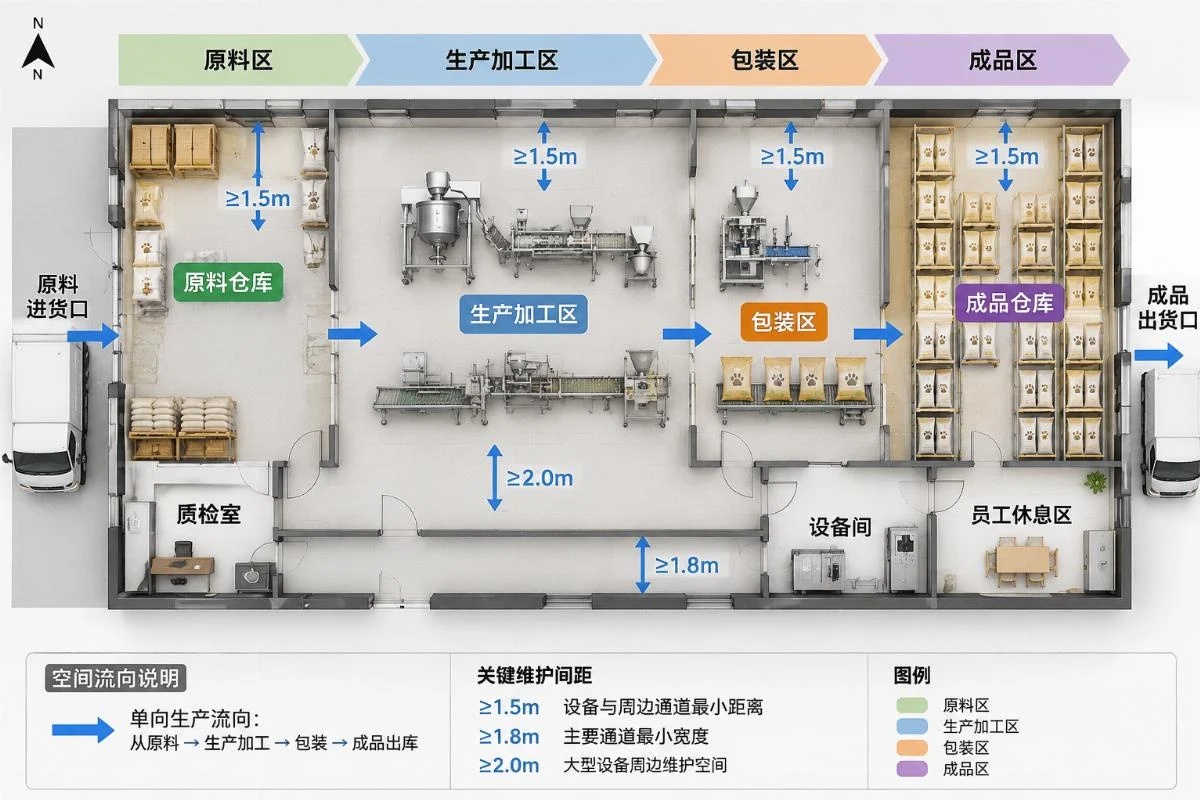
Designing the 200kg/h pet food line layout requires more than just fitting machines into a warehouse; it demands a strict spatial flow mapping from raw material intake to finished packaging. The layout must follow a unidirectional flow to prevent cross-contamination, which is especially critical for a multi-product startup producing different protein recipes or therapeutic diets.
In a compact warehouse setup, equipment clearance becomes a major constraint. You must allocate specific maintenance aisle widths around the extruder and dryer. If you pack the machines too tightly to save footprint, replacing a worn screw element or cleaning the dryer interior becomes a logistical nightmare, extending downtime significantly. The 200kg/h pet food line layout must account for the physical extraction space needed for the twin-screw pet food extruder setup during barrel opening.
Furthermore, the layout must separate the raw material handling zone from the finished product packaging zone. Dust from the milling section can easily contaminate the coated kibble if the spatial flow is not strictly controlled. Dedicated cooling zone airflow velocity must be mapped to ensure that the cooling air does not blow backward into the drying or coating sections. Meiteng provides on-site layout commissioning as part of our turnkey service, specifically resolving these spacing challenges by mapping the exact footprint required for safe operation and maintenance access, ensuring your facility design codes are fully respected.
Why Does Facility Ventilation Make or Break Pellet Quality?
Proper exhaust design removes moisture effectively from the drying and cooling zones, preventing mold growth and ensuring the final product achieves its intended shelf life.
This is where many new facility managers fail spectacularly. The exhaust capacity of your facility directly dictates the actual pellet quality. If the ambient air is saturated with moisture because the exhaust system is undersized, the dryer cannot pull moisture out of the kibble. In my Monterrey project, the local climate during the rainy season pushed the ambient moisture ratio to a level where the standard exhaust fans simply could not create enough negative pressure.
Airflow calculation methods for multi-stage dryers must account for the worst-case local weather conditions, not just the average dry season. The exhaust ducts must be sized to handle the volume of evaporated water plus the sensible heat required to maintain the drying temperature. If the exhaust velocity is too low, moist air lingers around the product, creating a microclimate that promotes surface mold.
Additionally, the cooling section requires a massive volume of ambient air to drop the pellet temperature. If the cooling zone exhaust is not balanced with the dryer exhaust, you create positive pressure in the facility, pushing humid air back into the drying tunnel. Industrial ventilation engineering guidelines dictate that the exhaust volume must exceed the supply air volume to maintain negative pressure in the processing area. Meiteng’s engineering team calculates these exact ventilation requirements during the facility design phase, ensuring that the 200 kg/h pet food production line operates flawlessly regardless of the local climate, preventing the exact humidity control failures I witnessed in Latin America.

How to Integrate Utilities and Power for Stable Operation?
Accurate load calculation and precise utility routing ensure continuous running without tripping the main breakers or causing voltage drops during peak extrusion.
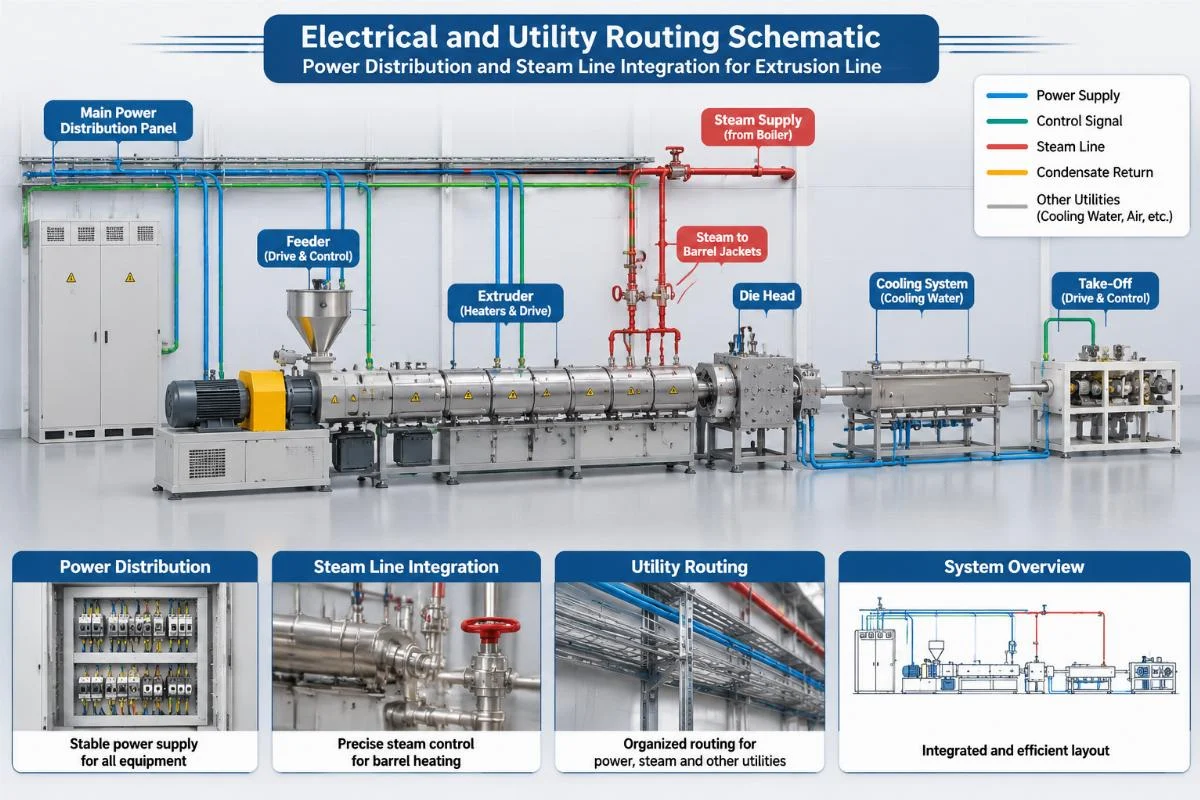
A 200 kg/h pet food production line draws significant power, particularly during the startup phase of the twin-screw pet food extruder setup when the motors must overcome the high viscosity of cold raw materials. Power load distribution across the extrusion, drying, and coating zones must be calculated to prevent phase imbalance and voltage drops.
The extruder requires a dedicated soft-start or variable frequency drive system to manage the massive inrush current. If the facility’s transformer is sized only for the running load, the startup surge will trip the main breaker or cause voltage sags that disrupt the programmable logic controllers of the other pet food extruder line components.
Beyond electricity, utility routing for steam, compressed air, and water must follow agricultural facility design codes. Steam is critical for the preconditioner, which injects moisture and heat into the raw mix before it enters the extruder. The steam lines must be properly insulated and pitched to prevent condensate from entering the preconditioner, which would cause uneven hydration and extruder surging. Compressed air powers the pneumatic valves and actuators throughout the line; if the air pressure drops due to undersized piping, the discharge gate on the extruder may fail to open, causing a dangerous pressure buildup inside the barrel. Meiteng’s turnkey approach includes comprehensive utility load mapping and on-site commissioning, ensuring that every electrical and fluid connection is verified before the first batch of raw material is fed into the system.
Conclusion
Building a reliable production facility requires balancing mechanical throughput with environmental reality. A perfectly engineered 200 kg/h pet food production line will still fail if the spatial layout restricts maintenance or if the ventilation cannot handle the local humidity. By synchronizing the pet food extruder line components with rigorous facility planning, you ensure stable output, product safety, and long-term operational success.
Machines Mentioned in This Article

cat food machine
Pet Food Processing Equipment Plant Manufacturer Dog Food
View Machine
cat food machine
Dry Dog Food Production Line Pet Food Pellet Machine
View Machine
cat food machine
Dog Food Pellet Making Machine Line, Automatic Pet
View Machine
cat food machine