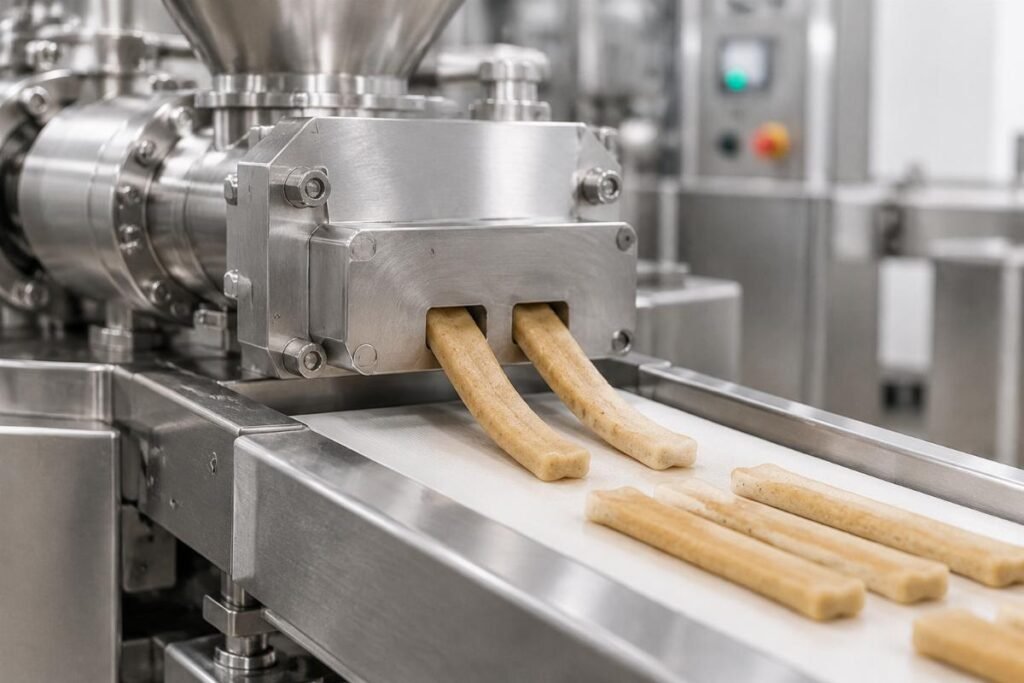
Most buyers obsess over the extruder, but the cooling stage actually dictates your final shelf-life and mold prevention.
A successful dental chew production line requires a closed-loop process flow where extrusion, drying, and cooling are perfectly balanced to prevent mold and ensure the exact texture dogs need for proper plaque removal.
I spent my early career squatting in workshops in Dongguan, tweaking the die heads of twin-screw machines until my hands were covered in dough and grease. Back then, I thought the magic only happened inside the barrel. It was not until I transitioned to international sales that I realized a machine that simply runs is useless if the process flow is broken. I remember a Southeast Asia client who launched a dental chew line and decided to cut the cooling stage to save on initial capital. They packaged the treats straight out of the dryer. When the summer heat hit the warehouse, the residual moisture caused condensation inside the bags. The entire container molded, resulting in a total batch rejection and a mid-six-figure loss. Since that disaster, I refuse to sign off on a project unless the process diagram is airtight. From extrusion shaping to the final cooling tunnel, every single step is non-negotiable.

Let us break down the exact machinery, the step-by-step flow, and the hidden traps that ruin batches.
What Machines Make Up a Dental Chew Line?
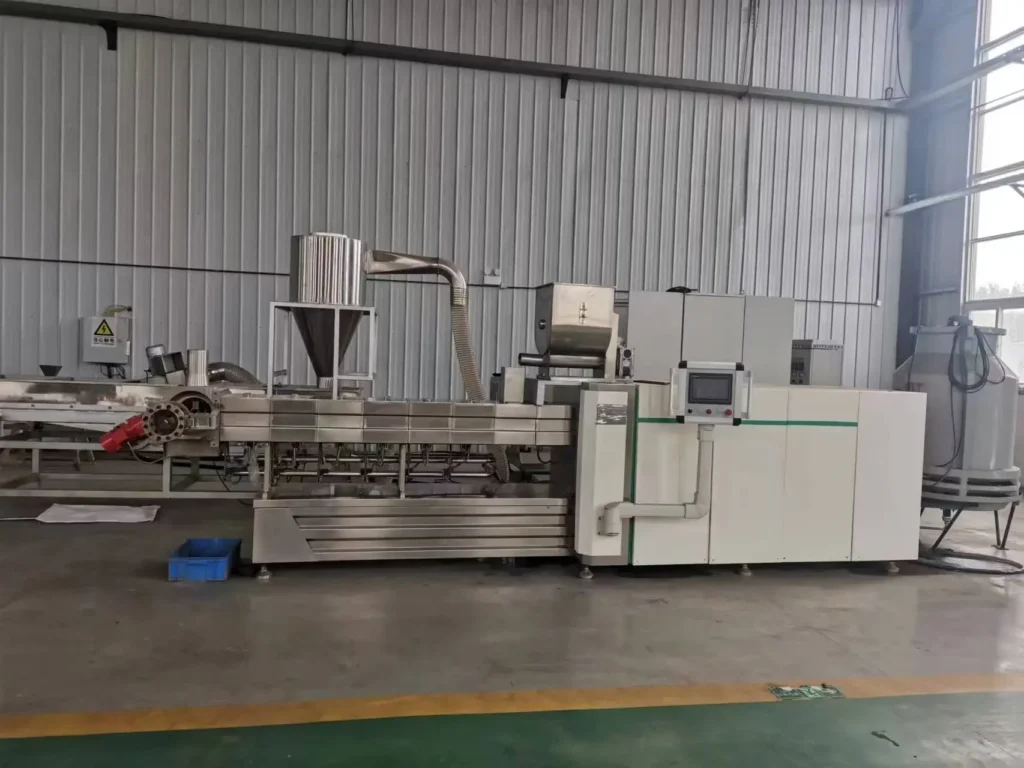
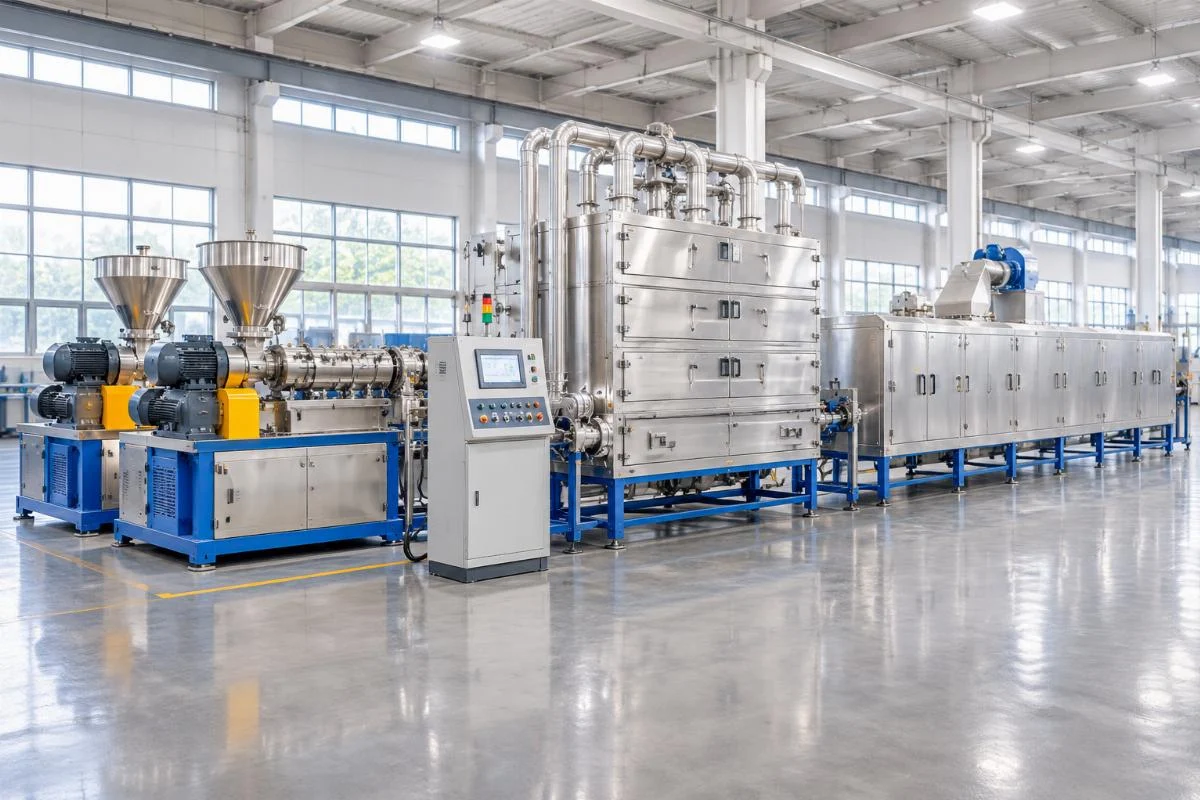
The backbone of any reliable dental chew production line consists of a twin-screw extruder paired with a multi-layer dryer and a precision cooling tunnel.
Many startups assume a single-screw machine can handle the dense, abrasive dough required for dental treats. This is a fundamental misunderstanding of shear force. Dental chews require a specific fibrous texture to scrape plaque off a dog’s teeth, which demands intense kneading and pressure that only a twin-screw extruder for dog treats can provide consistently.
When configuring the equipment, buyers often face a choice between basic and advanced setups. Here is how the core machinery compares in a commercial environment:
| Equipment Stage | Basic Configuration | Advanced Turnkey Configuration |
|---|---|---|
| Extrusion | Single-screw (Low shear, inconsistent texture) | Twin-screw (Controlled shear, uniform fibrous structure) |
| Drying | Single-layer oven (Uncontrolled hot spots) | Multi-layer dryer (Standardized moisture removal) |
| Cooling | Ambient room racks (Vulnerable to humidity) | Closed-loop cooling tunnel (Controlled airflow, Robust) |
| Automation | Manual transfer (High contamination risk) | Integrated conveyor link (Verifiable hygiene) |
The twin-screw design allows for precise temperature and moisture profiling across different zones. This ensures the starches gelatinize properly without burning the functional additives like enzymes or breath-freshening compounds. If you skip the multi-layer dryer and rely on a simple batch oven, you will inevitably get case-hardened treats—crispy on the outside, but soft and mold-prone on the inside.
How Does the Complete Process Flow Work?
The dental chew process flow is a seamless closed loop where mixing, extrusion, shaping, drying, and cooling must operate in perfect synchronization.
You cannot treat these stages as isolated islands. If your extruder outputs product faster than your dryer can handle, you create a bottleneck that forces the wet product to sit and ferment. The correct sequence requires strict parameter control at every transition point.
- Raw Material Mixing & Conditioning: The dry powders (flours, proteins, functional additives) are blended. Liquid binders are injected in a preconditioner. The goal is to achieve a uniform moisture distribution before the dough even hits the barrel.
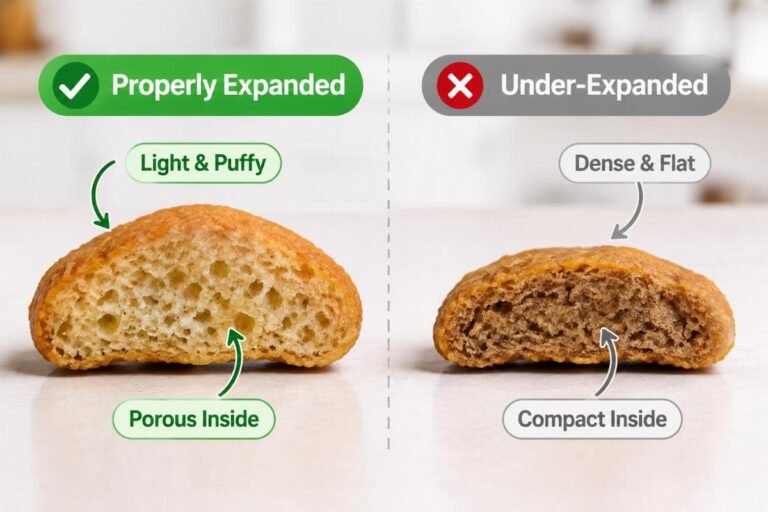
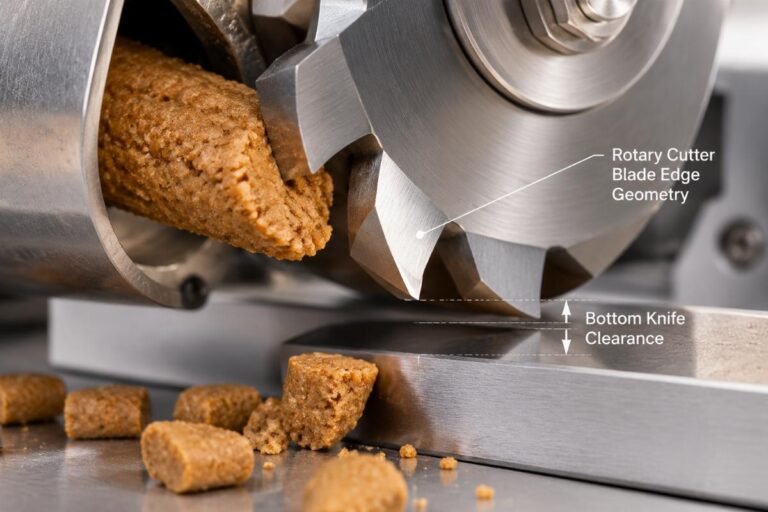
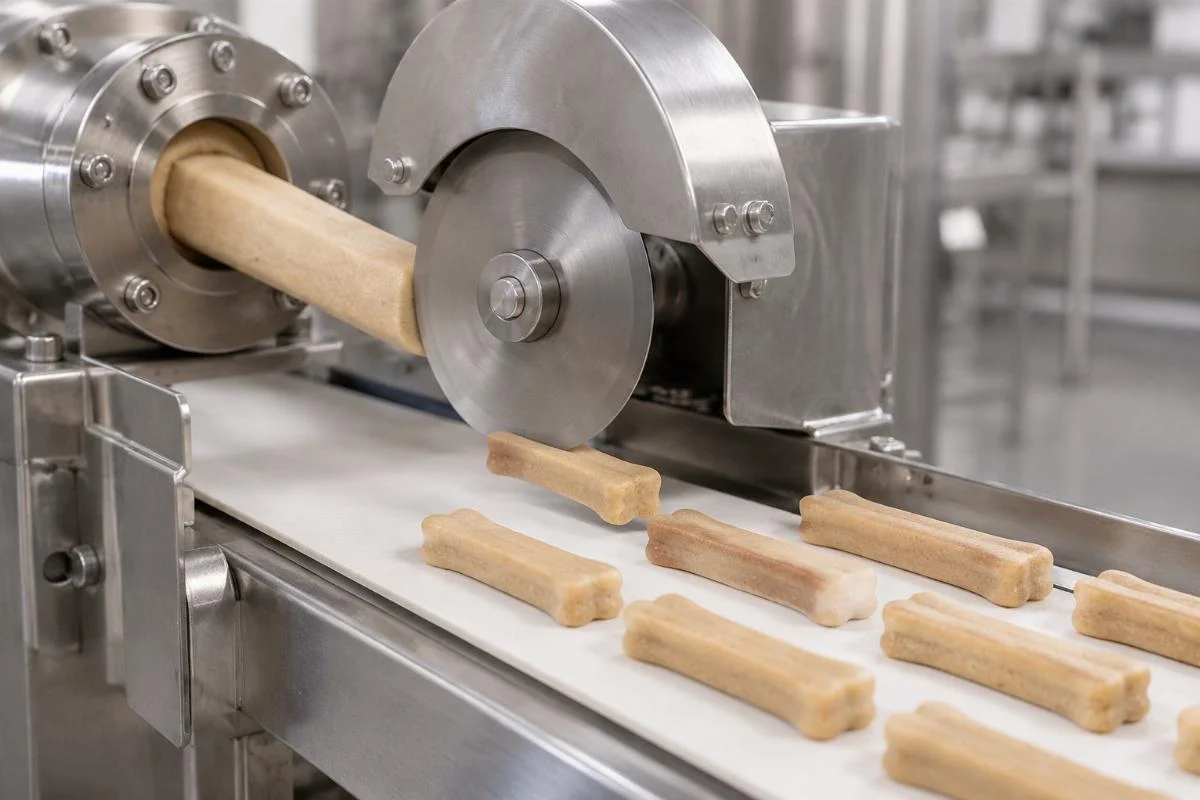
- Twin-Screw Extrusion & Shaping: The conditioned dough enters the pet dental chew extruder machine. The screws generate friction and heat, cooking the dough under high pressure. As it exits the die head, it expands slightly. A rotary cutter or continuous conveyor shapes it into the desired bone or stick form.
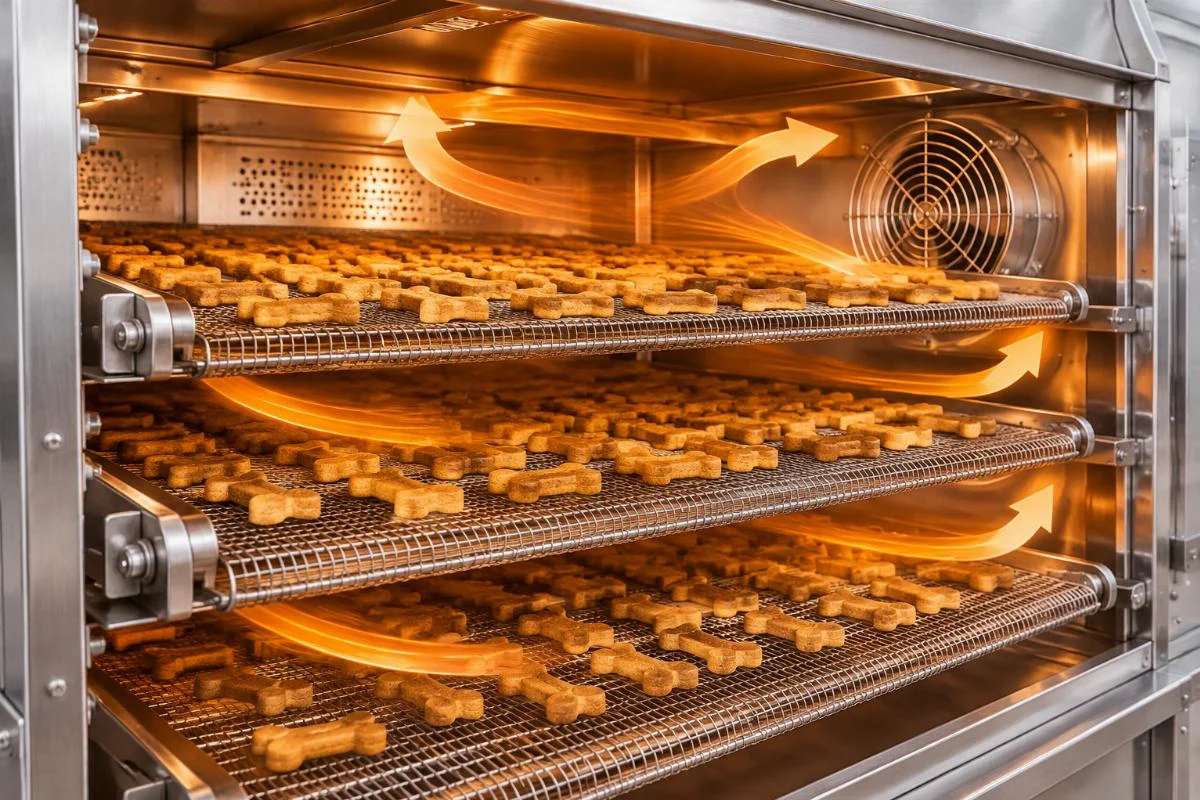
- Multi-Stage Drying: The freshly extruded treats are highly moist. They enter the dryer, where temperature curves must be carefully managed.
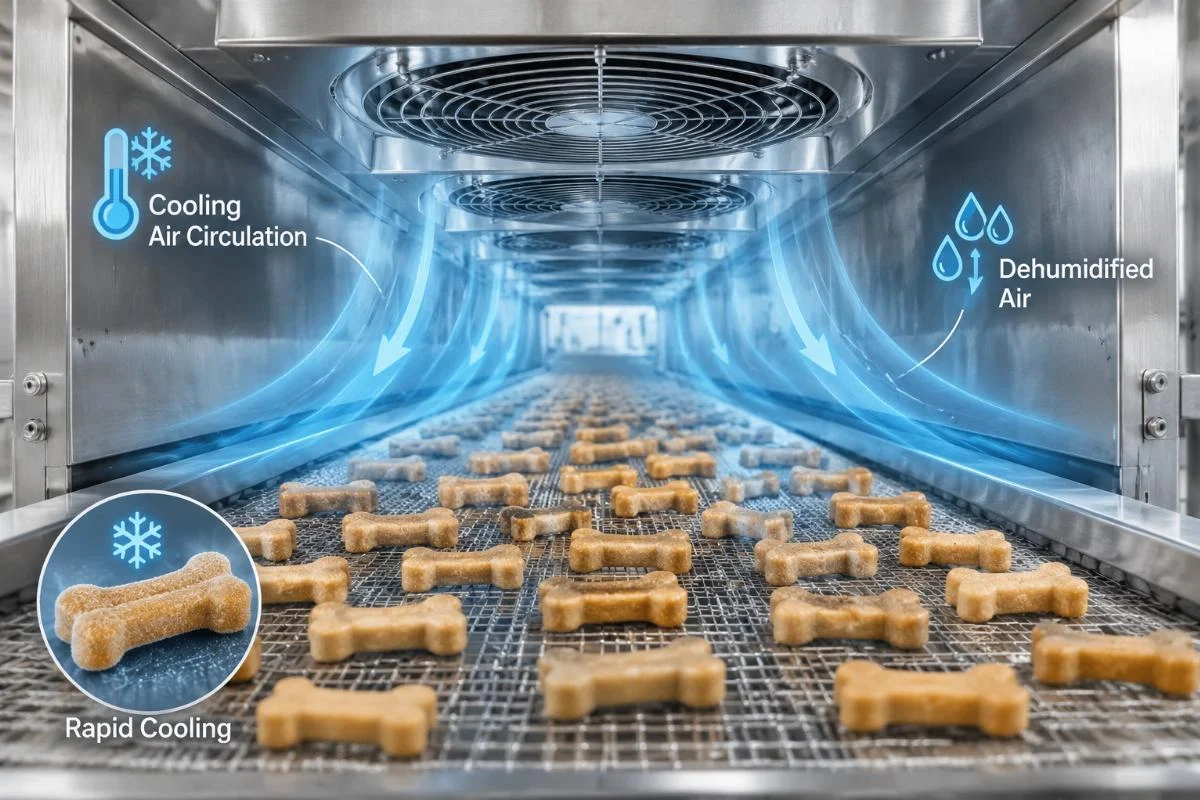
- Precision Cooling: The treats exit the dryer warm and fragile. They must be cooled gradually to room temperature while ambient humidity is strictly controlled.
A common mistake I see is pushing the drying temperatures too high to speed up the line. Most think higher drying temperatures speed up production; actually, it causes surface cracking and ruins the chew texture. The outside seals too quickly, trapping moisture inside. When the treat eventually cracks in the package, the shelf-life is compromised. The entire flow must be balanced so that moisture escapes evenly from the core to the surface.
Why is the Cooling Stage Non-Negotiable?
Skipping proper cooling leads directly to condensation, mold growth, and total batch rejection, regardless of how perfect your extrusion was.
This is the most counter-intuitive part of the entire operation. Buyers pour their budget into a high-end extruder and then try to save money by letting the treats cool on open racks in a warehouse. This is a catastrophic error.
When treats exit the dryer, their internal temperature is significantly higher than the ambient environment. If you pack them or expose them to unconditioned air while they are still warm, the temperature drop causes the residual internal moisture to migrate to the surface and condense. You are essentially creating a micro-sauna inside your packaging.
I once consulted for a new startup that struggled with inexplicable mold outbreaks. They had excellent ingredients and a great extruder. The issue was entirely post-drying. They were measuring the initial moisture content correctly, but they failed to account for the final moisture equilibrium after cooling. Because they rushed the cooling phase, the surface remained tacky, and the core retained hidden moisture pockets. Once we implemented a controlled cooling tunnel with dehumidified air, the mold rate dropped to zero, and the shelf-life extended noticeably.
The cooling stage is not just about dropping the temperature; it is about stabilizing the water activity. Without a dedicated, climate-controlled cooling phase, your dental chew production line is fundamentally incomplete.
How to Choose the Right Capacity and Configuration?
Matching your extruder capacity with your dryer length and cooling footprint is the only way to avoid severe production bottlenecks.
When scaling from a pilot phase to full commercial manufacturing, the weakest link in your dental chew production line will dictate your actual output. A medium-scale factory I worked with recently upgraded from a single-screw to a twin-screw setup. They doubled their extrusion capacity, but they kept their original, undersized dryer. The result? The extruder had to be stopped constantly to let the dryer catch up. The capacity scaling ratio was completely mismatched, leading to massive energy waste and inconsistent texture due to the machine constantly ramping up and down.
To choose the right configuration, you must look at the entire line as a single organism.
- Extruder Output: Determine your target hourly output. A twin-screw extruder for dog treats provides the necessary torque for dense dental doughs.
- Drying Residence Time: Dental chews require a longer drying time than standard puffed kibble because of their density and shape. Your multi-layer dryer must have enough belt surface area to handle the extruder’s maximum output without rushing the drying curve.
- Cooling Footprint: The cooling tunnel must be sized to hold the product long enough for the core temperature to reach ambient levels safely.
Meiteng approaches every project with this holistic view. Our turnkey line design ensures that the extrusion capacity, ranging from pilot scales up to heavy commercial volumes, is perfectly synchronized with integrated drying and cooling systems. We do not just sell you a machine; we engineer the entire process flow to guarantee that your texture, capacity, and food safety standards are met without bottlenecks.
Conclusion
A dental chew production line is only as strong as its weakest thermal stage.
Mastering the process flow means respecting the delicate balance between the shear force of the twin-screw extruder, the precise moisture removal of the multi-layer dryer, and the critical stabilization provided by the cooling tunnel. Ignore the cooling phase, and you invite mold; rush the drying phase, and you destroy the texture. By treating extrusion, drying, and cooling as a unified, closed-loop system, manufacturers can consistently produce safe, effective, and high-quality dental treats that meet the rigorous demands of the global pet care market.