
Choosing the wrong extruder type based solely on nominal capacity is the fastest way to bankrupt a high-meat pet food startup.
The decision between a twin-screw and single-screw extruder for dog kibble depends strictly on the recipe’s fresh meat inclusion and fat ratio, not just the desired hourly output. When fresh meat pulp exceeds a critical threshold or fat ratios are elevated, single-screw setups fail to generate adequate shear force, leading to poor expansion and crumbly kibble, whereas twin-screw configurations provide the positive conveying and multi-axis shear required for stable emulsification and high pellet durability.
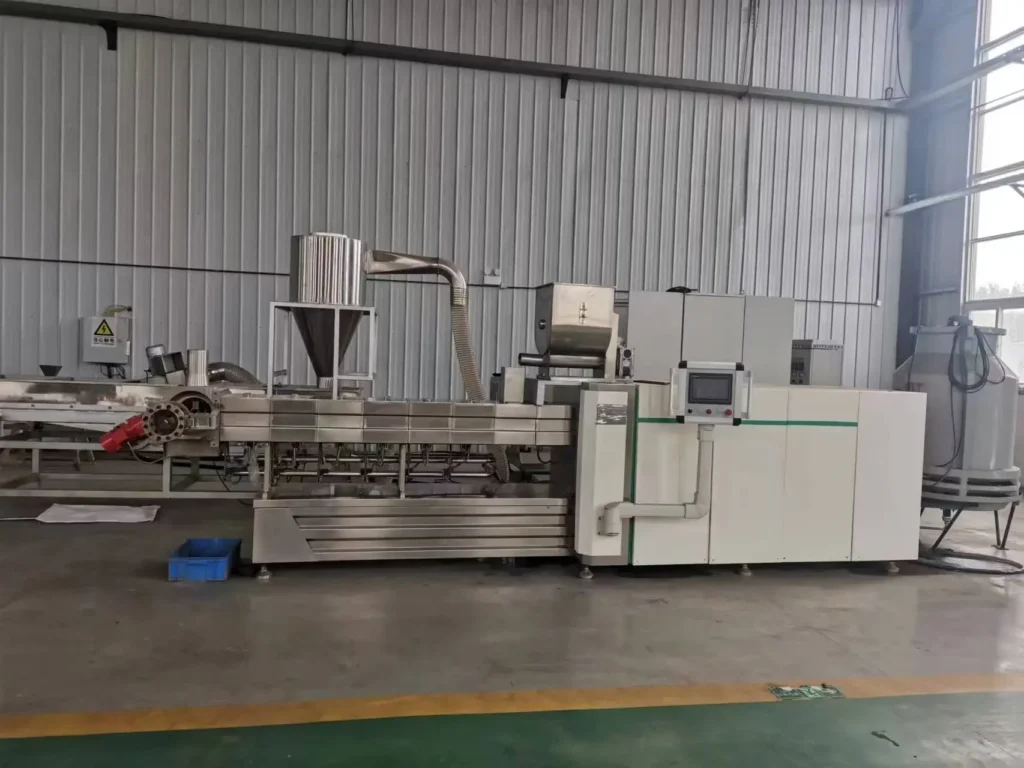
Standing on the exhibition floor in Chicago during Interzoo, I watched a North American startup founder obsess over the SLG-90 single-screw pet food extruder. He was convinced that a single-screw machine was perfectly sufficient for his high-meat kibble recipe to save on initial capital. However, during the trial run, the moment the fresh meat pulp exceeded a specific threshold, the single-screw shear force proved entirely inadequate. The kibble came out as soft, crumbly debris. They ultimately had to switch back to the DS65 twin-screw extruder high meat dog food configuration, relying on multi-axis strong shear to finally achieve the target expansion rate. Having spent years working in workshops and at overseas trade shows with my mentor, I have witnessed countless startups choose the wrong machine type just to cut budgets. Evaluating the twin-screw vs single-screw extruder for dog kibble is never about just reading a spec sheet; it is about understanding how the meat content and fat ratios actually behave inside the barrel.

Let us break down the mechanical realities to help you make the right equipment choice.
What is the core mechanical difference between DS65 and SLG-90?
The fundamental divergence lies in how each machine controls shear force and material conveying, which directly dictates the twin-screw vs single-screw extruder for dog kibble selection.
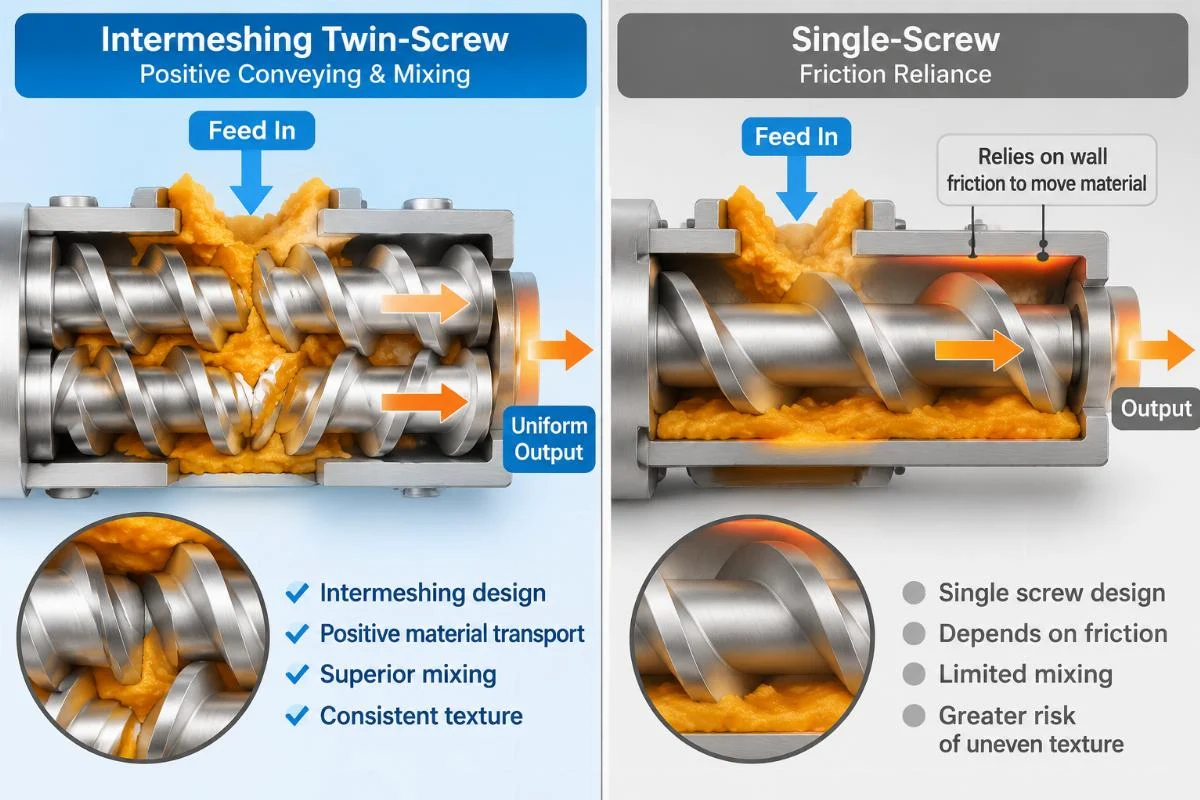
A single-screw extruder relies heavily on friction between the material and the barrel wall to push the dough forward. The shear force is largely a byproduct of this friction and the screw’s compression ratio. In contrast, a twin-screw extruder offers independent control over both shear and conveying. The intermeshing screws actively pump the material forward, meaning the specific mechanical energy input can be precisely managed regardless of the friction coefficient at the barrel wall.
| Mechanical Factor | DS65 Twin-Screw Configuration | SLG-90 Single-Screw Configuration |
|---|---|---|
| Conveying Mechanism | Positive conveying (independent of friction) | Friction-reliant (dependent on barrel wall grip) |
| Shear Force Control | Independent and highly adjustable | Limited by screw compression and friction |
| Material Residence Time | Narrow distribution, highly uniform | Broad distribution, prone to uneven cooking |
| High-Moisture Handling | Excellent emulsification and expansion | Vulnerable to slippage and poor expansion |
When a contract manufacturer was scaling up a complex multi-protein recipe, they initially struggled with inconsistent pellet durability index targets on a friction-reliant setup. By switching to a positive conveying system, they ensured uniform mixing and stable expansion. This highlights why the twin-screw vs single-screw extruder for dog kibble debate always comes down to mechanical control rather than just throughput claims.
How does fresh meat percentage dictate your extruder choice?
Recipes incorporating high proportions of fresh meat strictly require the intense, multi-axis shear of a twin-screw system to properly emulsify and expand the protein matrix.
Many assume that a single-screw machine is cheaper and sufficient for all kibble formulations. The counter-intuitive truth is that a single-screw barrel lacks the necessary shear force to handle high-moisture meat emulsions. When fresh meat pulp is introduced, the moisture acts as a plasticizer, drastically reducing the friction between the dough and the barrel wall. Without that friction, the single-screw cannot build the pressure required for proper puffing.
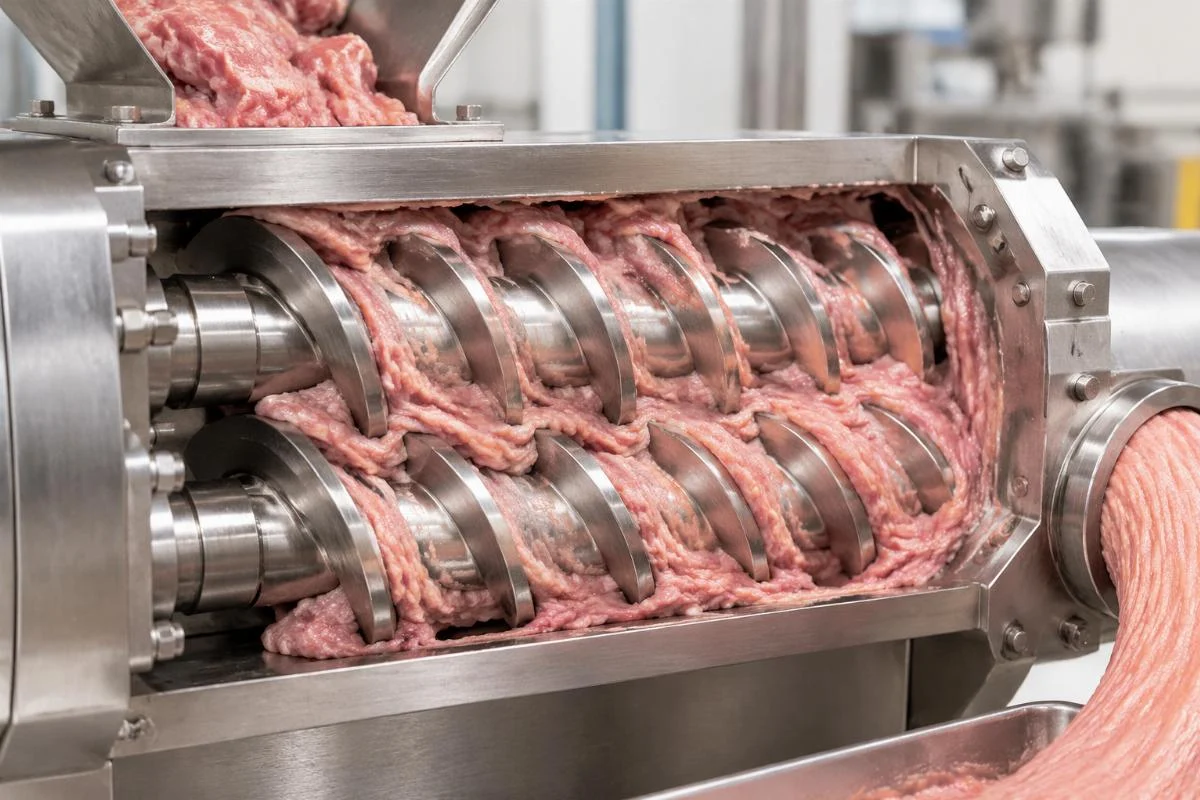
The DS65 twin-screw extruder high meat dog food setup solves this by mechanically forcing the material through the intermeshing screws. The intense shear breaks down the meat fibers and emulsifies the fat and moisture into a homogeneous dough before it reaches the die. This ensures that even with high fresh meat inclusion, the kibble expands uniformly and maintains structural integrity upon drying.
If your formulation relies heavily on fresh meat, attempting to process it through a single-screw barrel will inevitably result in dense, under-expanded, or completely crumbly products. The twin-screw vs single-screw extruder for dog kibble choice here is non-negotiable; the rheology of fresh meat demands multi-axis shear.
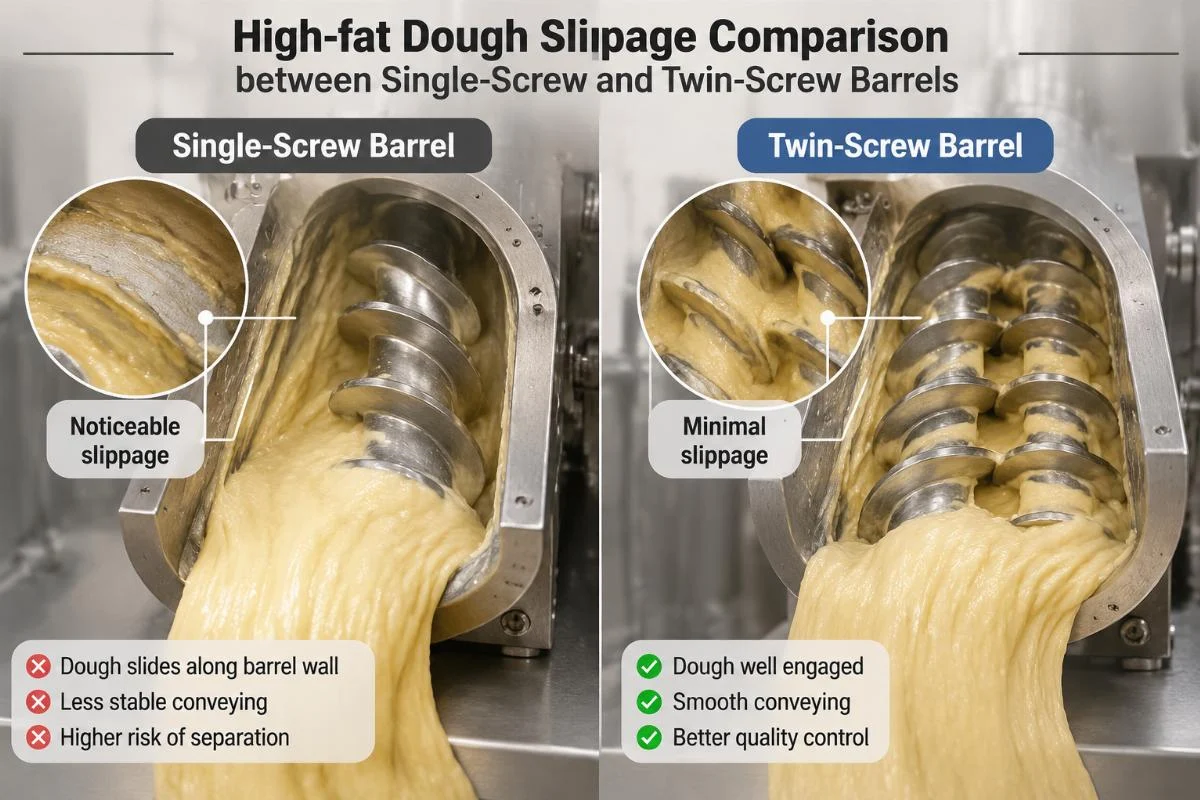
Why do high-fat formulas fail in single-screw extruders?
Elevated fat ratios cause severe material slippage in single-screw barrels, making positive conveying an absolute necessity for uniform mixing and stable extrusion.
Fat is an excellent lubricant. In a single-screw design, this lubrication effect destroys the friction required to push the material forward. The dough simply spins around the screw or slips backward, leading to massive fluctuations in pressure and temperature at the die face. Most operators mistakenly think that increasing the screw speed will compensate for this and improve puffing. The reality is that excessive speed without multi-axis shear merely burns the high-fat recipe, creating localized scorching while the core remains under-processed.
The SLG-90 single-screw pet food extruder is highly capable for standard, low-fat, meal-based recipes. However, when fat ratios climb, the material slippage becomes unmanageable. The DS65 twin-screw configuration bypasses this limitation entirely. Because the screws intermesh and actively wipe the barrel walls, they provide positive conveying that is completely unaffected by the lubricating properties of the fat. This ensures uniform mixing and consistent thermal history throughout the barrel.
When evaluating the twin-screw vs single-screw extruder for dog kibble for high-energy or high-palatability formulas, you must account for the lubricating effect of the fat. Relying on friction in a high-fat environment is a guaranteed path to production instability and wasted raw materials.
How to evaluate total cost of ownership for kibble lines?
Selecting the correct extruder requires factoring in recipe flexibility, waste reduction, and pellet durability, rather than just comparing the initial machine purchase price.
Startups often fixate on the upfront capital expenditure, assuming the single-screw option is the safer financial bet. However, the true cost of ownership in pet food manufacturing is dictated by yield, consistency, and formulation agility. A machine that cannot handle your target recipe will generate massive amounts of off-spec waste during startup and recipe changes.
When a contract manufacturer switched to a twin-screw line to handle complex, multi-protein recipes, they drastically reduced their waste and consistently hit their pellet durability index targets. The ability to process a wider range of ingredients—including high fresh meat and high fat—means the production line can adapt to market trends without requiring a completely new extruder investment. Furthermore, the uniform residence time in a twin-screw system ensures that every pellet is cooked evenly, reducing the load on the downstream drying and cooling systems and saving significant energy over time.
Meiteng provides comprehensive turnkey production line design and formula development support to ensure your equipment matches your exact nutritional targets. Whether you need the robust simplicity of the SLG-90 single-screw pet food extruder for standard diets or the advanced shear capabilities of the DS65 for premium high-meat recipes, the focus must be on long-term operational efficiency. The twin-screw vs single-screw extruder for dog kibble decision ultimately defines your factory’s ability to innovate and maintain profitability in a competitive market.

Conclusion
Machine selection must be driven by ingredient rheology, not just nominal capacity. Evaluating the twin-screw vs single-screw extruder for dog kibble requires a honest assessment of your fresh meat thresholds and fat ratios. Single-screw systems excel in standard, low-moisture applications, but high-meat and high-fat formulations demand the independent shear and positive conveying of a twin-screw design to ensure proper expansion and pellet durability. Aligning your mechanical setup with your recipe’s physical properties is the only way to secure consistent quality and long-term production viability.
Machines Mentioned in This Article

cat food machine
Pet Dog Food Extruder Manufacturer Production Line
View Machine
cat food machine
Pet Food Pellet Extruder Machine Manufacturer for Dog Cat
View Machine
cat food machine
Pet Food Extruder Machine Manufacturer Production Line
View Machine
cat food machine