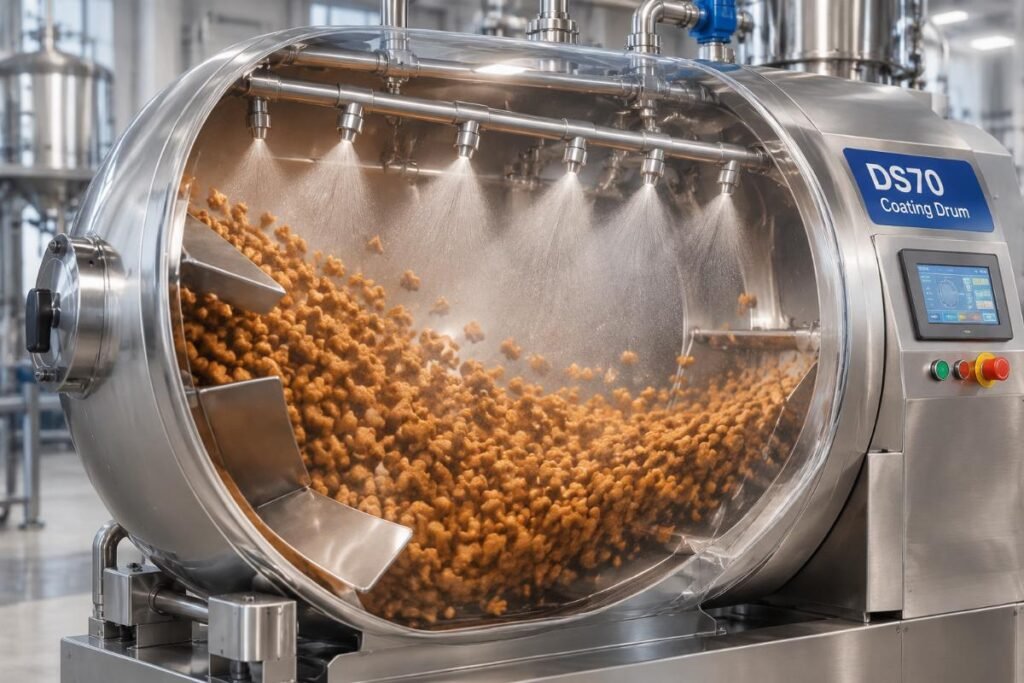
Pumping more fat into the coating drum does not improve taste; it guarantees rancidity and massive batch rejections when atomization fails.
A flawless DS70 coating drum setup requires synchronizing drum rotation speed, nozzle spray angle, and thermal zones to guarantee uniform fat and palatant atomization, which directly dictates kibble palatability and shelf stability.
Years ago, inside a manufacturing facility in Jinan, I was rushing a trial run for a new dog food line. The client was anxious to start production, and I failed to properly synchronize the drum rotation speed with the nozzle angles. The fat atomization was completely uneven, the palatant refused to adhere to the kibble surface, and the entire batch failed palatability tests. We nearly lost the contract. That disaster forced me to obsess over every parameter of the DS70 coating drum setup. Transitioning into technical sales, I stopped treating the coating section as an afterthought. Today, I break down the exact methodology we use to prevent coating failures and ensure every pellet is perfectly enrobed.
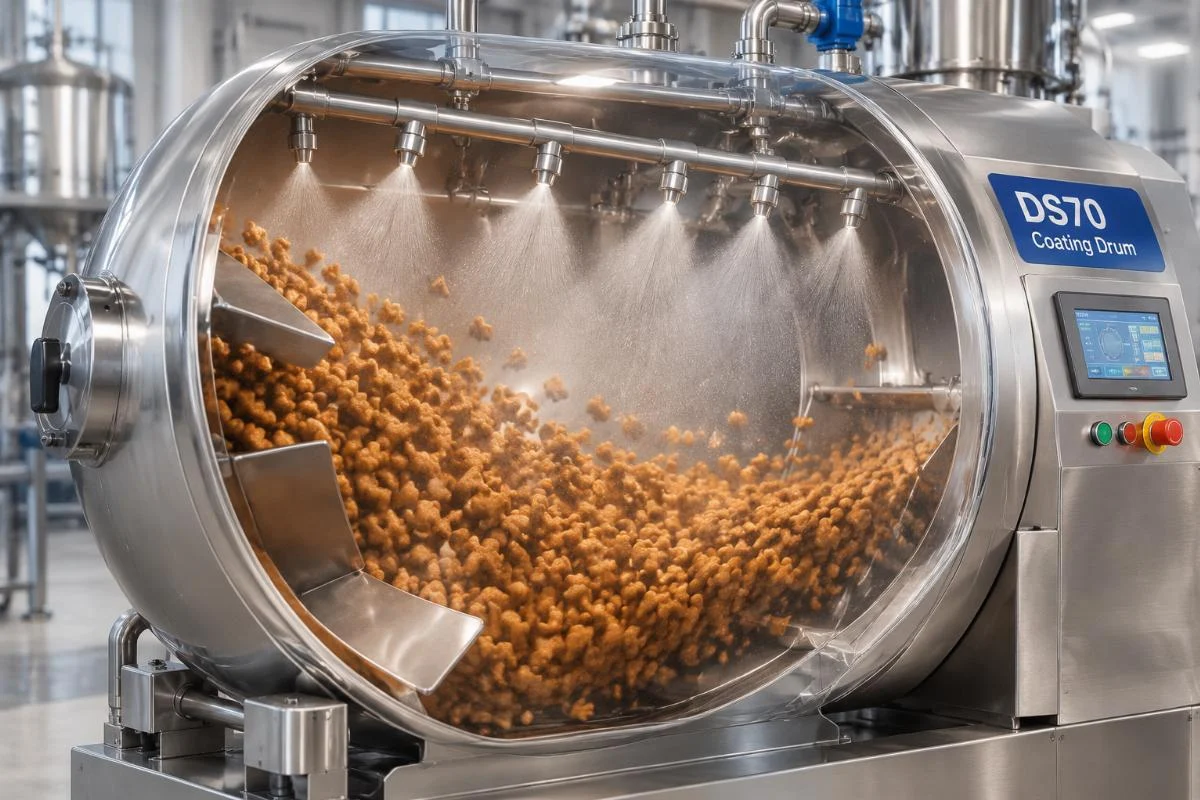
Let us walk through the exact operational parameters required to master this process.
Why Does DS70 Coating Fail?
Coating failures almost always stem from a mismatch between mechanical rotation and fluid dynamics, leading to poor fat atomization and severe palatant loss.
When the DS70 coating drum setup is misconfigured, the liquid fat and palatants do not form a fine mist. Instead, they hit the kibble as large droplets or continuous streams. This causes immediate pooling at the bottom of the drum and leaves the top layer of kibble completely dry. The unatomized fat oxidizes rapidly, creating off-flavors that ruin the batch.
To diagnose and prevent this, follow these steps:
- Inspect the nozzle tips for partial clogging, which disrupts the spray pattern.
- Verify that the liquid pumping pressure matches the viscosity of the fat at the current temperature.
- Check the drum interior for buildup, which alters the tumbling cascade of the kibble.
- Measure the droplet size visually; it should be a fine mist, not visible streaks.
In a recent case, a contract manufacturer in Southeast Asia experienced massive palatant loss. Their DS70 coating drum setup was running fine mechanically, but the nozzle overlap was miscalculated, leaving a dry zone in the center of the product bed. Adjusting the spray overlap solved the issue without changing the fat recipe.
How to Match Drum Speed and Feed Rate?
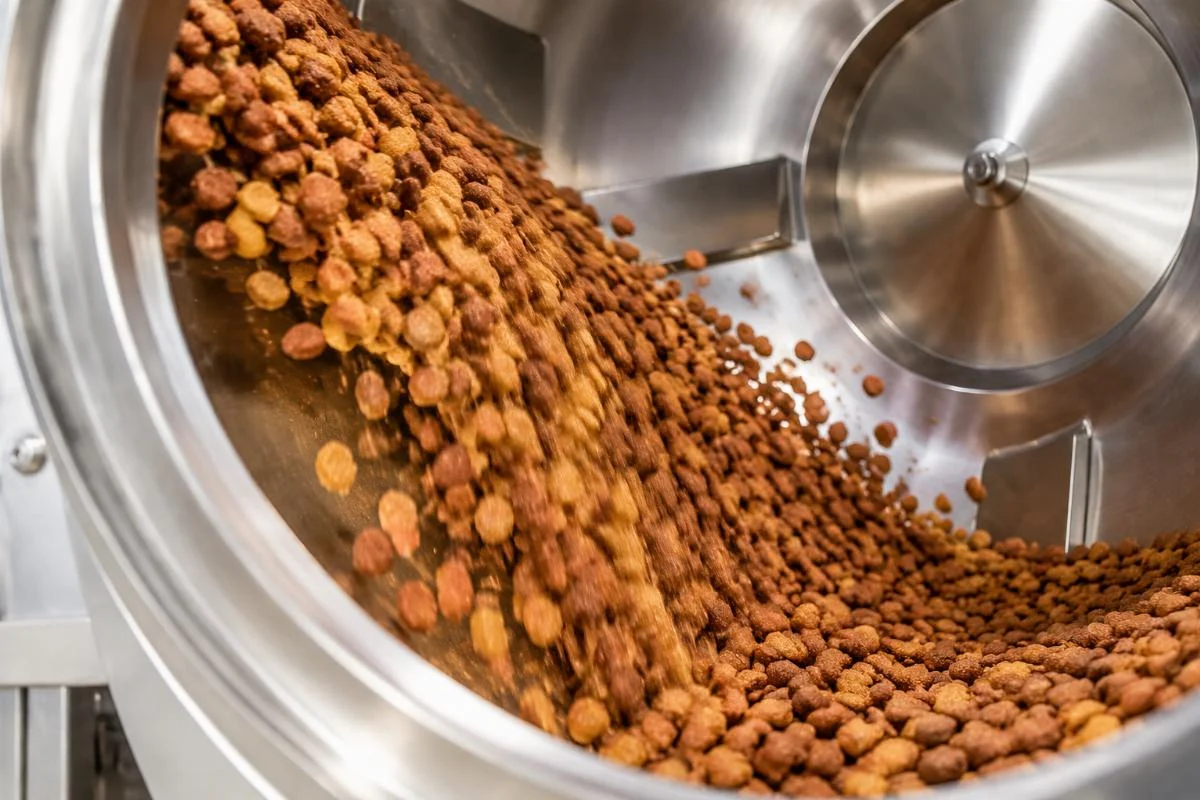
Synchronizing the drum rotation speed with the extruder output ensures the optimal coating residence time and prevents fat pooling.
A common misconception is that increasing the drum speed will increase throughput. In reality, running the drum too fast reduces the residence time, meaning the kibble tumbles too quickly for the fat to adhere properly. Conversely, running it too slow causes the kibble to slide rather than cascade, leading to uneven coverage.
Execute the following steps to achieve the perfect balance:
- Determine the mass flow rate from the twin screw extruder feeding the drum.
- Set the drum rotation to maintain a specific ratio against the feed rate, ensuring the kibble forms a continuous cascading waterfall.
- Observe the product bed; it should lift and fall smoothly without slipping against the drum wall.
- Adjust the speed incrementally until the fat has enough time to coat each piece before it exits the drum.
A startup dog food line in Europe struggled with fat pooling at the discharge end. Their DS70 coating drum setup was running at a speed that was too high for their feed rate. By reducing the drum speed to match the extruder output, the residence time increased just enough for the fat to bind to the kibble surface, completely eliminating the pooling issue.
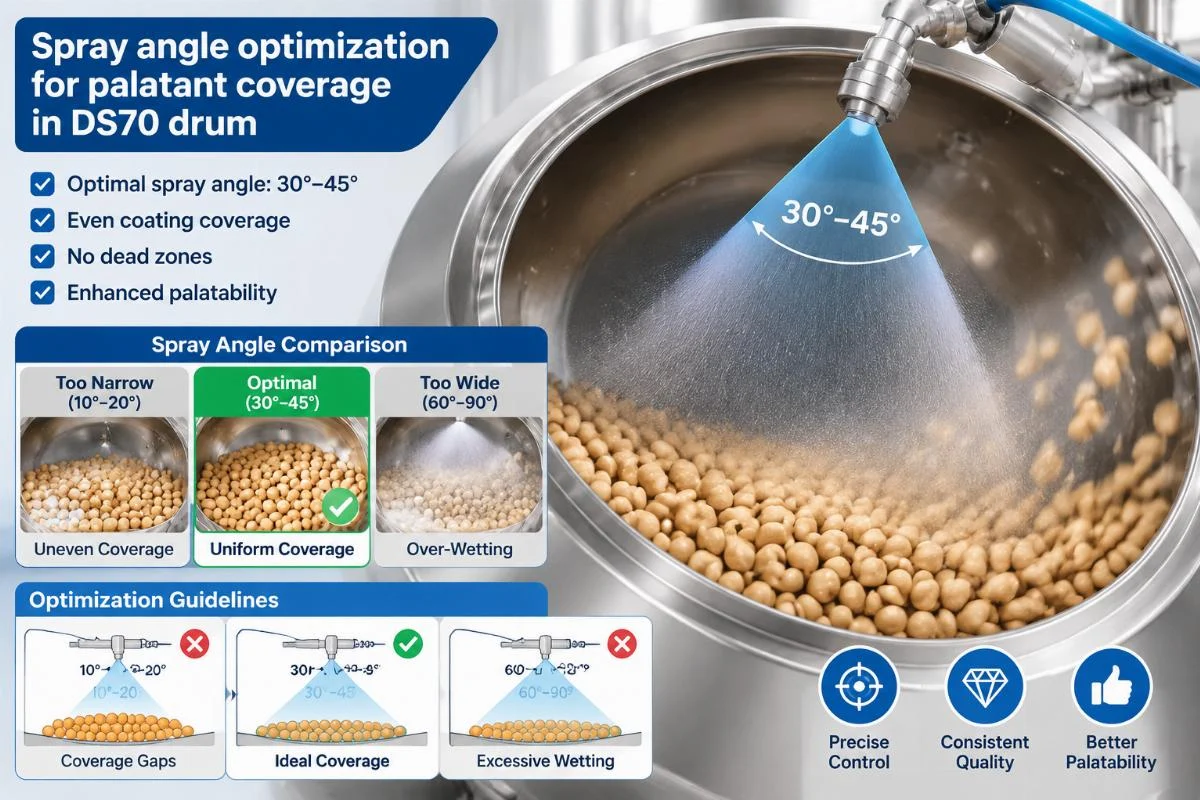
What is the Best Nozzle Angle for Palatants?
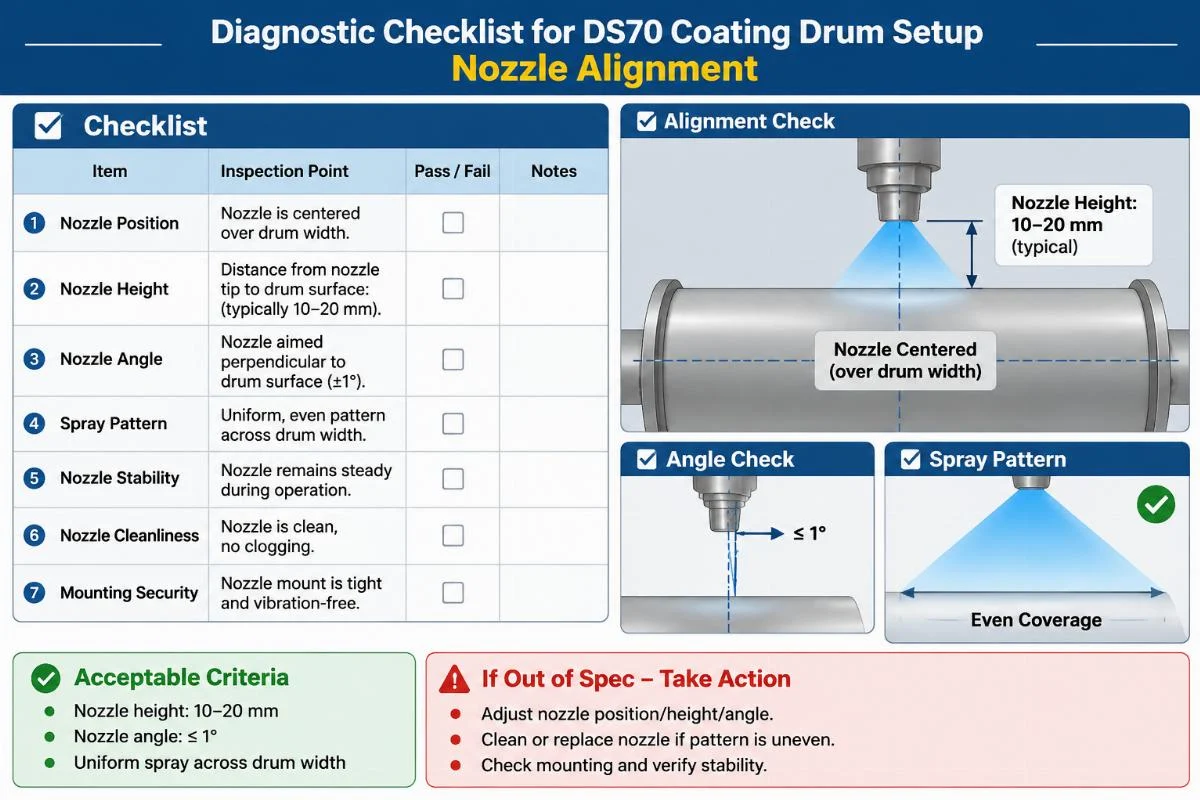
A precise spray angle maximizes surface coverage without causing kibble breakage or creating blind spots in the product bed.
The angle at which the nozzles inject the palatant determines how the liquid interacts with the falling kibble. If the angle is too steep, the liquid shoots past the product bed and coats the opposite drum wall. If it is too shallow, the spray does not penetrate the center of the cascading kibble.
Follow this procedure to optimize the nozzle angle:
- Position the nozzles to intersect the cascading product bed at the optimal trajectory.
- Adjust the spray angle to ensure the mist covers the entire width of the falling kibble curtain.
- Verify that the spray pressure is sufficient to atomize the palatant but not so high that it shatters the kibble upon impact.
- Use a test run with a visible tracer dye to map the coverage area and adjust the angle accordingly.
During a high-palatability treat production run, a client noticed excessive kibble breakage. Their DS70 coating drum setup utilized a spray angle that was too aggressive, causing the high-pressure nozzles to physically impact and fracture the treats. By adjusting the nozzle angle to a more oblique trajectory, we maintained full coverage while reducing mechanical stress on the kibble, preserving the integrity of the final product.
How to Control Temperature for Fat Application?
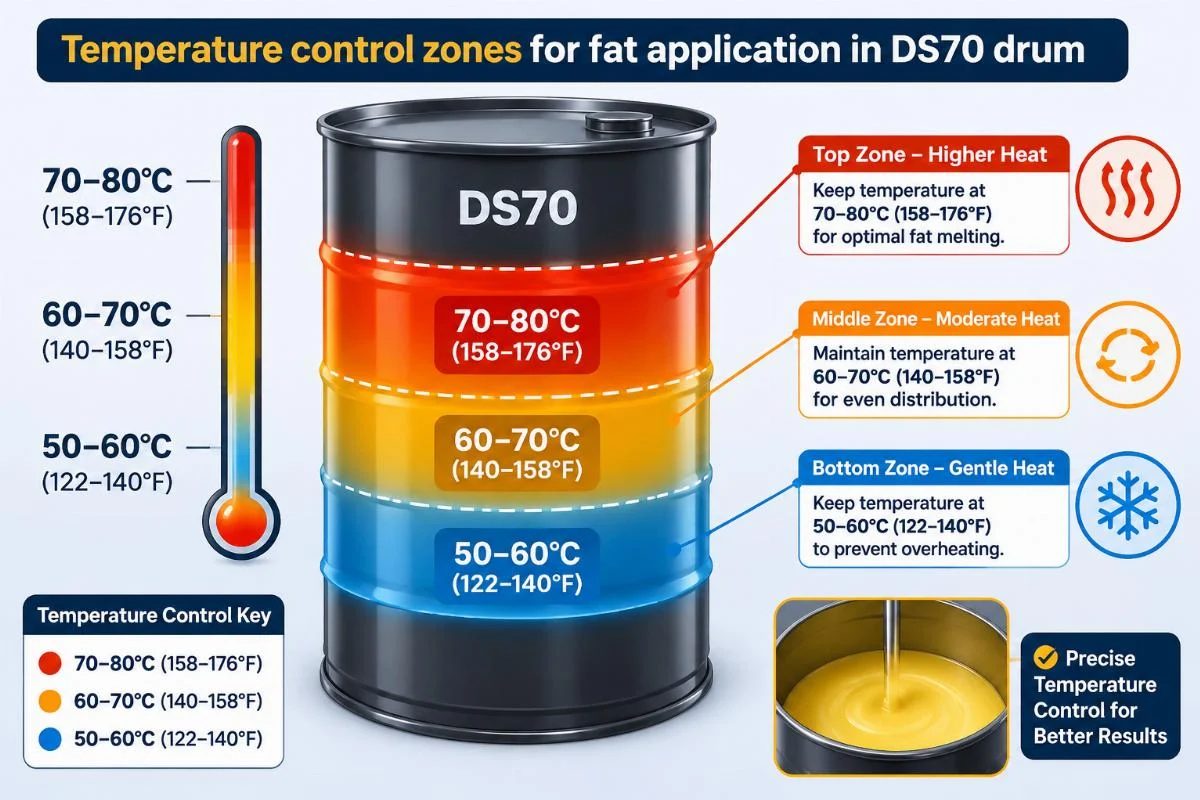
Maintaining precise fat and drum temperatures prevents premature oxidation and ensures uniform adherence across the entire batch.
Temperature control is the most critical variable in the DS70 coating drum setup. Fat that is too cool will not atomize properly, resulting in large droplets. Fat that is too hot will degrade, lose its volatile flavor compounds, and oxidize rapidly inside the drum. Furthermore, the drum itself must be temperature-controlled to prevent the fat from solidifying upon contact with cold metal.
Implement these temperature control steps:
- Pre-heat the fat holding tank to the optimal viscosity range for atomization.
- Ensure the drum heating system maintains the internal surface temperature within the required range to prevent thermal shock to the fat.
- Monitor the exhaust air temperature to verify that the drum environment is stable.
- Continuously sample the coated kibble to check for any signs of thermal degradation or uneven melting.
During a high-temperature season production run in a tropical region, a facility faced severe oxidation issues. The ambient heat caused the fat to exceed its thermal limit before it even reached the nozzles. By upgrading the thermal retention and cooling protocols in their DS70 coating drum setup, we stabilized the fat temperature, preventing oxidation and ensuring the palatants remained intact. This is where Meiteng’s integrated drying and flavor-coating systems prove their value, offering turnkey line design and precise thermal management. We provide on-site operator training to guarantee that your team can maintain these perfect DS70 coating parameters from day one, ensuring your product tastes as good as the formula intends.
Conclusion
Mastering the DS70 coating drum setup is the definitive factor between a highly palatable product and an unsellable batch.
Properly matching drum speed, nozzle angle, and temperature guarantees uniform fat atomization and maximum palatant retention. By treating the coating section with the same engineering rigor as the extrusion process, manufacturers can eliminate coating failures and deliver superior taste in every bag.
Machines Mentioned in This Article

cat food machine
Dog Food Extruder Machine Manufacturer for Pet Food Kibble Making Line
View Machine
cat food machine
Pet Food Processing Equipment Plant Manufacturer Dog Food
View Machine
cat food machine
Dry Dog Food Production Line Pet Food Pellet Machine
View Machine
cat food machine