
Running a high-meat formula on the wrong machine does not just lower your yield; it destroys your equipment.
For any pet food formula containing more than half fresh meat, a twin-screw vs single-screw extruder for high fresh meat kibble evaluation always points to one mandatory choice: the twin-screw design is strictly required to handle the extreme shear, positive conveying, and moisture evaporation needed to prevent catastrophic jamming and ensure uniform kibble expansion.
I learned this the hard way early in my career while commissioning equipment in Dongguan. A client insisted on using a standard single-screw machine for a feline recipe packed with seventy percent fresh meat. During the very first trial, the meat paste was so viscous that it completely bypassed the weak friction zones. The material turned into a solid plug inside the barrel. The screw locked up instantly, the torque spiked, and the rotating cutter shattered against the die face. We had to scrap the entire batch of raw material and spend days dismantling the seized barrel. That disaster cemented my obsession with screw mechanics. When you are dealing with a high meat inclusion pet food extruder, you cannot rely on basic friction to move sticky proteins. You need engineered intermeshing geometry.
Let us break down the mechanics, the failures, and the exact specifications you need to evaluate before investing in a production line.
Why Does Single-Screw Fail with High Fresh Meat?
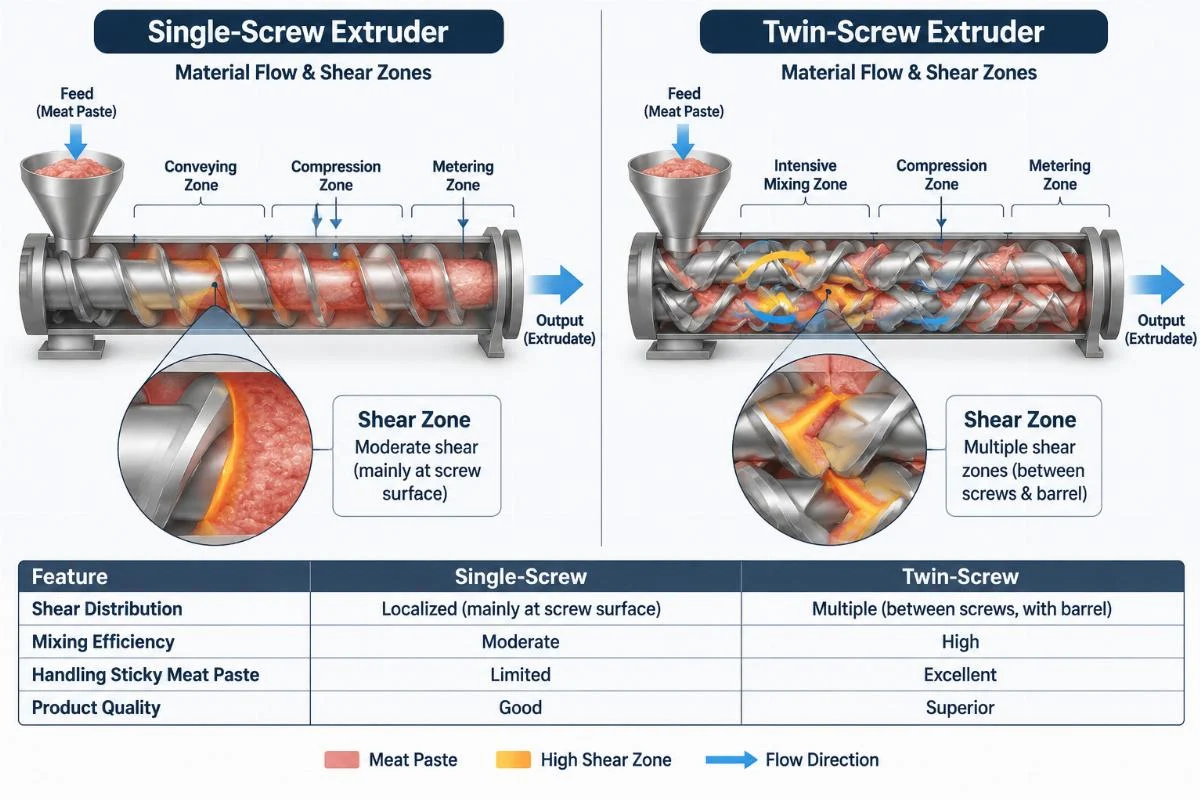
Single-screw machines rely entirely on friction between the meat paste and the barrel wall to convey material forward, a mechanism that completely collapses when processing high-moisture, high-fat fresh meat.
In a single-screw design, the material must stick to the barrel and slide against the screw flights to move forward. When you introduce fresh chicken or beef paste, the high fat and moisture content act as a lubricant. The paste simply spins with the screw instead of being pushed toward the die. This is where many startup manufacturers make a critical counter-intuitive mistake: they assume that increasing the screw speed will force the material through. In reality, ramping up the RPM on a single-screw machine with sticky meat paste merely generates excessive frictional heat. This leads to localized overheating and severe protein denaturation right inside the barrel, long before the material reaches the die.
The consequences are physical and expensive. The un-conveyed meat paste builds up pressure unpredictably. This causes severe jamming that frequently bends the single screw shaft or snaps the coupling. Furthermore, the inconsistent flow results in pulsating extrusion, which immediately breaks the face cutter blades due to uneven material resistance. If your recipe exceeds a modest fresh meat threshold, a single vs twin screw pet food machine comparison will always reveal that the single-screw architecture lacks the positive displacement needed to stabilize the process.

How Does Twin-Screw Solve High-Meat Extrusion Challenges?
Twin-screw extruders utilize intermeshing, co-rotating screws that physically grab, knead, and positively pump sticky meat pastes, completely eliminating the reliance on barrel friction.
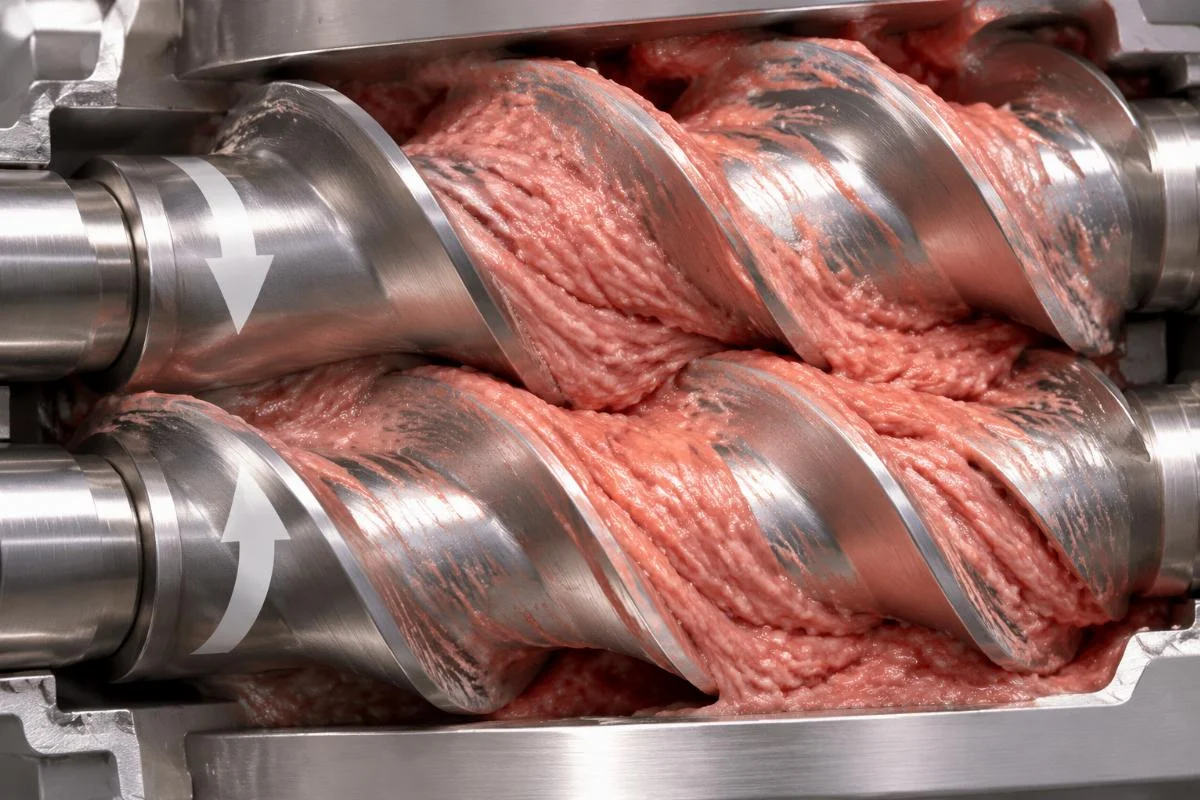
When evaluating a twin screw extruder for fresh meat kibble, the magic lies in the calendering action. As the two screws rotate inward at the啮合 (intermeshing) zone, they force the material out of one screw flight and into the other. This creates a highly efficient, self-wiping action that prevents sticky meat paste from accumulating and burning on the metal surfaces. The material is subjected to intense, uniform shear forces that break down the muscle fibers and emulsify the fats without generating the destructive localized heat seen in single-screw setups.
This positive conveying mechanism is why a high meat inclusion pet food extruder must be twin-screw. The machine controls the residence time distribution precisely. You can inject fresh meat slurries directly into the barrel via liquid pumps, and the screws will instantly incorporate them into the dry base ingredients.
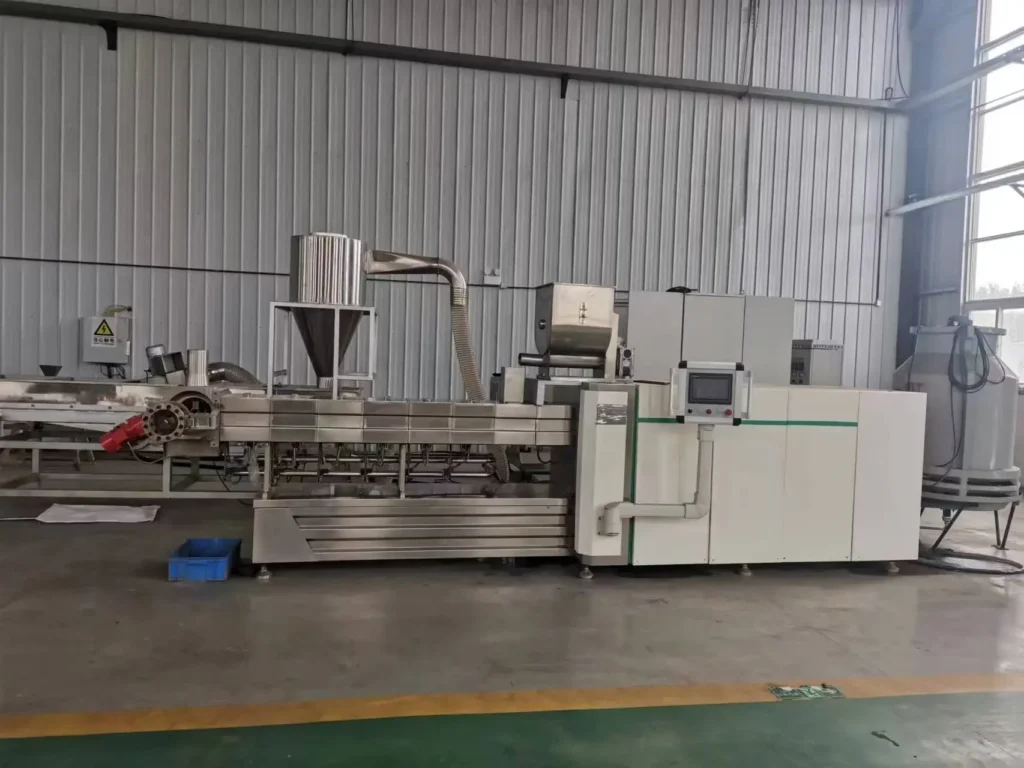
This is exactly the engineering philosophy behind the DS-series twin-screw extruders developed by Meiteng. Designed specifically for the brutal demands of high-protein pet food startups, the DS-series features modular screw configurations that allow operators to adjust the shear intensity and mixing severity based on the exact meat ratio. Whether you are processing a delicate multi-protein treat blend or a dense, high-fat canine kibble, the anti-jamming design and precise temperature zoning ensure the meat paste flows smoothly to the die, protecting your cutters and maximizing your uptime.
What Are the Key Spec Differences for Kibble Quality?
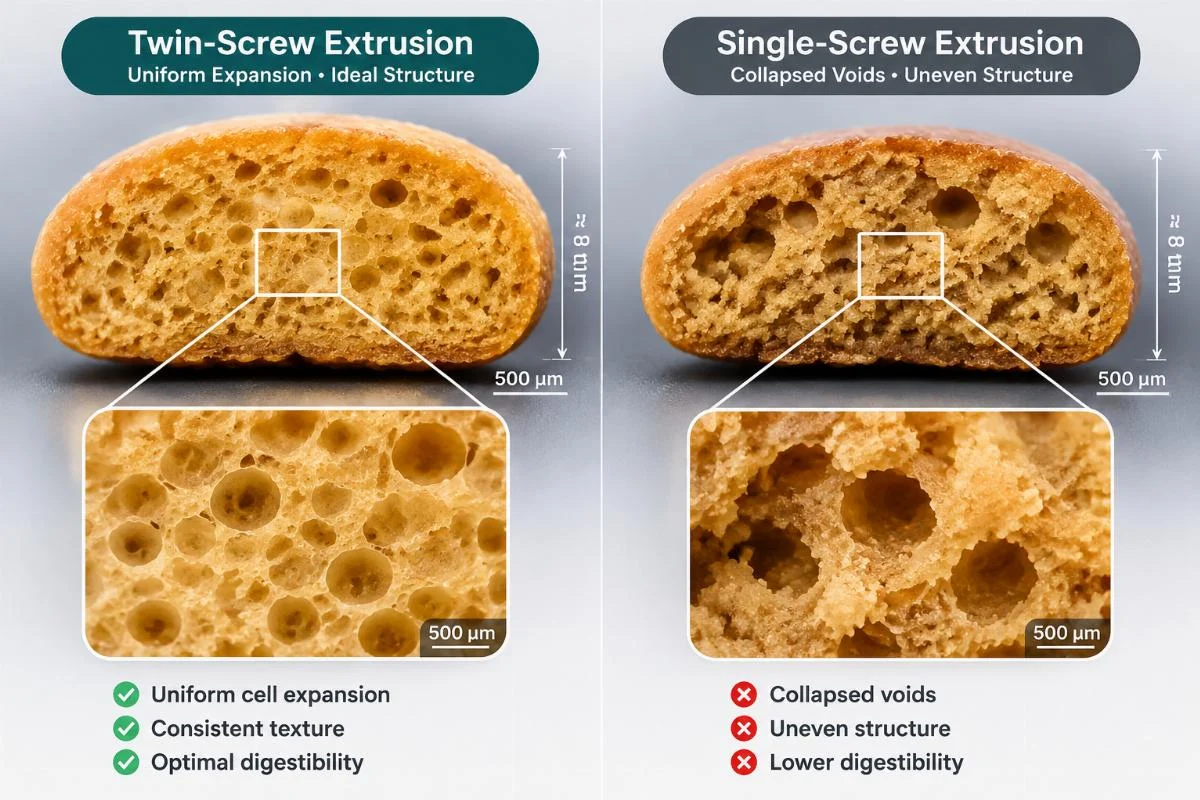
Beyond preventing machine failure, the twin-screw architecture fundamentally alters the gelatinization degree, density control, and final shape consistency of the kibble.
When pet food startups formulate with fresh meat, they often focus entirely on the meat pump capacity, ignoring the real bottleneck: moisture evaporation during extrusion. Fresh meat brings massive amounts of water into the conditioner. If this moisture is not uniformly flashed off under controlled pressure and temperature, the kibble will either collapse after exiting the die or develop a porous, weak structure that shatters during the cooling and coating phases.
Let us look at the spec differences through a practical matrix.
| Parameter | Single-Screw Extruder | Twin-Screw Extruder (DS-Series) |
|---|---|---|
| Conveying Mechanism | Friction-dependent (Vulnerable to slip) | Positive displacement (Robust) |
| Shear Distribution | Uneven, high at barrel wall | Uniform, controlled across flight |
| Gelatinization Degree | Inconsistent with high-moisture inputs | Highly uniform, optimized for starch-protein matrix |
| Moisture Evaporation Control | Poor, prone to localized boiling | Precise pressure profiling across multiple zones |
| Kibble Density & Shape | High variation, frequent die clogging | Tight tolerance, excellent shape retention |
| Cleaning & Changeover | Difficult, high dead zones | Self-wiping, rapid color/flavor changeovers |
Consider a contract manufacturer producing a fifty percent fresh chicken dog food. On a single-screw machine, the uneven shear means some starch granules remain raw while others scorch, leading to a kibble with poor water stability and inconsistent expansion rates. On a twin-screw machine, the specific mechanical energy (SME) input is distributed evenly. The result is a kibble with a perfect, uniform cell structure, a crisp texture, and a surface that accepts fat coatings evenly.
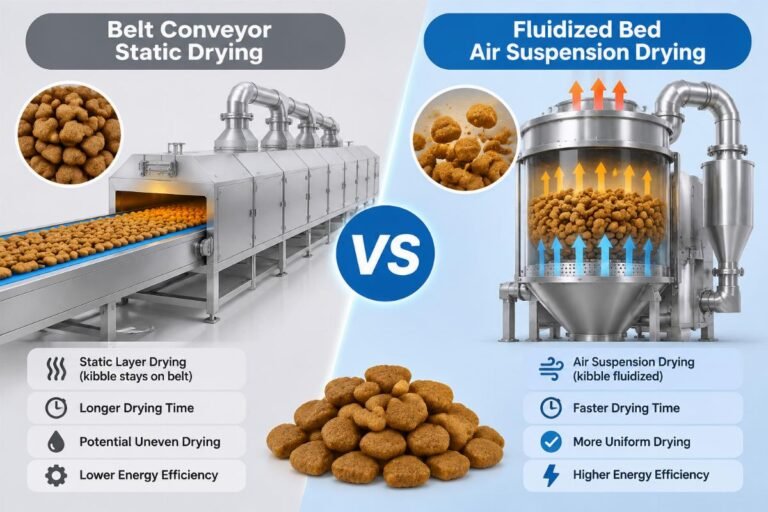
For multi-protein fresh meat treats, formula flexibility is paramount. The modular barrel and screw design of advanced twin-screw lines allow you to reconfigure the shear profile on the fly. You can run a high-shear mix for a dense meat snack, then quickly swap elements for a gentle fold when switching to a delicate, multi-color treat, all while utilizing the integrated drying and cooling systems to lock in the final product integrity.
How to Choose the Right Extruder for Your Meat Formula?
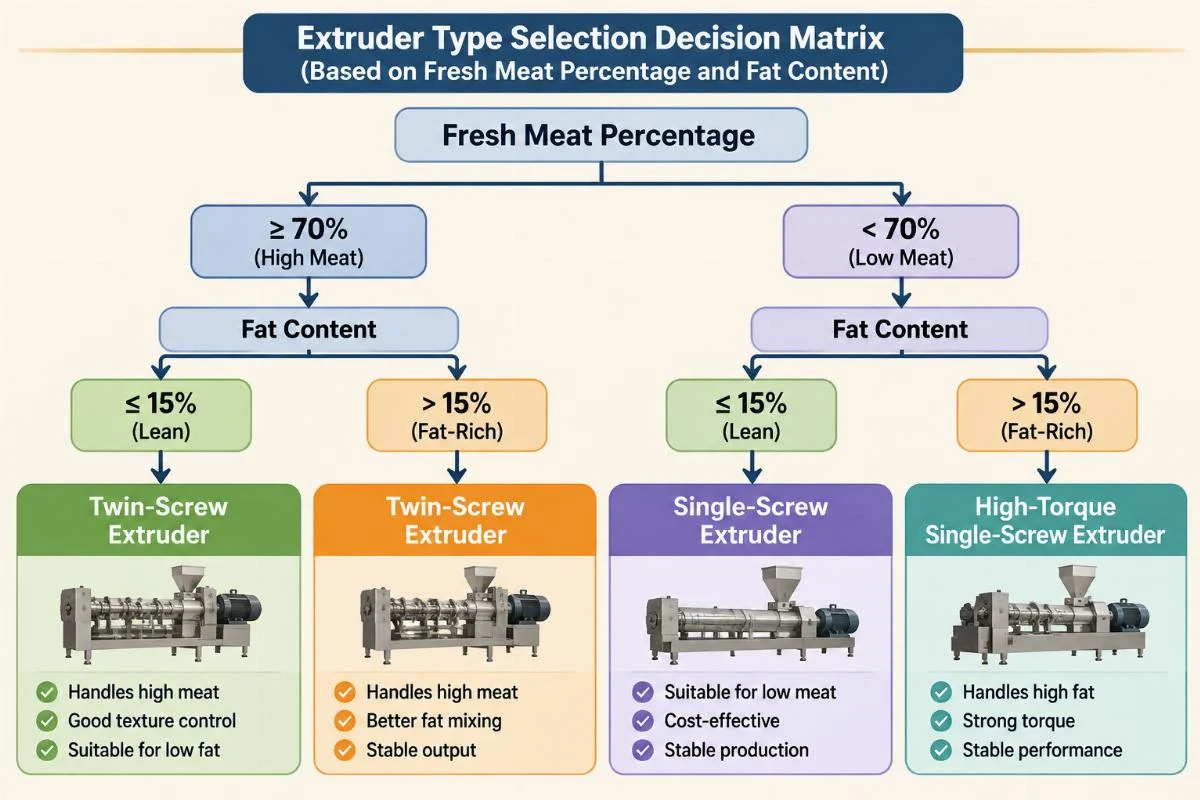
The selection rule is absolute: match the screw type directly to your fresh meat percentage, and strictly mandate twin-screw technology for any formulation exceeding the half-meat threshold.
If your target market is premium pet food, the formulation trends are moving aggressively toward fresh, raw, and high-meat inclusions. You cannot future-proof your factory with equipment that caps out at low-meat dry formulas.
Here is the decision framework for your procurement:
- Analyze the Fresh Meat Ratio: If your recipe relies on meat meals and powders with minimal fresh liquid, a single-screw machine might suffice for basic shapes. However, if your formula includes fresh muscle meat, organs, or bone pastes pushing past the fifty percent mark, you must source a twin screw extruder for fresh meat kibble.
- Evaluate the Fat and Moisture Content: High fat acts as a lubricant that breaks single-screw friction. High moisture requires precise pressure venting. Twin-screw barrels are equipped with multiple open and closed vent ports, allowing you to vacuum-extract excess moisture precisely where needed to ensure the kibble expands correctly at the die face.
- Assess Recipe Flexibility: Startups and contract manufacturers need to run multiple SKUs. The self-wiping nature of co-rotating twin screws drastically reduces cleaning cycles and prevents cross-contamination between different protein blends or colorants.
This is where partnering with an experienced manufacturer becomes critical. Meiteng provides comprehensive turnkey pet food production lines, ranging from pilot-scale testing units to high-capacity industrial setups. Beyond just supplying the DS-series extruders, the real value lies in the formula development support. Before you commit to a massive capital expenditure, Meiteng’s R&D team can test your exact fresh meat recipe in their laboratory, optimizing the screw profile, barrel temperature map, and die design to guarantee the kibble’s expansion rate and density. They handle the entire integration, from the raw meat grinding and pre-mixing stages to the multi-pass drying and flavor-coating systems, ensuring your high-meat vision translates into a stable, scalable manufacturing reality.
Conclusion
Equipment selection dictates the physical limits of your pet food formulation. Attempting to force high fresh meat recipes through a single-screw extruder guarantees mechanical failure, product inconsistency, and wasted capital. Upgrading to a properly configured twin-screw system is not merely an operational preference; it is a fundamental engineering requirement to achieve positive conveying, uniform shear, and precise moisture control for premium, high-meat kibble production.
Machines Mentioned in This Article

cat food machine
Dog Food Extruder Machine Manufacturer for Pet Food Kibble Making Line
View Machine
cat food machine
Pet Food Processing Equipment Plant Manufacturer Dog Food
View Machine
cat food machine
Dry Dog Food Production Line Pet Food Pellet Machine
View Machine
cat food machine